Generate Flashcards for Information Security
Make and generate Information Security flashcards from your notes to master cybersecurity concepts and exam prep.
Generate Flashcards with AI Free
What are Information Security flashcards?
Information Security (InfoSec) flashcards are concise study tools designed to help you master the vast terminology, frameworks, and protocols required to protect data integrity and privacy. These flashcards cover everything from foundational concepts like the CIA Triad (Confidentiality, Integrity, Availability) to complex encryption algorithms and compliance standards like GDPR or HIPAA.
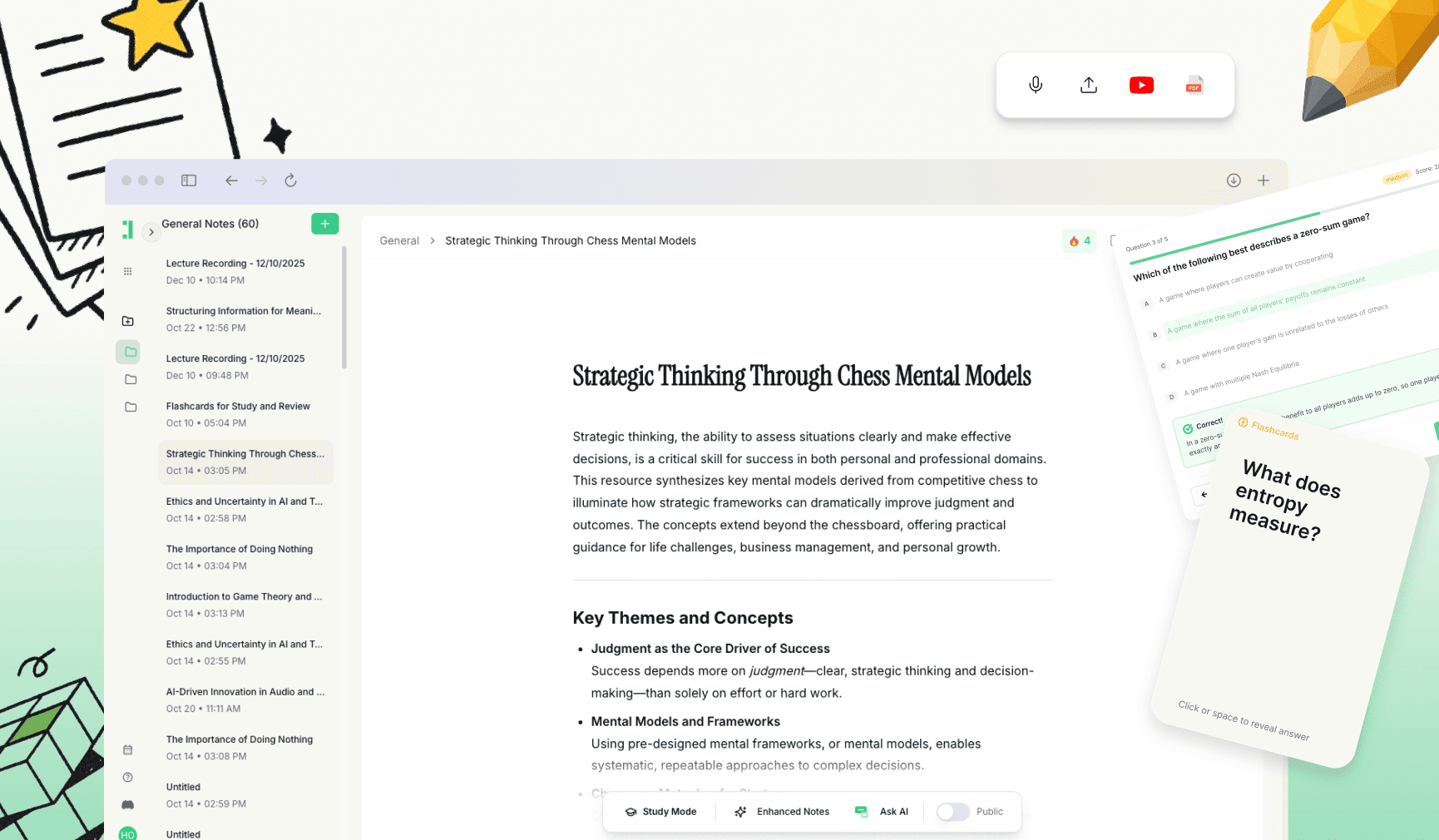
The primary outcome of using these cards is a shift from passive reading to active memory retrieval. Instead of skimming a 50-page textbook on cybersecurity, you test your knowledge on specific threats, defense mechanisms, and risk management strategies. If you already have lecture slides or PDFs, Duetoday can generate a clean deck in seconds, allowing you to focus on learning rather than formatting.
Why flashcards are one of the best ways to study Information Security
Information Security requires a unique blend of rote memorization (port numbers, acronyms) and conceptual understanding (how a man-in-the-middle attack works). Flashcards are perfectly suited for this because they utilize active recall, forcing your brain to retrieve information from scratch rather than simply recognizing it on a page.
By leveraging spaced repetition, you can ensure that high-stakes concepts—like the difference between symmetric and asymmetric encryption—are moved from your short-term memory into your long-term knowledge base. This is critical for passing professional certifications such as CompTIA Security+, CISSP, or CEH.
Master complex InfoSec acronyms (AES, DES, IDS/IPS) without feeling overwhelmed.
Differentiate between similar attack vectors like Phishing, Vishing, and Smishing.
Learn the specific steps of Incident Response and Disaster Recovery.
Practice identifying the correct security control for various business scenarios.
What to include in your Information Security flashcards
Effective InfoSec flashcards should follow the atomic principle: one specific question and one specific answer per card. Avoid putting entire paragraphs on a single card; instead, break down complex systems into their component parts. This makes it easier to identify exactly which concepts you are struggling with.
To build a comprehensive deck, focus on these four card categories:
Definitions & Key Terms: What is the Principle of Least Privilege?
Threats & Vulnerabilities: How does a SQL injection attack work?
Security Controls: What is the difference between a stateful and stateless firewall?
Compliance & Policy: What are the three tiers of risk management according to NIST?
Try these example prompts: Define Salting in password hashing, Name the 7 layers of the OSI model, or What is the primary goal of Kerberos?

How to study Information Security with flashcards
To master InfoSec, we recommend a two-pass system. First, use Duetoday to generate a comprehensive deck from your course materials. Go through the entire deck once to identify which areas—such as cryptography or network security—feel the most challenging. This initial pass helps you map out your knowledge gaps.
In the second pass, focus heavily on the cards you got wrong. Information Security is a field that builds upon itself; you cannot understand advanced network defense if you haven't mastered basic port numbers. Review your weak cards daily for 15 minutes, then gradually reintegrate the easier cards to ensure your foundational knowledge remains sharp.
Generate a deck from your specific textbook chapters or lecture transcripts.
Run a quick session to tag cards as Hard, Medium, or Easy.
Prioritize reviewing Hard cards every morning.
Explain the answer out loud to verify you actually understand the underlying security principle.
Conduct a full deck review 48 hours before your exam or certification test.
Generate Information Security flashcards automatically in Duetoday
Creating InfoSec flashcards manually is notoriously tedious. Copying definitions of hundreds of malware types or encryption standards takes hours that could be spent actually studying. Duetoday eliminates this friction by using AI to scan your documents and extract the most testable information instantly.
Simply upload your PDF notes, PowerPoint slides, or even a transcript of a security seminar. Duetoday's AI identifies the key terms and concepts, formats them into professional flashcards, and prepares them for your first study session. Stop rereading highlighting—start recalling.
Upload or paste your Information Security material.
Select Generate Flashcards.
Review, customize, and start your active recall session.
Generate Information Security Flashcards in Duetoday
Start with your notes and get a deck you can actually use today.
Common Information Security flashcard mistakes
Many students create cards that are too broad, such as Explain the OSI model. This is too much information for one card. Instead, create seven separate cards for each layer. Another common mistake is focusing only on definitions while ignoring application. In InfoSec, knowing what a firewall is isn't enough; you need to know where to place it in a network architecture.
Overloading cards: Keep it to one question and one answer per card.
Ignoring the 'Why': Don't just memorize what an exploit is; include cards on how to mitigate it.
Neglecting Updates: InfoSec changes fast. Ensure your cards reflect current standards (e.g., TLS 1.3 vs 1.2).
No Spaced Repetition: Don't just look at the deck once; revisit difficult protocols frequently.
Ready to generate your Information Security flashcards?
Don't waste another hour typing out definitions. Upload your study guide or lecture notes to Duetoday and let our AI handle the heavy lifting. You'll get a tailored deck of Information Security flashcards designed to help you pass your exams and build a solid foundation for your cybersecurity career.
Start Generating Flashcards
Works with notes, PDFs, slides, and transcripts.
FAQ
How many flashcards do I need for Information Security? A typical introductory course might require 150–300 cards to cover all frameworks, port numbers, and terminology effectively.
What’s the best format for InfoSec flashcards? Question-and-answer format is best. For example: Front: Which port does HTTPS use? Back: Port 443.
How often should I review my cards? Daily sessions of 15–20 minutes are more effective than one long 5-hour session once a week.
Should I make cards from my textbook or slides? Use both. Textbooks provide the deep definitions, while slides often highlight the most important concepts your instructor will test on.
How do I stop forgetting encryption types? Group similar encryption methods together in your review sessions to help your brain differentiate and categorize them.
What if my flashcards feel too easy? If cards are too easy, rewrite them to be more application-based. Instead of Define RSA, use Why is RSA preferred over DES?
Can I generate InfoSec flashcards from a PDF? Yes, Duetoday can scan your security PDFs and automatically create a formatted study deck in seconds.
Are digital flashcards better than paper? For InfoSec, digital is often better because you can easily update cards as new security threats or standards emerge.
How long does it take to create a full deck? With Duetoday, you can generate a full deck of 50+ cards from your notes in less than a minute.
Can Duetoday organize my flashcards by topic? Yes, you can generate separate decks for Network Security, Cryptography, and Physical Security to keep your studying organized.

Duetoday is an AI-powered learning OS that turns your study materials into personalised, bite-sized study guides, cheat sheets, and active learning flows.