Generate Flashcards for Human-Computer Interaction
Easily generate or make Human-Computer Interaction flashcards from your study guides or notes to master HCI subjects.
Generate Flashcards with AI Free
Generate Flashcards for Human-Computer Interaction
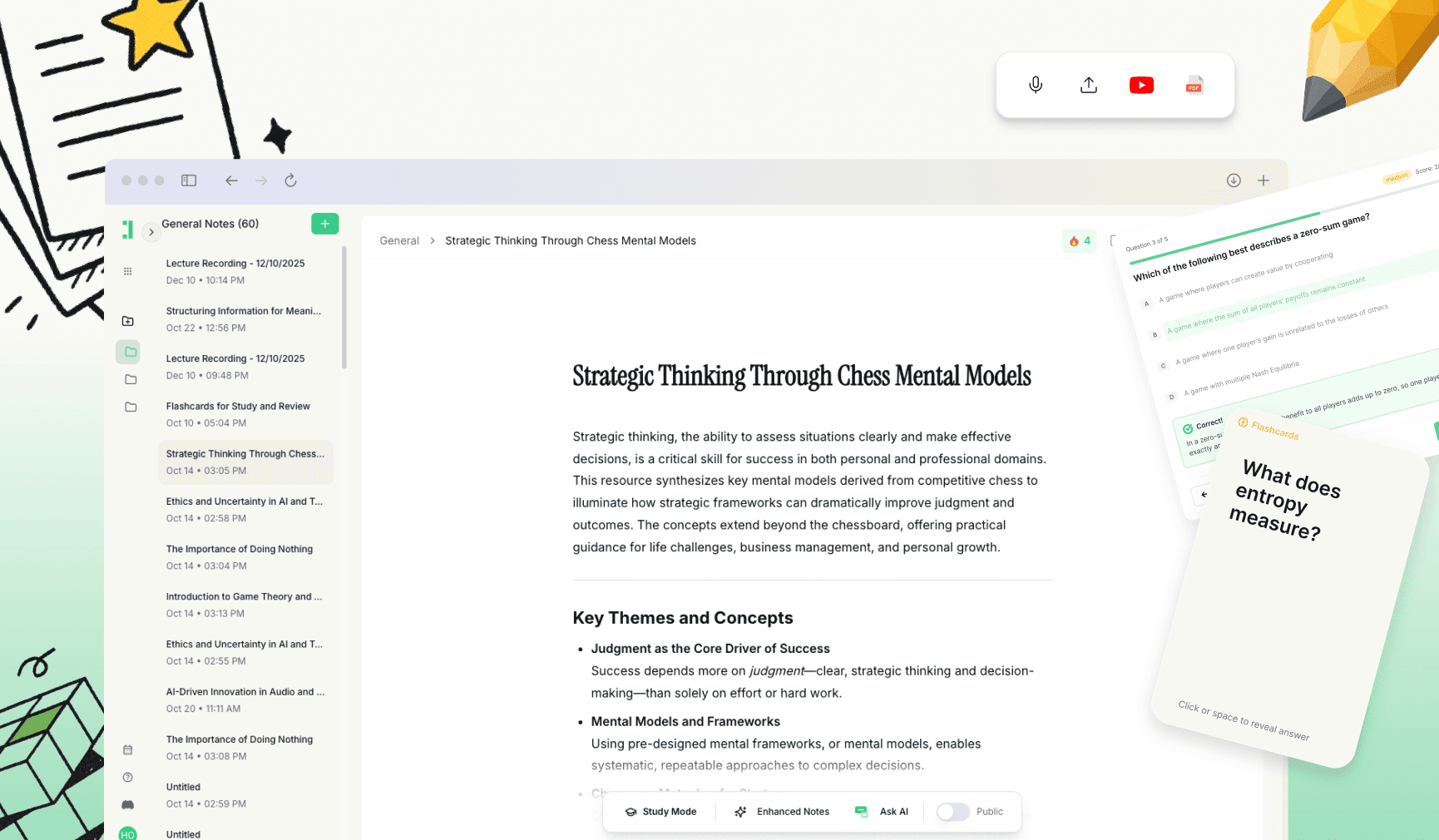
Turn your notes, PDFs, slides, or transcripts into Human-Computer Interaction (HCI) flashcards so you can review design principles faster and remember user experience frameworks more clearly. Duetoday helps you stop staring at long textbooks and start testing your knowledge.
Generate HCI FlashcardsUpload notes / paste text
When you use Duetoday, the process is simple: upload your course material, our AI generates a structured deck, you refine the content, and then you start your review session immediately.
What are Human-Computer Interaction flashcards?
HCI flashcards cover the intersection of computer science, behavioral sciences, and design. They focus on key terms like 'affordance,' 'mental models,' 'Heuristic evaluation,' and the psychological principles that govern how humans interact with digital interfaces.
The outcome is a shift from passive reading to active testing. Instead of hoping you remember the difference between UI and UX, you test yourself on specific scenarios, building the neural pathways required for long-term recall and faster application in design projects.
If you already have lecture notes on user-centered design, Duetoday can generate a clean, organized deck in minutes.
Why flashcards work for Human-Computer Interaction
HCI requires a mix of memorizing specific terminology and understanding complex, multi-step design processes. Flashcards are ideal because they force your brain to retrieve information rather than just recognizing it on a page.
By using active recall and spaced repetition, you ensure that high-level concepts like Fitts's Law or Nielsen’s 10 Heuristics move from your short-term memory into your long-term design toolkit.
Remember high-level usability principles without cramming.
Separate similar concepts, such as Accessibility vs. Usability.
Learn the stages of the Design Thinking process step-by-step.
Practice applying design rules to real-world interface problems.
What to include in your Human-Computer Interaction flashcards
The most effective HCI flashcards follow the 'atomic' rule: one idea per card. This prevents confusion and ensures you actually know the material. Formulating your cards as questions rather than just terms and definitions is the key to deep learning.
Focus on these four main categories to cover the breadth of the subject:
Definitions & key terms: Topics like 'What is a Gulf of Execution?' or 'Define Dark Patterns.'
Processes & steps: Focusing on sequences like the 'User-Centered Design Cycle.'
Comparisons: Highlighting differences, such as 'Quantitative vs. Qualitative research.'
Application: Scenario questions like 'When would you use a Breadcrumb navigation?'
Example prompts for your deck: 'What are the 3 pillars of design?' 'Define the 'Visibility of System Status' heuristic.' 'What is the primary goal of a Persona?' 'How does cognitive load affect interface design?'
How to study HCI with flashcards (a simple system)
To master HCI, we recommend a two-pass approach. First, generate your deck from your syllabus or slides, then move into focused review rounds. Don't try to master every card at once; focus on the ones that challenge your design intuition.
Make a deck from your lecture slides or interface design PDFs.
Do one quick round to identify which design principles are hardest to remember.
Review those weak cards daily for at least three days.
Mix in harder application cards as you get more comfortable with definitions.
Conduct a final mixed review session before your design critiques or exams.
Generate HCI flashcards automatically in Duetoday
Making HCI flashcards manually is slow, especially when you have to copy-paste complex definitions or design laws. It’s easy to get bogged down in the formatting rather than the learning.
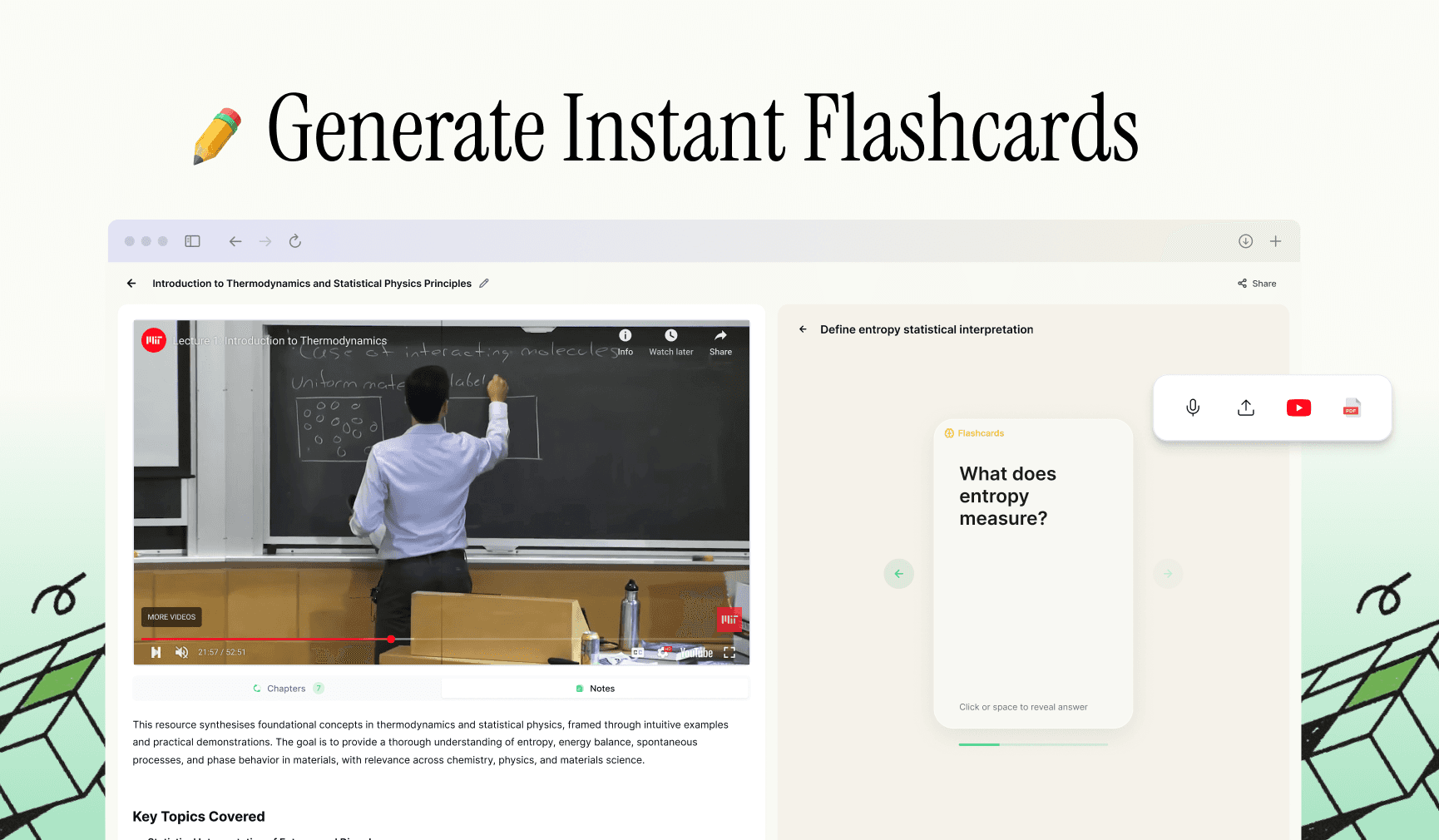
Duetoday streamlines this by letting you upload your PDFs, slides, or design transcripts and turning them into flashcards instantly. You get the benefits of active recall without the manual labor.
Upload or paste your HCI course material.
Click 'Generate Flashcards'.
Review, edit, and start studying your new deck.
Generate HCI Flashcards in Duetoday
Start with your notes and get a deck you can actually use today to ace your next project.
Common HCI flashcard mistakes
Many students make cards that are too wordy or focus on the wrong things. Avoid these pitfalls to maximize your study time:
Cards are too long: If a card has three sentences, split it into three separate cards.
Only memorizing terms: Don't just learn the name of the law; add 'explain why' prompts.
Ignoring user context: Ensure your cards include how a principle affects the end-user.
No review schedule: Spaced repetition only works if you return to the cards over several days.
Ready to generate your Human-Computer Interaction flashcards?
Stop rereading your textbooks and start recalling the core principles of design. Upload your notes, generate your flashcards, and master HCI with Duetoday.
Start Generating Flashcards
Works with notes, PDFs, slides, and transcripts.
FAQ
How many flashcards do I need for HCI? It depends on the depth of the course, but usually 50-100 cards cover the foundational principles and heuristics for an introductory module.
What’s the best format for HCI flashcards? Question-and-answer format is best. For example, 'What principle is being used when a button changes color on hover?' is better than just writing 'Feedback.'
How often should I review HCI flashcards? Aim for daily reviews of new cards and every 3-5 days for cards you already know well to leverage spaced repetition.
Should I make cards from a textbook or slides? Both are useful. Textbooks provide the theory, while lecture slides often highlight the specific frameworks your professor wants you to know.
How do I stop forgetting HCI theories? Use application-based cards. Instead of just defining 'Affordance,' create a card that asks for a real-world example of it.
What if my flashcards feel too easy? This is a sign you need to move toward application. Change 'What is Fitts's Law?' to 'How would you apply Fitts's Law to mobile menu placement?'
Can I generate HCI flashcards from a PDF? Yes, Duetoday can scan your HCI textbooks or research paper PDFs and extract the most important concepts into cards.
Are digital flashcards better than paper? For HCI, digital is often better because you can easily include screenshots of interfaces and use automated spaced repetition algorithms.
How long does it take to make a full HCI deck? With Duetoday, it takes less than a minute to generate a comprehensive deck from your uploaded materials.
Can Duetoday organize my flashcards by topic? Yes, the AI categorizes generated cards by the sections in your notes, keeping Heuristics, User Research, and Implementation separate.

Duetoday is an AI-powered learning OS that turns your study materials into personalised, bite-sized study guides, cheat sheets, and active learning flows.