Generate Flashcards for Human Anatomy
Generate Human Anatomy flashcards in seconds using AI. Turn your notes into study tools. Try for free!
Generate Flashcards with AI Free
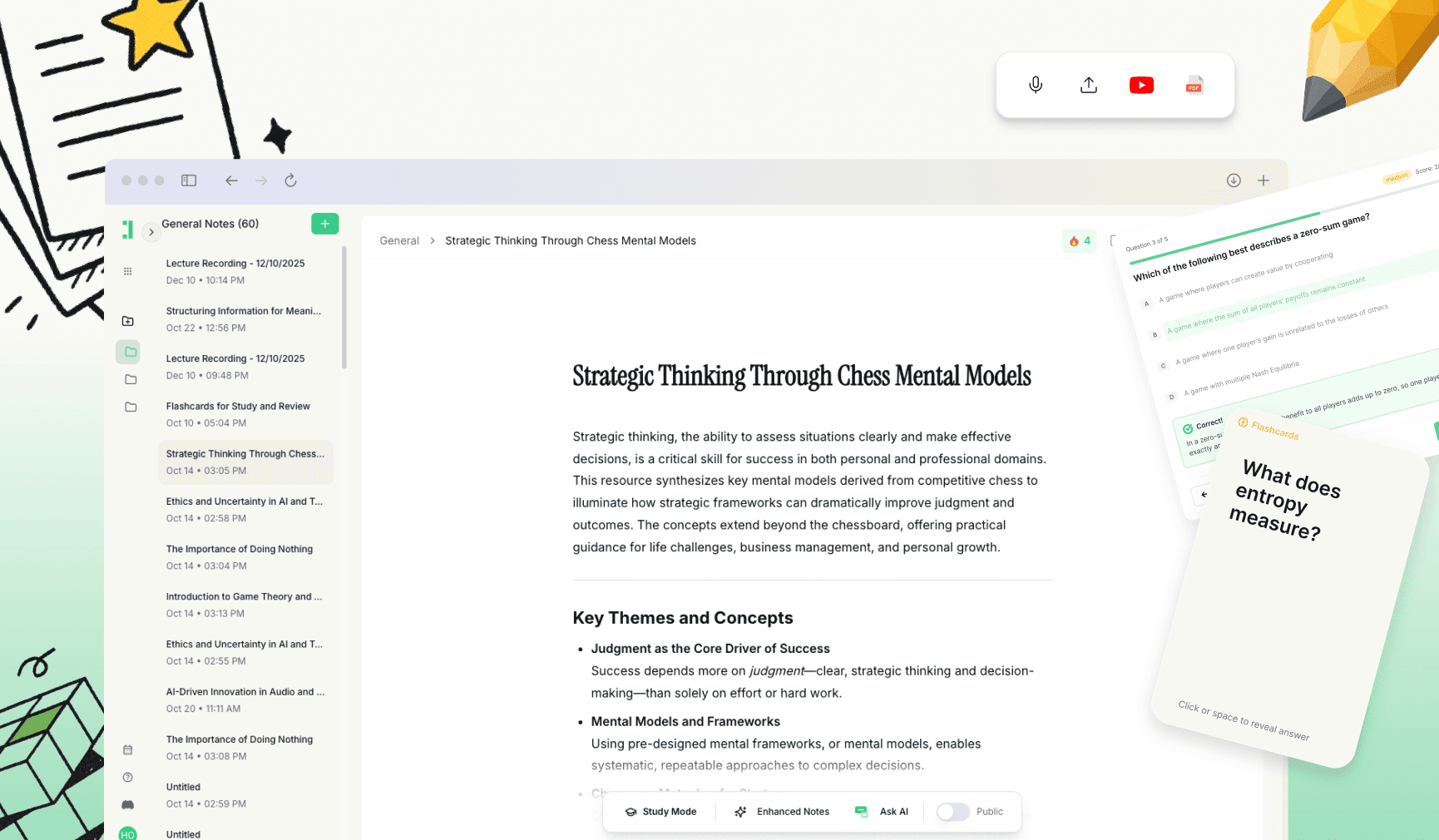
Master Human Anatomy with AI-Generated Flashcards
Turn your notes, PDFs, slides, or lectures into Human Anatomy flashcards so you can review anatomical structures faster and remember more during your lab practicals. Studying the human body involves massive amounts of memorization, but simply rereading your textbook won't help you identify a nerve or muscle under pressure. Duetoday transforms your study material into active recall tools instantly.
Generate Human Anatomy Flashcards
Upload your notes or paste your textbook chapters to get started.
In Duetoday, the process is simple: you upload your material, our AI identifies key structures and functions, generates a clean deck, and allows you to edit and study them using spaced repetition. No more spending hours cutting paper or typing out definitions.
What are Human Anatomy flashcards?
Human Anatomy flashcards are focused study tools that cover essential biological structures, including bones, muscles, organ systems, and tissues. These cards typically test your ability to name a part, identify its location, describe its function, or explain its relationship to other systems (like the nervous system’s control over muscle contraction).
The outcome is simple: instead of passive reading, you test yourself quickly to build neural pathways. If you already have lecture notes or lab manuals, Duetoday can generate a comprehensive deck in minutes, ensuring you cover every system from the skeletal to the reproductive.
Why flashcards work for Human Anatomy
Anatomy is a subject that demands high-volume memorization and spatial understanding. Flashcards are uniquely suited for this because they force active recall, the most effective way to move anatomical terms from short-term to long-term memory.
Remember complex Latin and Greek terminology without cramming.
Separate similar concepts like tendons vs. ligaments or veins vs. arteries.
Learn physiological processes step-by-step, such as the cardiac cycle.
Practice identifying structures from different angles and perspectives.

What to include in your Human Anatomy flashcards
Effective anatomy flashcards follow the 'one idea per card' rule. Each card should ask a clear question that requires a specific answer. When cards are too cluttered, your brain struggles to isolate the information, making it harder to recall under exam conditions.
Definitions & Key Terms: "What is the periosteum?" or "Define the sagittal plane."
Processes & Steps: "What happens first during an action potential?"
Comparisons: "How is skeletal muscle different from smooth muscle?"
Application: "Which muscle is the primary mover during a bicep curl?"
Example prompts: 'What are the four lobes of the brain?', 'Name the bones of the inner ear', 'What is the function of the alveoli?', 'Identify the origin and insertion of the deltoid.'
How to study Human Anatomy with flashcards
To master anatomy, use a two-pass approach. First, generate your deck from your lab notes or slides. Then, perform an initial round to filter out what you already know from what is confusing.
Make a deck from your lab manuals or lecture transcripts in Duetoday.
Do one quick round to identify difficult structures (like cranial nerves).
Review high-difficulty cards every day for a week.
Mix in physiological 'why' questions with 'where' questions.
Perform a final review of the entire deck before your practical exam.
Generate Human Anatomy flashcards automatically
Making cards manually is slow and takes time away from actual studying. Duetoday automates the tedious part: just upload your course PDF or paste your notes, and the AI generates precise flashcards for you.
Upload your anatomy lecture slides or lab manual.
Click 'Generate Flashcards'.
Review, edit, and start your active recall session immediately.
Stop rereading. Start recalling. Get your Human Anatomy deck ready in seconds and spend your time where it matters: learning the body.
Common Human Anatomy flashcard mistakes
Don't fall into the trap of making cards that are too long. If a card has five bullet points on the back, you'll memorize the 'shape' of the card rather than the actual facts. Split them up! Also, avoid just memorizing words—make sure to include 'why' or 'how' cards to understand the function behind the structure.
FAQ
How many flashcards do I need for a Human Anatomy exam? Usually, a single organ system can require 50–100 cards to cover all structures, functions, and terminology in detail.
What’s the best format for anatomy cards? A mix of 'identify' (naming the part) and 'describe' (explaining the function) works best for comprehensive mastery.
How often should I review my anatomy cards? Daily review is essential for anatomy due to the sheer volume of terms. Use spaced repetition to focus on the cards you find hardest.
Should I make cards from my textbook or lab manual? Use both. Textbooks provide the 'why' (physiology), while lab manuals provide the 'what' (identification).
How do I stop forgetting bone names after a few days? Spaced repetition is key. Reviewing the same bone names at increasing intervals prevents the 'forgetting curve' from taking over.
Can I generate anatomy cards from a PDF? Yes, Duetoday allows you to upload any anatomy PDF and converts the text and concepts into a ready-to-use flashcard deck.
Are digital flashcards better than paper for anatomy? Digital cards are superior because they use algorithms to show you difficult cards more frequently, which is vital for high-memorization subjects.
How long does it take to make a full anatomy deck? Manually, it takes hours. With Duetoday, it takes less than a minute to turn your lecture notes into a full deck.

Duetoday is an AI-powered learning OS that turns your study materials into personalised, bite-sized study guides, cheat sheets, and active learning flows.