Generate Flashcards for Graph Theory
Learn how to make or generate Graph Theory flashcards for computer science and math using this complete study guide.
Generate Flashcards with AI Free

What are Graph Theory flashcards?
Graph Theory flashcards are specialized study tools designed to help you master the mathematical structures used to model pairwise relations between objects. These cards cover essential concepts such as vertices (nodes), edges, connectivity, and complex algorithms like Dijkstra's or Kruskal's.
The outcome is a shift from passive reading to active testing. Instead of simply looking at a diagram, you challenge yourself to define properties, identify planarity, or recall the steps of a specific traversal method. This builds logical intuition and ensures you can apply theory to problem-solving quickly.
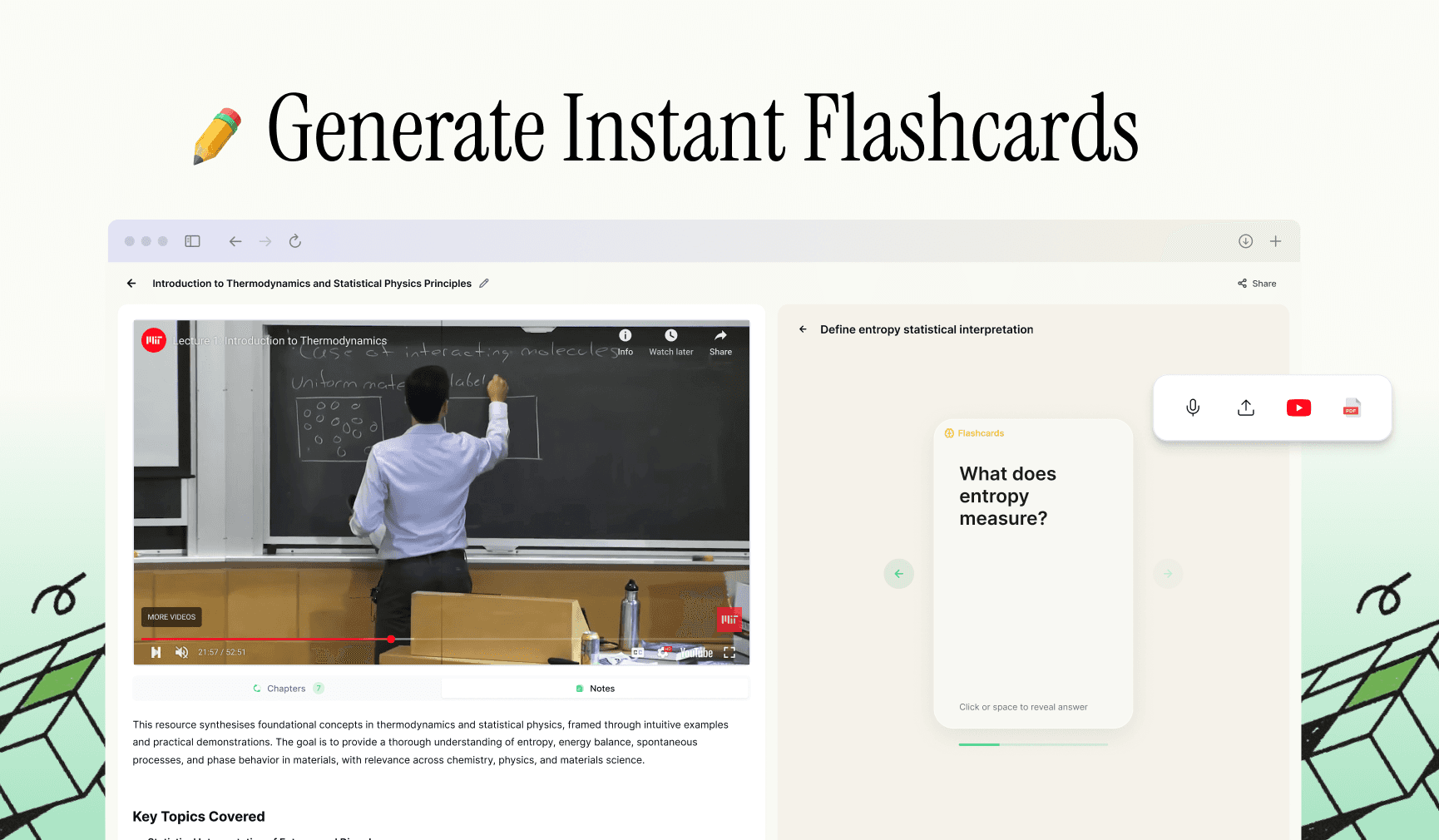
If you already have lecture notes or a textbook PDF, Duetoday can generate a clean deck of Graph Theory flashcards in minutes.
Why flashcards are one of the best ways to study Graph Theory
Graph Theory is a highly visual and procedural subject. Flashcards are effective because they force you to link abstract definitions to specific structural properties and algorithmic steps, which is exactly how you are tested in exams.
By using active recall and spaced repetition, you move beyond memorizing names and start understanding the underlying logic of networks and discrete structures. You stop confusing similar theorems and start recognizing patterns in complex graphs.
Remember complex definitions like 'Isomorphism' or 'Bipartite' without cramming.
Separate similar concepts, such as Eulerian vs. Hamiltonian paths.
Learn algorithmic processes step-by-step, from initialization to termination.
Practice applying formulas for degrees, edges, and chromatic numbers.
What to include in your Graph Theory flashcards
Effective Graph Theory flashcards follow the "one idea per card" rule. Because the subject is visual, your cards should prompt you to recall specific properties or identify flaws in a graph's structure based on a premise.
We recommend focusing on four main card types to ensure full coverage of the syllabus: definitions, processes, comparisons, and application scenarios.
Definitions & Key Terms: "What is a handshaking lemma?" "Define a complete graph (Kn)."
Processes & Steps: "What is the first step in Prim’s Algorithm?" "Outline the BFS traversal order."
Comparisons: "How does a directed graph differ from an undirected graph?"
Application: "What is the maximum number of edges in a simple graph with n vertices?"
How to study Graph Theory with flashcards
A simple yet effective system for Graph Theory involves a "two-pass" approach. Start by building your deck from your syllabus, then move into iterative review cycles that focus on your specific weak points.
Review in short, frequent sessions. Graph Theory involves a lot of mental visualization; by repeating tough cards daily, you train your brain to "see" the properties of a graph without having to draw it out every single time.
Make a deck from your notes (or generate it automatically from your PDF).
Do one quick round to find weak spots in algorithms or theorems.
Review weak cards every day for a week to build long-term retention.
Mix in harder application cards, like calculating the chromatic number, each session.
Do a final mixed review before your midterm or final exam.
Generate Graph Theory flashcards automatically in Duetoday
Making math cards manually is incredibly slow, especially when you have to copy complex definitions or algorithmic steps. It’s easy to get bogged down in the formatting rather than the actual studying.
Duetoday solves this by allowing you to upload your notes, PDFs, or slides. Our AI analyzes the material and creates high-quality flashcards instantly, allowing you to spend your time mastering the logic instead of writing out cards.
Upload or paste your Graph Theory material (PDFs, slides, or notes).
Click Generate Flashcards.
Review, edit, and start studying immediately.
Common Graph Theory flashcard mistakes
Many students create cards that are too wordy or focus on the wrong details. To succeed, stay focused on the atomic facts of the theory.
Cards are too long: Don't try to put an entire proof on one card; split it into individual logical steps.
Only memorizing terminology: Ensure you include "why" prompts to explain the reasoning behind a theorem.
Ignoring edge cases: Always include cards for special graphs like null graphs or disconnected graphs.
No visual prompts: Describe the visual properties you need to recall, not just the text.
Ready to level up your study game? Start generating your Graph Theory flashcards in Duetoday today.
FAQ
How many flashcards do I need for Graph Theory? A standard introductory course usually requires 60 to 100 cards to cover all definitions, basic theorems, and major algorithms.
What’s the best format for Graph Theory flashcards? Use a Q&A format. Ask a specific question on the front and provide a concise, one-idea answer on the back.
How often should I review Graph Theory flashcards? Review daily during the first week of learning a new topic, then use spaced repetition to review every few days as you get closer to your exam.
Should I make cards from a textbook or slides? Both are useful, but lecture slides usually highlight the specific algorithms your professor wants you to know, making them a great starting point.
How do I stop forgetting complex algorithms? Break the algorithm into steps (Step 1, Step 2, etc.) and create a separate flashcard for each specific phase of the process.
What if my flashcards feel too easy? Increase the difficulty by adding cards that require you to compare two different theorems or solve a small numerical problem on the fly.
Can I generate Graph Theory flashcards from a PDF automatically? Yes, Duetoday is designed to parse PDFs and extract key mathematical concepts into study-ready flashcards instantly.
Are digital flashcards better than paper for Graph Theory? Digital cards are generally better because they allow for faster organization and use automated spaced repetition algorithms to save you time.
How long does it take to make a full Graph Theory deck? Manually it can take hours; with Duetoday’s AI generator, you can have a full deck ready in less than a minute.
Can Duetoday organize my flashcards for me? Yes, Duetoday categorizes and stores your decks by topic, making it easy to jump back into specifically your Graph Theory material whenever you need.

Duetoday is an AI-powered learning OS that turns your study materials into personalised, bite-sized study guides, cheat sheets, and active learning flows.