Generate Flashcards for Geotechnical Engineering
Make Geotechnical Engineering flashcards from your notes. This guide shows how to generate study sets for soil mechanics and foundations.
Generate Flashcards with AI Free
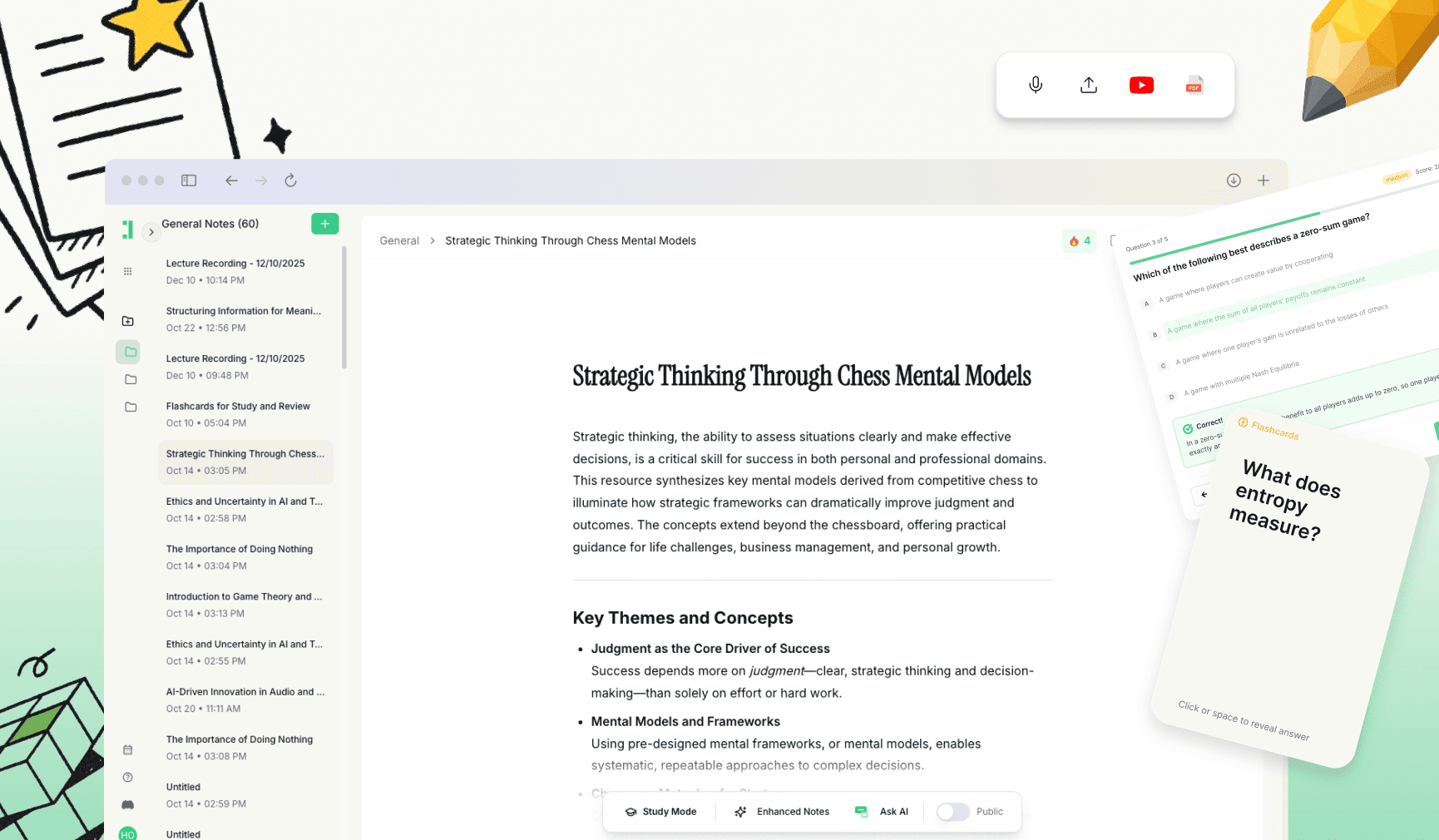
What are Geotechnical Engineering flashcards?
Geotechnical Engineering flashcards are specialized study tools designed to help you master the behavior of earth materials. These flashcards cover essential topics like soil mechanics, rock mechanics, foundation design, and site investigation. Instead of just reading about Shear Strength or Atterberg Limits, flashcards force you to define terms, recall formulas, and identify soil classifications from memory.
The outcome is a shift from passive reading to active mastery. By testing yourself on specific parameters like void ratio, permeability, or effective stress, you build the mental pathways needed for complex engineering problem-solving. If you already have lecture notes or textbook chapters, Duetoday can generate a clean deck in minutes so you can stop formatting and start studying.
Why flashcards are one of the best ways to study Geotechnical Engineering
Geotechnical Engineering requires a unique blend of terminology and mathematical application. Flashcards allow you to isolate individual variables and mechanical principles, making it easier to understand how they interact in a larger system. They help you bridge the gap between theoretical soil science and practical civil engineering applications.
Remember AASHTO and USCS soil classification criteria without cramming.
Separate similar concepts like consolidation vs. compaction easily.
Learn multi-step processes for laboratory tests like the Triaxial Shear Test.
Practice applying Mohr-Coulomb failure criteria and other vital formulas.
What to include in your Geotechnical Engineering flashcards
Effective flashcards follow the atomic rule: one specific idea per card. This prevents you from glazing over complex details. Your deck should feature a mix of conceptual questions, unit conversions, and diagnostic criteria to ensure you are ready for both exams and field work.
Definitions & Key Terms: What is the definition of Liquefaction? or Define Specific Gravity of soil solids.
Processes & Steps: What are the three stages of a standard Proctor test?
Comparisons: How does Darcy’s Law differ in saturated vs. unsaturated soils?
Application: Given a liquidity index > 1, what can be inferred about the soil's state?
Try these example prompts: What is the primary difference between a shallow and deep foundation?, State the formula for Effective Stress., or What does a high plasticity index indicate about clay behavior?

How to study Geotechnical Engineering with flashcards
Mastering this subject requires a two-pass approach. Start by creating a deck that covers the foundational vocabulary and empirical formulas. Once you have those memorized, move into cards that describe site conditions or soil profiles that require diagnosis. This builds the intuition needed for professional engineering judgment.
Make a deck from your rock mechanics or soil distribution notes using Duetoday.
Do one quick round to identify which formulas (like Terzaghi's) you struggle with.
Review weak cards daily, focusing on the relationship between phase diagrams.
Mix in harder application cards, such as predicting settlement behavior.
Do a final mixed review before your midterms or the FE/PE exams.
Generate Geotechnical Engineering flashcards automatically in Duetoday
Building a comprehensive deck for Geotechnical Engineering manually is incredibly slow. Drawing phase diagrams or typing out the Rankine Earth Pressure theory takes time you could be using to actually study. Duetoday automates this by extracting the most critical engineering concepts directly from your source material.
Upload or paste your Geotechnical slides, PDFs, or lab manuals.
Click Generate Flashcards and let the AI identify the core formulas and terms.
Review, edit for specific project needs, and start studying immediately.
Generate Geotechnical Engineering Flashcards in Duetoday. Start with your notes and get a deck you can actually use today to ace your next design project or exam.
Common Geotechnical Engineering flashcard mistakes
Many students make cards that are too dense, trying to fit an entire soil profile analysis onto one card. This leads to recognition bias, where you think you know the material but can't recall it under pressure.
Cards are too long: Split complex foundation types into individual pros/cons cards.
Only memorizing words: Ensure you include the physical significance of parameters like the 'e-log p' curve.
Confusing similar units: Create cards specifically for unit conversions (pcf to kg/m3).
No review schedule: Soil mechanics is cumulative; repeat weak cards daily to avoid logic gaps.
Ready to generate your Geotechnical Engineering flashcards?
Stop rereading your textbooks and start recalling the data that matters. Upload your notes, generate your deck, and master the earth.
Start Generating Flashcards
Works with notes, PDFs, slides, and transcripts.
FAQ
How many flashcards do I need for Geotechnical Engineering? A typical introductory course usually requires 150-200 cards to cover soil classification, permeability, and foundation basics.
What’s the best format for these flashcards? Use a mix of 'What is' definitions and 'If/Then' scenarios, such as 'If the water table rises, what happens to effective stress?'
How often should I review my cards? Reviewing daily is best for the first week to lock in formulas, then every 3-4 days as you become more confident.
Should I make cards from my textbook or lab reports? Both. Textbooks provide the theory, but lab reports contain the testing procedures (like Sieve Analysis) that are frequently tested.
How do I stop forgetting soil formulas? Use Duetoday to create flashcards that ask for the variable definitions within a formula, not just the formula itself.
What if my cards feel too easy? You are likely only testing definitions. Add 'Application' cards where you must predict soil behavior based on given data points.
Can I generate flashcards from a Geotechnical PDF? Yes, Duetoday is designed to parse complex engineering PDFs and turn them into structured flashcard sets instantly.
Are digital flashcards better than paper for Engineering? Digital is usually better because you can easily include images of charts (like the Casagrande Plasticity Chart) that are hard to draw by hand.
How long does it take to make a full deck? With Duetoday, you can turn a 40-page PDF into a comprehensive study deck in less than 60 seconds.
Can Duetoday handle mathematical symbols and formulas? Yes, the AI is capable of recognizing and formatting engineering notation for your study sessions.

Duetoday is an AI-powered learning OS that turns your study materials into personalised, bite-sized study guides, cheat sheets, and active learning flows.