Generate Flashcards for General Chemistry I
Make General Chemistry I flashcards from your notes. Generate custom study sets for atomic structure and stoichiometry.
Generate Flashcards with AI Free
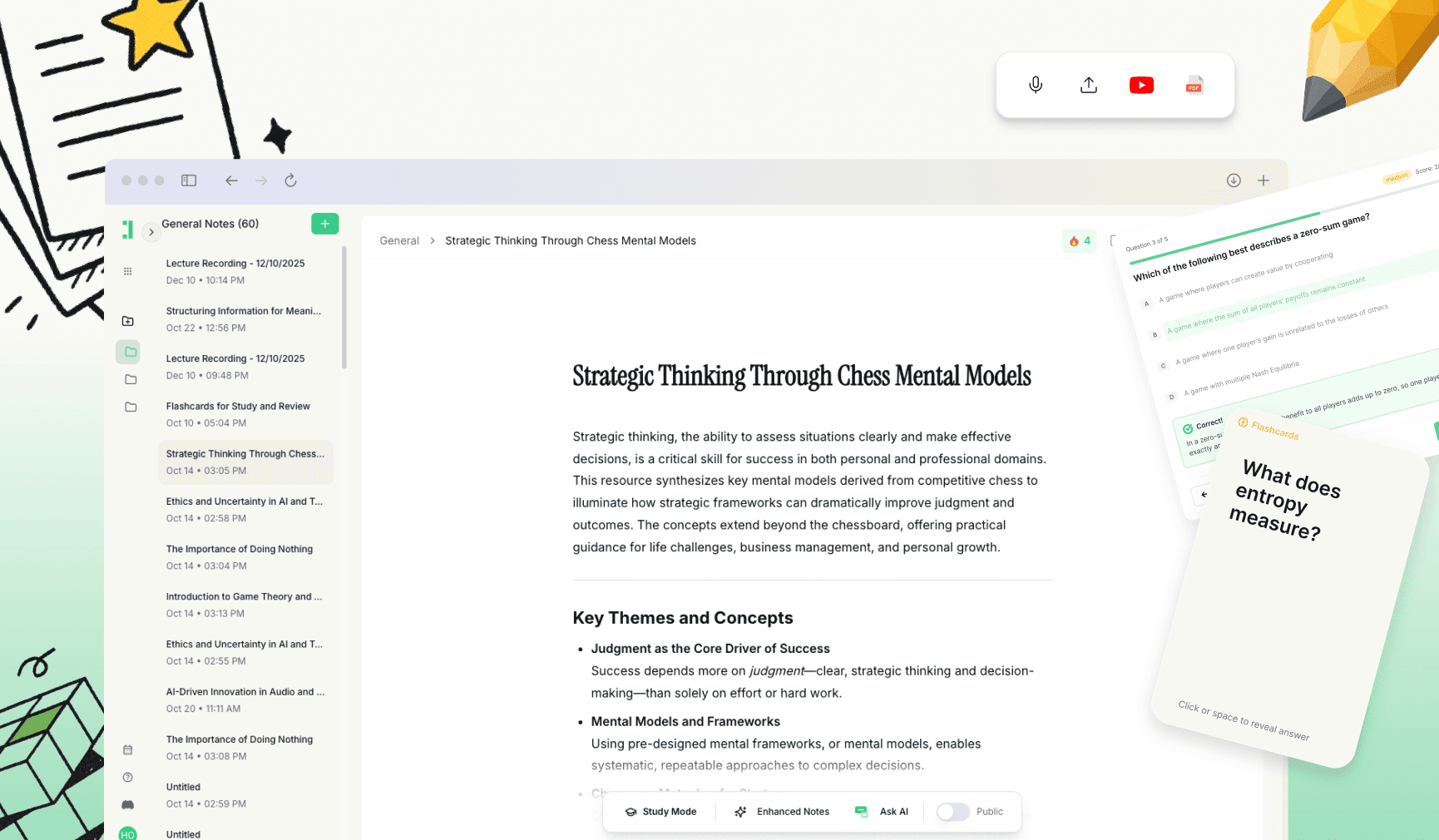
Turn your notes, PDFs, slides, or lectures into General Chemistry I flashcards.
General Chemistry I covers a massive amount of foundational material, from the periodic table to complex chemical reactions. Instead of spending hours manually writing out cards for every element and formula, Duetoday allows you to upload your materials and generate a complete study deck in seconds. This lets you focus on what actually matters: mastering the concepts and passing your exams.
By turning your lecture notes or textbooks into interactive flashcards, you transition from passive reading to active testing. Whether you are struggling with balancing equations or understanding electron configurations, digital flashcards provide the repetitive exposure needed to make these concepts stick.
What are General Chemistry I flashcards?
General Chemistry I flashcards are concise study tools designed to test your knowledge of core chemical principles. They typically cover atomic theory, molecular structure, stoichiometry, gas laws, and basic thermodynamics. Rather than just listing facts, effective chemistry flashcards prompt you to recall definitions, predict reaction products, or apply a specific formula to a problem.
The goal is to build rapid-fire recall. When you see a chemical symbol or a specific law, you shouldn't have to flip through a book to remember what it means. Using flashcards helps you internalize the 'language' of chemistry so you can solve complex problems more efficiently during midterms and finals.
Why flashcards work for General Chemistry I
Chemistry is a subject built on cumulative knowledge; you cannot understand chemical bonding if you don't first understand atomic structure. Flashcards are perfect for this because they utilize active recall and spaced repetition to strengthen your memory pathways without the burnout of traditional cramming.
Remember key terms without cramming: Memorize polyatomic ions and solubility rules through quick daily sessions.
Separate similar concepts: Easily distinguish between things like ionic vs. covalent bonds or endothermic vs. exothermic reactions.
Learn processes step-by-step: Break down the steps of finding a limiting reactant or calculating enthalpy changes.
Practice applying formulas: Quickly drill the Ideal Gas Law or Molarity calculations until they become second nature.
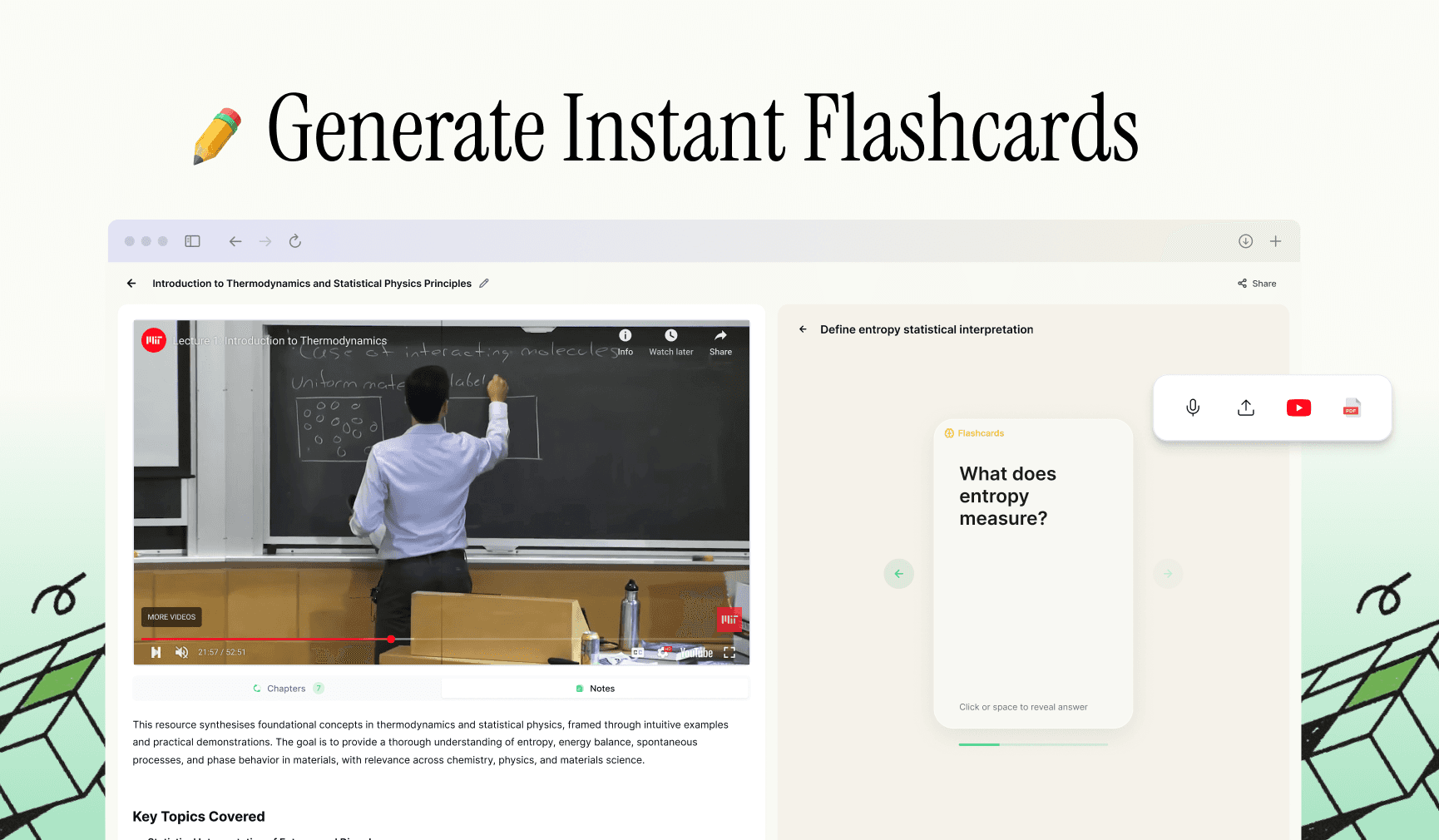
What to include in your General Chemistry I flashcards
The secret to high-scoring chemistry flashcards is keeping them focused. A card should never contain entire paragraphs of text; instead, it should challenge you with a single, clear question. We recommend categorizing your cards into four distinct types to cover all your bases.
Definitions & Key Terms: "What is the Pauli Exclusion Principle?" or "Define electronegativity."
Processes & Steps: "What is the first step in balancing a redox reaction?"
Comparisons: "How does an isotope differ from an ion?"
Application: "If the volume of a gas decreases, what happens to the pressure (at constant T)?"
Example prompts for your deck: "What are the four quantum numbers?", "State the Law of Conservation of Mass," "What is the charge of a sulfate ion?", and "How do you calculate percent yield?"
How to study General Chemistry I with flashcards
To master Gen Chem, use a 'two-pass' system. First, use Duetoday to generate your deck from your syllabus or notes. In the first pass, go through the whole deck to identify which constants or rules you keep forgetting. In the second pass, focus exclusively on those difficult cards.
Generate your deck from your lecture slides or textbook chapters.
Run a quick practice session to mark ‘easy’ vs ‘hard’ concepts.
Review the 'hard' cards (like stoichiometry or orbital diagrams) daily.
Mix in old cards once a week to ensure long-term retention.
Test yourself under a time limit to simulate exam conditions.
Generate General Chemistry I flashcards automatically
Writing out hundreds of chemistry cards by hand is a waste of valuable study time. Duetoday simplifies the process by using AI to scan your documents and extract the most important information for you. You get high-quality, accurate cards without the tedious manual labor.
Upload your Gen Chem PDFs, slides, or handwritten notes.
Click 'Generate Flashcards' to see your AI-curated deck.
Edit your cards and start studying immediately with our built-in tools.
Common General Chemistry I flashcard mistakes
Many students fail because their cards are too cluttered. If a card asks for three different things at once, you’ll likely only remember one. Focus on ‘atomizing’ your information—one concept per card. Additionally, don't just memorize the name of a law; make sure you have cards that ask you how to apply it in a word problem.
Ready to generate your General Chemistry I flashcards?
Stop rereading your textbook and start testing your knowledge. Upload your General Chemistry I materials to Duetoday right now and get a study-ready deck in seconds.
FAQ
How many flashcards do I need for General Chemistry I?
A typical semester of Gen Chem I usually requires between 200 to 400 cards to cover all definitions, formulas, and ions thoroughly.
What’s the best format for chemistry flashcards?
The best format is a clear question on the front and a single specific answer or formula on the back to ensure quick recall.
How often should I review my chemistry flashcards?
Ideally, you should review your hard cards daily and your mastered cards once every 3-5 days to maintain retention until the final exam.
Should I make cards from a textbook or my lecture notes?
Lecture notes are usually better because they highlight exactly what your professor thinks is important for the exam, though textbooks are great for supplemental formulas.
How do I stop forgetting polyatomic ions?
Consistency is key. Use flashcards for 5 minutes every day. Spaced repetition acts as a 'memory anchor' for rote memorization tasks like ions.
What if my flashcards feel too easy?
If they feel easy, start adding 'application' cards where you have to use a concept to solve a mini-problem rather than just defining a term.
Can I generate flashcards from a chemistry PDF?
Yes, Duetoday allows you to upload PDFs and will automatically extract the key terminology and formulas to create a deck.
Are digital flashcards better than paper for chemistry?
Digital cards are often better because they allow for easier organization, image integration (for molecular structures), and automated spaced repetition algorithms.
How long does it take to make a full General Chemistry I deck?
Manually, it can take hours. With Duetoday, you can generate a comprehensive deck from your notes in less than a minute.
Can Duetoday organize my cards by chapter?
Yes, you can upload material chapter-by-chapter to keep your study sessions organized and focused on specific exam topics.

Duetoday is an AI-powered learning OS that turns your study materials into personalised, bite-sized study guides, cheat sheets, and active learning flows.