Generate Flashcards for GDP and Economic Growth
Generate GDP and Economic Growth flashcards instantly with AI. Turn notes into study tools now!
Generate Flashcards with AI Free

Generate Flashcards for GDP and Economic Growth
Turn your notes, PDFs, slides, or economics lectures into GDP and Economic Growth flashcards so you can review faster and remember more. Whether you are studying for AP Macroeconomics or a college degree, mastering the components of GDP and theories of growth is essential.
Generate GDP FlashcardsUpload Notes / Paste Text
In Duetoday, the process is simple: upload your study material, and our AI identifies key economic indicators to generate a structured deck. You can then review, edit, and use active recall to ensure you never forget the difference between Real and Nominal GDP again.
What are GDP and Economic Growth flashcards?
GDP and Economic Growth flashcards cover the fundamental metrics used to measure a nation's wealth and the factors that lead to long-term prosperity. These include the expenditure approach (C+I+G+NX), the income approach, inflation adjustments, and the production possibilities curve.
The outcome is simple: instead of rereading dense chapters on macroeconomics, you test yourself on specific concepts like the GDP deflator or human capital. This builds instant recall, making it easier to solve complex problems during exams.
If you already have notes, Duetoday can generate a clean deck in minutes.
Why flashcards are one of the best ways to study GDP and Economic Growth
Macroeconomics requires a mix of memorizing definitions and applying mathematical formulas. Flashcards bridge this gap by forcing you to define terms and execute calculations quickly.
Remember key terms like 'Intermediate Goods' and 'Transfer Payments' without cramming.
Separate similar concepts (e.g., Real GDP vs. Nominal GDP).
Learn the stages of the business cycle and how they relate to growth.
Practice applying the Rule of 70 to calculate doubling times.
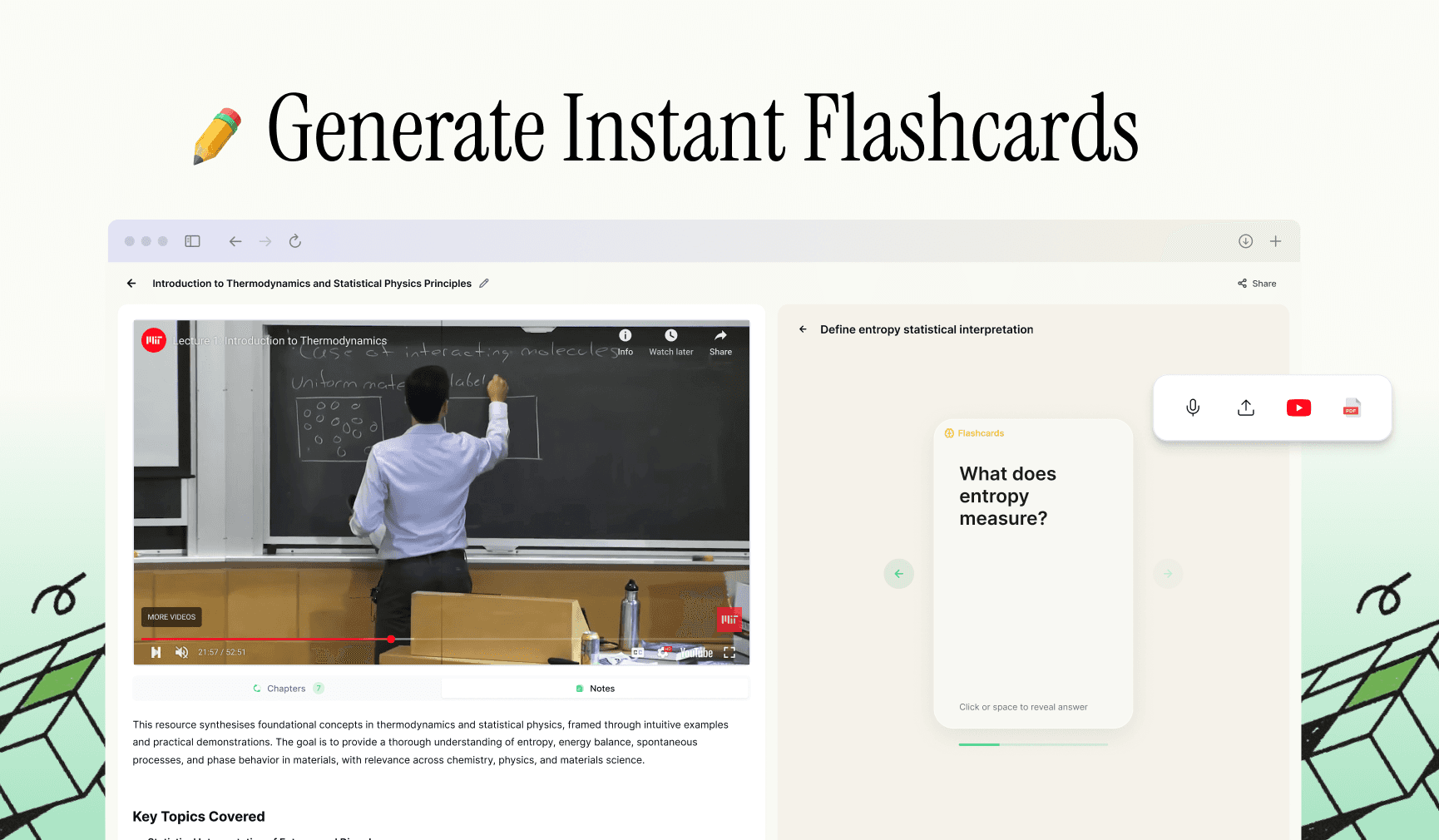
What to include in your GDP and Economic Growth flashcards
Good economics flashcards follow the "atomic" rule: one idea per card. Your deck should focus on why certain transactions are included in GDP and why others are excluded. We recommend four main categories:
Definitions: "Define Net Domestic Product."
Processes: "How do you calculate the GDP Deflator?"
Comparisons: "What is the difference between GNP and GDP?"
Application: "How does an increase in technology affect the LRAS curve?"
Example prompts: "What is the formula for the expenditure approach?", "Why are social security payments excluded from GDP?", "Definition of Productivity.", "What does the Rule of 70 find?"
How to study GDP and Economic Growth with flashcards
Use a two-pass approach. First, generate your deck from your textbook or lecture slides. Then, do a quick round to identify which formulas you struggle with most. Focus your energy on those specific gaps in knowledge.
Make a deck from your notes or generate it from content.
Do one quick round to find weak spots like price indices or growth models.
Review weak cards daily to cement the math in your long-term memory.
Mix in scenario-based cards (e.g., "If investment increases, what happens to GDP?").
Do a final mixed review before your midterm or final.
Generate GDP flashcards automatically in Duetoday
Making economics cards manually is slow and tedious, especially when drawing graphs or writing out long formulas. Duetoday automates the grunt work so you can spend your time actually learning.
Upload or paste your Macroeconomics material.
Click Generate Flashcards.
Review, edit, and start studying immediately.
Generate GDP Flashcards in Duetoday
Start with your notes and get a deck you can actually use today.
Common GDP flashcard mistakes
Cards are too long: Don't put the entire definition of 'Growth' on one card; split it into 'determinants' and 'outcomes'.
Targeting only vocabulary: You must include formula-based cards to pass macro exams.
Ignoring the 'Why': Don't just memorize that GDP increases; know why 'Investment' includes unsold inventory.

FAQ
How many flashcards do I need for GDP? Usually, 40-60 cards cover the main definitions, formulas, and components of growth thoroughly.
What is the best format for these flashcards? Question and answer format is best for formulas, while 'compare and contrast' works for Real vs. Nominal GDP.
How often should I review? Review high-difficulty cards daily and mastered cards every 3-4 days using spaced repetition.
Should I make cards from my textbook or slides? Use lecture slides for what your professor prioritizes, and the textbook for supplementary formulas.
How do I stop forgetting the formulas? Practice active recall by writing out the full GDP expenditure formula every time you see the prompt.
Can I generate flashcards from a PDF? Yes, Duetoday scans your PDFs and extracts the most relevant economic data for cards.
Are digital flashcards better than paper? Yes, because digital tools like Duetoday use AI to automate the creation and scheduling of your review sessions.
Can Duetoday organize my cards? Absolutely, Duetoday categorizes your cards by topic so you can focus specifically on Economic Growth theories.

Duetoday is an AI-powered learning OS that turns your study materials into personalised, bite-sized study guides, cheat sheets, and active learning flows.