Generate Flashcards for Gas Laws
Generate Gas Laws flashcards in seconds. Convert notes to study decks. Try it for free!
Generate Flashcards with AI Free
Generate Flashcards for Gas Laws
Turn your notes, PDFs, slides, or chemistry lectures into Gas Laws flashcards so you can review variables like pressure, volume, and temperature faster and remember more for your exams.
Generate Gas Laws FlashcardsUpload notes / paste text
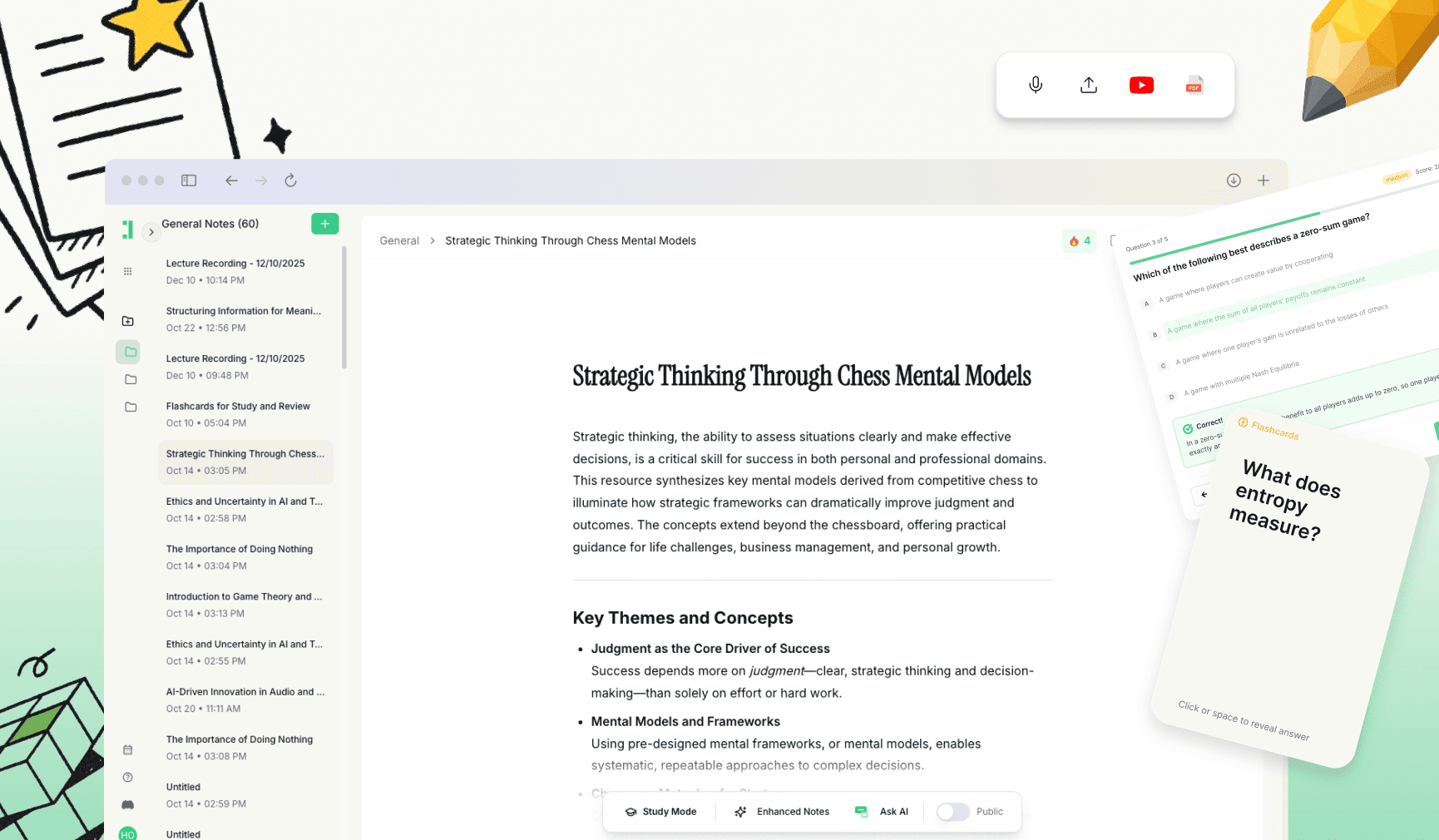
With Duetoday, you simply upload your chemistry materials and our AI instantly identifies key formulas and relationships to create a custom study deck. You can then review, edit, and use active recall to master the material in half the time.
What are Gas Laws flashcards?
Gas Laws flashcards cover the fundamental principles governing how gases behave under different conditions. This includes Boyle’s Law, Charles’s Law, Gay-Lussac’s Law, Avogadro’s Law, and the Combined and Ideal Gas Laws. They focus on the relationships between pressure (P), volume (V), temperature (T), and moles (n).
Instead of just staring at a textbook page of equations, these flashcards force you to predict how one variable changes when another is altered. This builds functional recall, ensuring you can solve word problems quickly during a test rather than just memorizing a formula you don't know how to use.
If you already have notes, Duetoday can generate a clean deck in minutes.
Why flashcards are one of the best ways to study Gas Laws
Gas Laws require a mix of rote memorization (the formulas) and conceptual understanding (the relationships). Flashcards bridge this gap by isolating variables and testing your ability to apply the correct law to a specific scenario.
Using active recall and spaced repetition helps you move these mathematical relationships into your long-term memory. Instead of rereading the same chapter, you spend your time on the specific laws you keep forgetting.
Remember constants for each law without cramming
Separate similar concepts (e.g., Charles's Law vs. Boyle's Law)
Learn unit conversions (Celsius to Kelvin, atm to kPa) step-by-step
Practice applying the Ideal Gas Law formula quickly
What to include in your Gas Laws flashcards
The most effective flashcards follow the "one idea per card" rule. For Gas Laws, your cards should focus on the name of the law, the formula, the variables held constant, and the direct or inverse relationship between variables.
Definitions & key terms: "Define Absolute Zero" or "What is an Ideal Gas?"
Processes & steps: "How do you convert Celsius to Kelvin?"
Comparisons: "How is Boyle's Law different from Charles's Law in terms of variables?"
Application: "If pressure doubles and temperature stays constant, what happens to volume?"
Example prompts: "State Boyle's Law formula," "What variable is constant in Gay-Lussac’s Law?", "What does 'R' represent in PV=nRT?", "Convert 1.5 atm to mmHg."
How to study Gas Laws with flashcards (a simple system)
Start with a "two-pass" approach. First, use your cards to memorize the names and formulas of the five main laws. Once those are locked in, move to cards that describe a scenario (e.g., a balloon shrinking in cold water) where you must identify which law applies.
Make a deck from your lecture slides or textbook chapters.
Do one quick round to identify which formulas you struggle to remember.
Review the laws you find difficult daily for three days.
Mix in calculation-based cards to practice the math.
Do a final mixed-topic review before your chemistry midterm.
Generate Gas Laws flashcards automatically in Duetoday
Writing out every formula and constant by hand is tedious and takes away from actual study time. Duetoday automates the creation process so you can start testing yourself immediately.
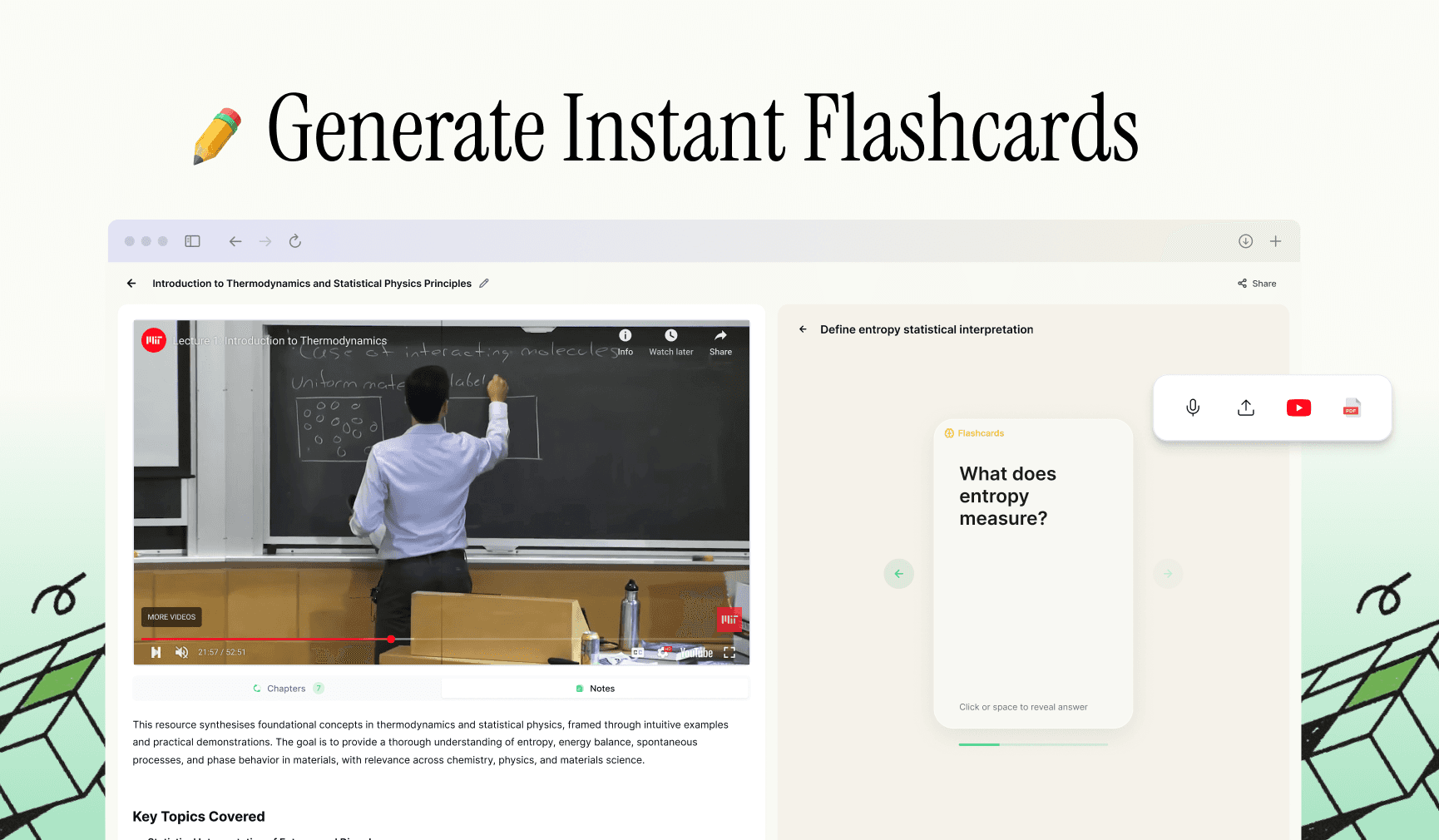
Simply upload your chemistry PDF, lab notes, or lecture recording. Our AI identifies the laws, the units, and the problem-solving steps to build a comprehensive deck.
Upload or paste your Gas Laws material
Click Generate Flashcards
Review, edit, and start studying
Generate Gas Laws Flashcards in Duetoday
Start with your notes and get a deck you can actually use today.
Common Gas Laws flashcard mistakes
Many students create cards that are too complex. If a card has three different variables and a conversion step, it’s too long. Split it into two cards: one for the conversion and one for the relationship. Also, ensure you don't forget to include the units—forgetting to convert to Kelvin is the #1 mistake in Gas Law problems!
FAQ
How many flashcards do I need for Gas Laws? Typically 20-30 cards cover the main laws, constants, unit conversions, and conceptual relationships.
What’s the best format for Gas Laws flashcards? A question-and-answer format works best, especially for predicting changes (e.g., 'If T increases, what happens to V?').
How often should I review Gas Laws flashcards? Review them once a day leading up to your exam to keep the formulas fresh in your mind.
Should I make cards from a textbook or slides? Both. Textbooks are great for definitions, while lecture slides often highlight the specific formulas your professor wants you to use.
How do I stop forgetting the formulas after a few days? Spaced repetition is key. Reviewing the cards at increasing intervals forces your brain to work harder to recall the info.
What if my flashcards feel too easy? Add 'Application' cards where you have to solve a mini-word problem instead of just stating a law.
Can I generate Gas Laws flashcards from a PDF? Yes, Duetoday can read your chemistry PDFs and extract the relevant laws and equations into flashcards.
Are digital flashcards better than paper for Gas Laws? Digital is often better because you can include more deck variations and use AI to generate them instantly.
How long does it take to make a full Gas Laws deck? Manually it could take an hour; with Duetoday, it takes less than a minute.
Can Duetoday organize my cards by law? Yes, you can categorize your cards into tags like Boyle’s, Charles’s, or Ideal Gas Law for targeted practice.

Duetoday is an AI-powered learning OS that turns your study materials into personalised, bite-sized study guides, cheat sheets, and active learning flows.