Generate Flashcards for Game Theory in Economics
Make Game Theory flashcards to master economic strategy. Use Duetoday to generate study decks from notes and PDFs.
Generate Flashcards with AI Free

What are Game Theory flashcards?
Game Theory flashcards are specialized study tools designed to help you master the mathematical modeling of strategic interaction among rational agents. These flashcards cover critical concepts such as players, strategies, payoffs, and the various types of games like Zero-Sum or the Prisoner's Dilemma.
Instead of passively rereading complex proofs and diagrams, these flashcards force you to define terms, calculate equilibrium points, and predict outcomes. The goal is to build instant recall so you can analyze strategic behavior without hesitation during exams or research.
Why flashcards work for Game Theory in Economics
Game Theory requires a blend of logical reasoning and memorization of specific equilibrium conditions. Flashcards are ideal for this subject because they break down dense mathematical concepts into bite-sized, testable units. By using active recall, you strengthen the neural pathways associated with strategic analysis.
Memorize key definitions like Dominant Strategy and Pareto Efficiency without cramming.
Separate similar concepts, such as Nash Equilibrium versus Subgame Perfect Equilibrium.
Learn the steps to solve backward induction in extensive-form games.
Practice applying the rules of payoff matrices to find optimal outcomes quickly.
What to include in your Game Theory flashcards
Effective Game Theory flashcards focus on one core principle per card. You should move beyond simple definitions and include logic-based questions that mimic real-world economic scenarios. This ensures you understand the 'why' behind the math.
Definitions & Key Terms: What is a Zero-Sum game? and Define a Strictly Dominant Strategy.
Processes & Steps: What are the steps to find a Nash Equilibrium in a 2x2 matrix?
Comparisons: How does a Cooperative game differ from a Non-Cooperative game?
Application: In a Prisoner's Dilemma, why is the (Confess, Confess) outcome an equilibrium?
Example prompts for your deck include: State the definition of a Mixed Strategy, Explain the concept of Common Knowledge, and What is the Folk Theorem in repeated games?
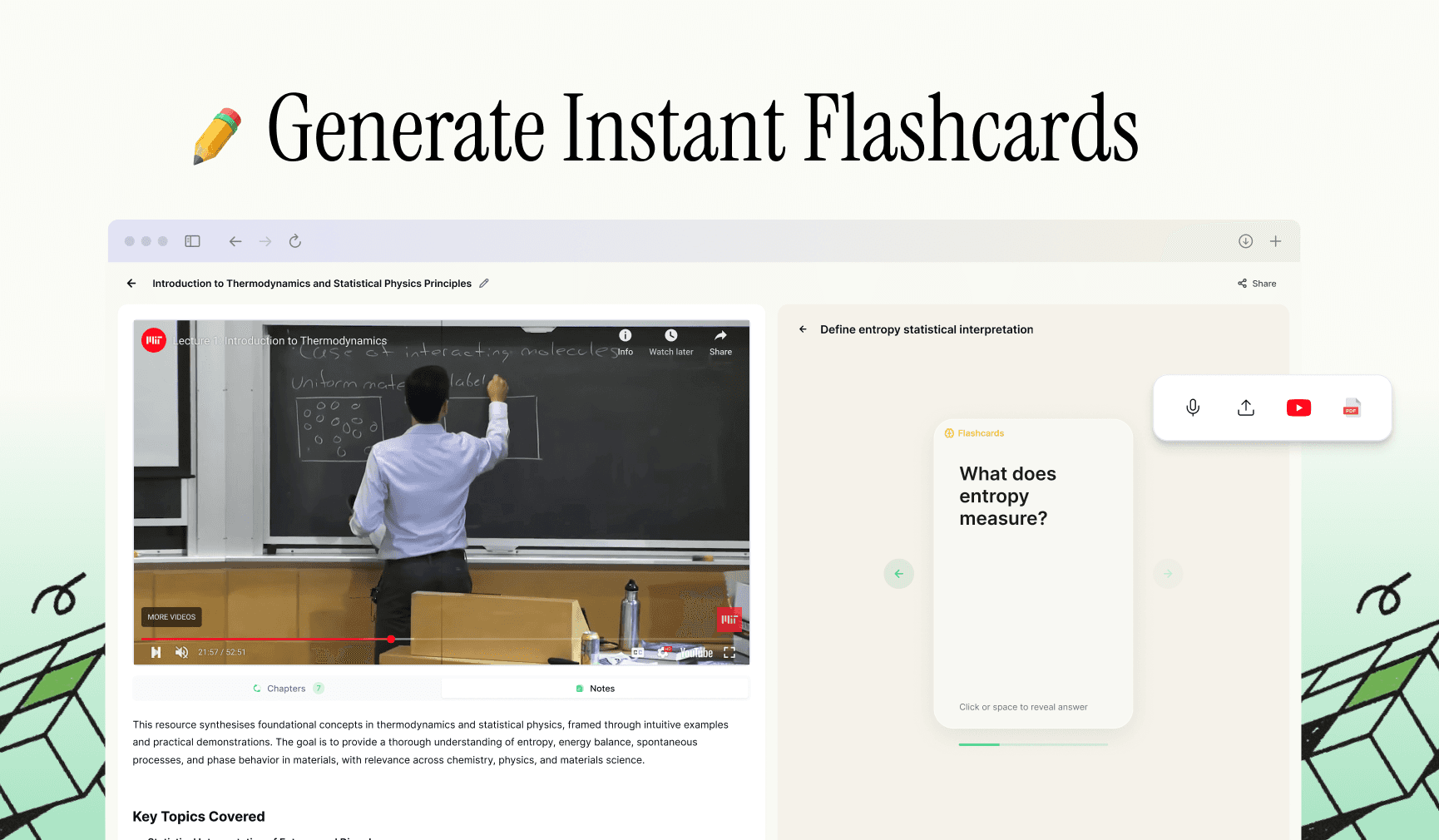
How to study Game Theory with flashcards
To master Game Theory, use a systematic two-pass approach. First, generate your deck from your lecture notes or textbook chapters. Then, move through your cards in focused rounds, focusing on the logic behind the strategies rather than just the numbers.
Generate your deck automatically from your PDF syllabus or textbooks.
Perform a rapid first pass to identify which equilibrium concepts are confusing.
Review high-difficulty cards daily until the logic becomes second nature.
Shuffle your deck to ensure you can identify game types out of context.
Run a final review of payoff matrix calculations before your exam.
Generate Game Theory flashcards automatically in Duetoday
Writing out payoff matrices and definitions by hand is time-consuming and prone to errors. Duetoday streamlines this process by using AI to analyze your study materials and extract the most important strategic concepts for you.
By uploading your economics slides or PDFs, Duetoday creates a structured deck ready for study in seconds. You spend less time formatting and more time mastering the Cournot and Stackelberg models.
Upload your Game Theory PDF or paste your lecture notes.
Click Generate Flashcards to create your custom deck.
Review, edit the logic, and start your active recall session immediately.
Common Game Theory flashcard mistakes
Standard mistakes can hinder your progress. Avoid making cards that are too wordy; instead, focus on the criteria for each equilibrium. Do not just memorize the name of a game—memorize the incentive structure that defines it.
Cards are too complex: Break down large matrices into specific strategy questions.
Ignoring the math: Ensure you have cards that ask for the conditions of an inequality.
No Application: Add cards that ask what happens if a player's payoff changes slightly.
Ready to generate your Game Theory flashcards?
Stop rereading your textbook and start testing your knowledge. Upload your Game Theory materials to Duetoday and get a professional-grade study deck instantly.
FAQ
How many flashcards do I need for Game Theory? Usually, a deck of 40-60 cards is sufficient to cover the core definitions and major equilibrium types for an undergraduate course.
What is the best format for Game Theory flashcards? A mix of 'Term/Definition' and 'Scenario/Outcome' works best to cover both theory and application.
How often should I review Game Theory flashcards? Review daily for the first week to cement the logic, then every few days to maintain recall.
Should I make cards from a textbook or slides? Use both. Textbooks provide the rigorous definitions, while slides often highlight the specific games your professor prioritizes.
How do I stop forgetting Nash Equilibrium steps? Use cards that break the process into 'Step 1,' 'Step 2,' etc., and repeat them until the sequence is automatic.
What if my flashcards feel too easy? Add 'What if' scenarios to your cards to challenge your understanding of how variables affect outcomes.
Can I generate Game Theory flashcards from a PDF? Yes, Duetoday can read your economics PDFs and extract the key strategic models into flashcards.
Are digital flashcards better for Economics? Digital cards are superior for Game Theory because they allow for easy editing of matrices and faster repetition of complex concepts.
How long does it take to make a full deck? With Duetoday, you can generate a comprehensive deck in less than a minute.
Can Duetoday organize my cards by game type? Yes, Duetoday categorizes your content so you can study specific topics like Sequential Games or Signaling separately.

Duetoday is an AI-powered learning OS that turns your study materials into personalised, bite-sized study guides, cheat sheets, and active learning flows.