Generate Flashcards for Game Theory
Make Game Theory flashcards to master Nash Equilibrium and strategic logic using our AI generation guide.
Generate Flashcards with AI Free
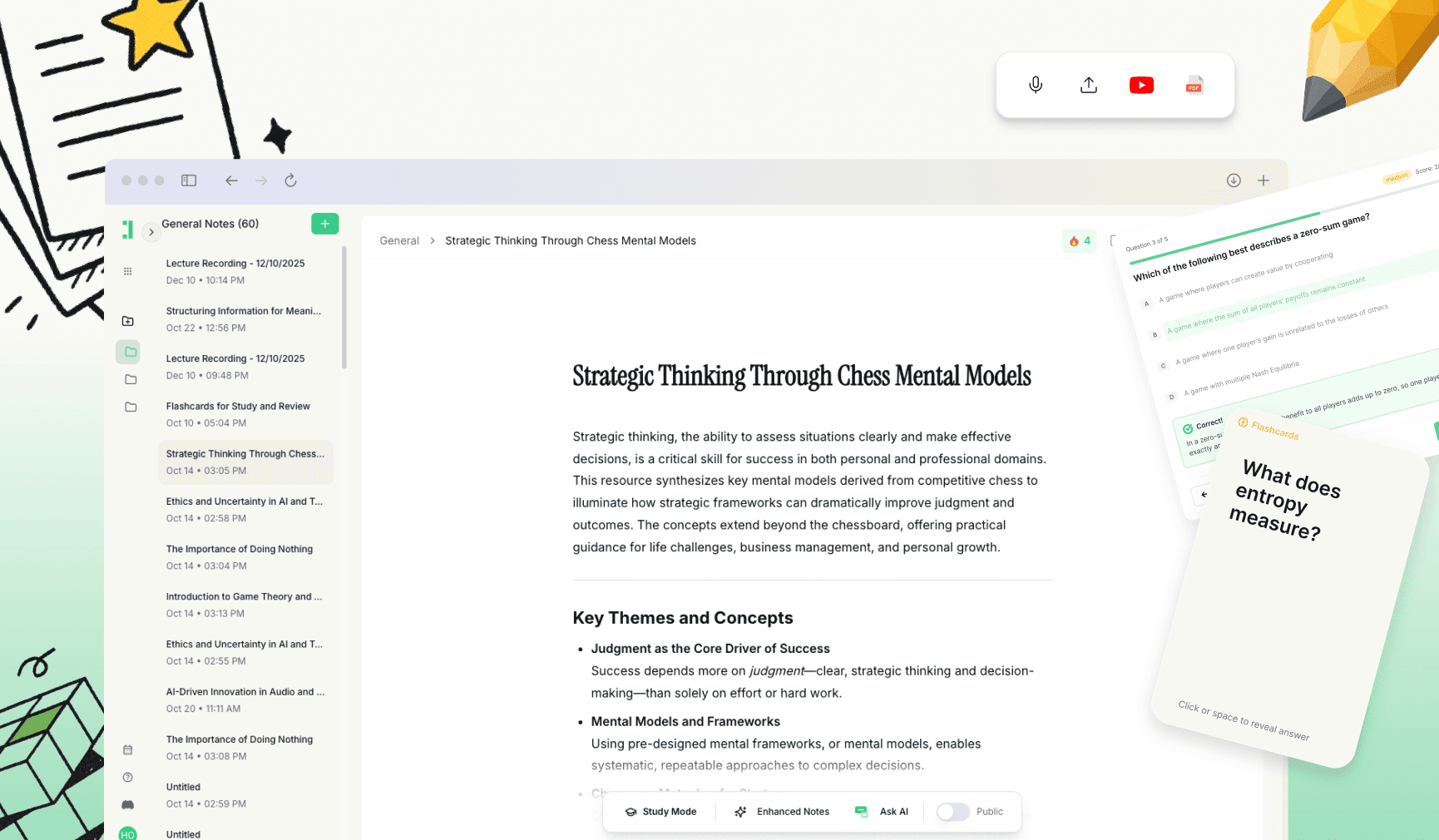
What are Game Theory flashcards?
Game Theory flashcards are specialized study tools designed to help you master the mathematical modeling of strategic interaction among rational agents. These cards cover essential concepts such as dominant strategies, symmetric vs. asymmetric games, and zero-sum outcomes. Instead of staring at complex payoff matrices in a textbook, flashcards force you to define terms and solve strategic scenarios on the fly.
The primary outcome of using these flashcards is moving beyond passive reading to active recall. By testing your ability to identify a Nash Equilibrium or a Prisoner's Dilemma without looking at the solution, you build the neural pathways necessary for high-level economic and logical reasoning. If you already have lecture notes or a syllabus, Duetoday can generate a clean deck of Game Theory flashcards in minutes.
Why flashcards work for Game Theory
Game Theory requires a mix of precise vocabulary and the ability to apply logic to various scenarios. Flashcards are ideal because they break down these complex relationships into manageable bites. They help you internalize the "rules of the game" so you can focus on the analysis rather than struggling to remember what a 'maximin' strategy is.
Using active recall and spaced repetition, you can master the following:
Remember key terms like 'Pareto efficiency' without cramming.
Separate similar concepts such as Cooperative vs. Non-cooperative games.
Learn multi-stage processes like Backward Induction step-by-step.
Practice applying rules to find subgame perfect equilibria quickly.
What to include in your Game Theory flashcards
Effective Game Theory cards follow the "one idea per card" rule. They should be question-based, forcing your brain to produce an answer rather than simply recognizing a prompt. This turns a study session into a series of mini-drills that simulate exam conditions.
Definitions & key terms: "What is a Dominant Strategy?" or "Define a Zero-Sum Game."
Processes & steps: "How do you find a Nash Equilibrium using the 'best response' method?"
Comparisons: "What is the difference between a Pure Strategy and a Mixed Strategy?"
Application: "In a 2x2 payoff matrix, if Player A chooses X, what is Player B's optimal response?"
Example prompts: "State the condition for a Tit-for-Tat strategy," "Define the Folk Theorem in repeated games," or "Identify the focal point in a coordination game."
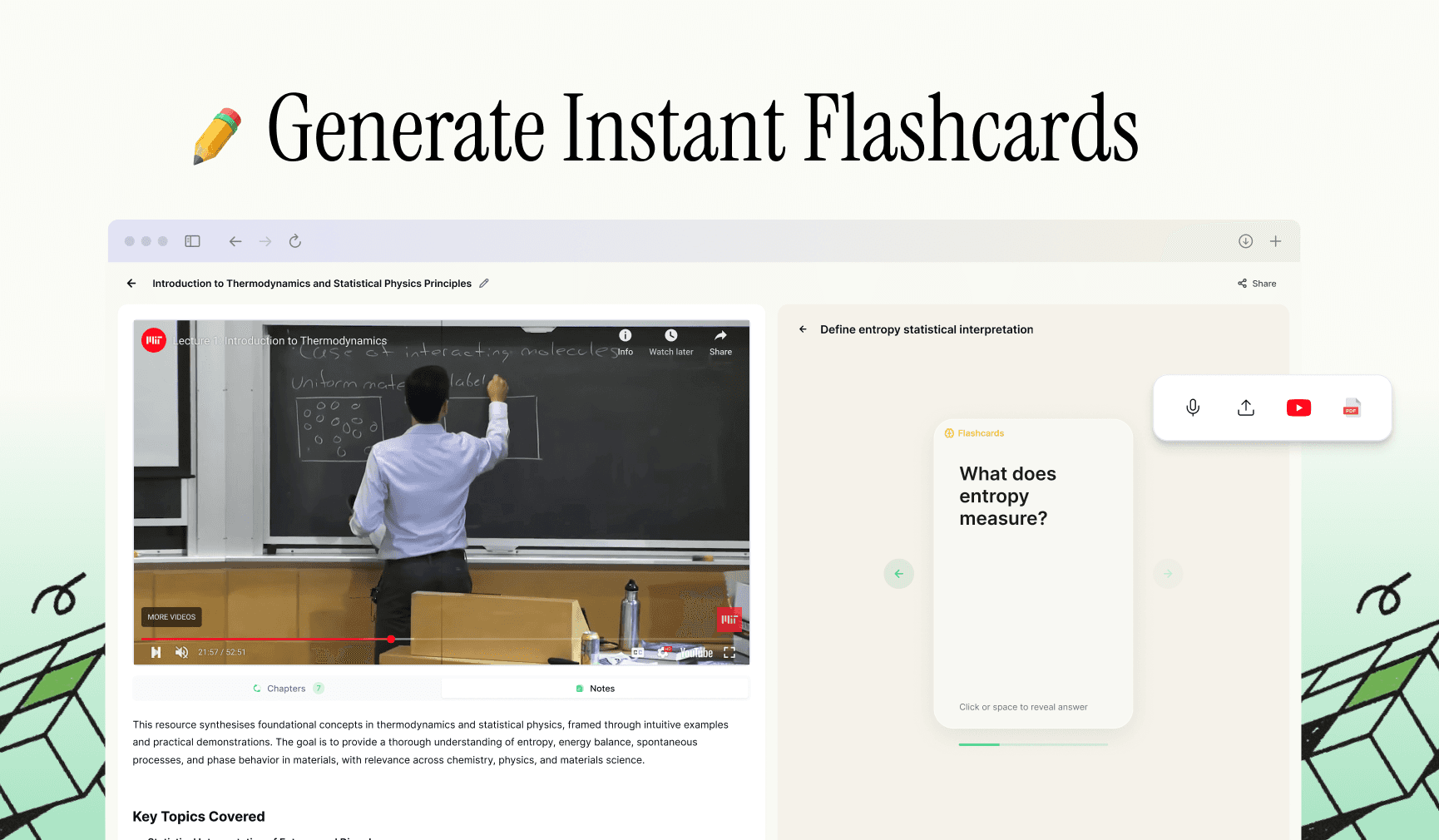
How to study Game Theory with flashcards
To master Game Theory, use a two-pass approach. Start by building a deck that covers the foundational logic, then move into specific game scenarios. Don't just flip through them; actually say the answer out loud or sketch the payoff matrix on a scrap of paper before checking the back.
Review in short, focused sessions. If you find a particular concept like 'Evolutionarily Stable Strategies' difficult, the system should show you that card more frequently until it becomes second nature.
Make a deck from your notes or generate it from your textbook PDF.
Do one quick round to identify which strategies or theorems are tripping you up.
Review weak cards daily to cement the logic.
Mix in harder application problems to avoid rote memorization of definitions.
Do a final mixed review session before your exam to ensure you can switch between game types.
Generate Game Theory flashcards automatically in Duetoday
Manually drawing payoff matrices and writing out definitions for every game type is slow and tedious. Duetoday eliminates this friction by automating the card-creation process, allowing you to spend more time actually studying the logic of the games.
Simply upload your Game Theory materials—whether they are lecture slides on the Cournot model or notes on signaling—and watch as the AI creates a structured study deck for you.
Upload or paste your Game Theory material.
Click Generate Flashcards.
Review, edit for specific nuances, and start studying instantly.
Common Game Theory flashcard mistakes
Many students create cards that are too wordy, making it hard to test a single concept. Avoid putting an entire proof on one card. Instead, break the proof down into its logical steps.
Cards are too long: Split complex games into separate cards for each player's perspective.
Only memorizing words: Ensure you have cards that ask “why” a certain outcome is an equilibrium.
Confusing similar models: Use comparison cards for Bertrand vs. Cournot competition.
No review schedule: Ensure you aren't just looking at the cards once; repeat the hard ones.
FAQ
How many flashcards do I need for Game Theory? For a standard introductory course, 50 to 80 cards usually cover the core definitions, game types, and equilibrium concepts thoroughly.
What’s the best format for Game Theory flashcards? A question on the front and a concise explanation or a simplified 2x2 matrix on the back is most effective for visual and logical learning.
How often should I review Game Theory flashcards? Review daily when first learning new models, then taper off to every few days once you can consistently identify equilibria without hesitation.
Should I make cards from a textbook or lecture notes? Use both. Textbooks provide the formal definitions, while lecture notes often contain the specific game variations your professor emphasizes.
How do I stop forgetting Game Theory concepts? Use spaced repetition. The logic of Game Theory is cumulative, so reviewing foundations like 'rationality' and 'payoffs' helps later concepts stick.
What if my flashcards feel too easy? If they are too easy, you are likely just recognizing terms. Add "Application" cards where you have to determine a strategy based on set numerical values.
Can I generate Game Theory flashcards from a PDF? Yes, Duetoday can read your textbook chapters or lecture PDFs and extract the most important strategic concepts into cards.
Are digital flashcards better than paper for Game Theory? Digital is often better because you can easily include images of matrices and utilize spaced repetition algorithms to save time.
How long does it take to make a full Game Theory deck? Manually it could take hours, but with Duetoday's AI generation, you can have a full deck ready to study in under a minute.
Can Duetoday organize my cards into categories like 'Simultaneous' and 'Sequential'? Yes, you can generate cards based on specific sections of your notes to keep different game structures organized.

Duetoday is an AI-powered learning OS that turns your study materials into personalised, bite-sized study guides, cheat sheets, and active learning flows.