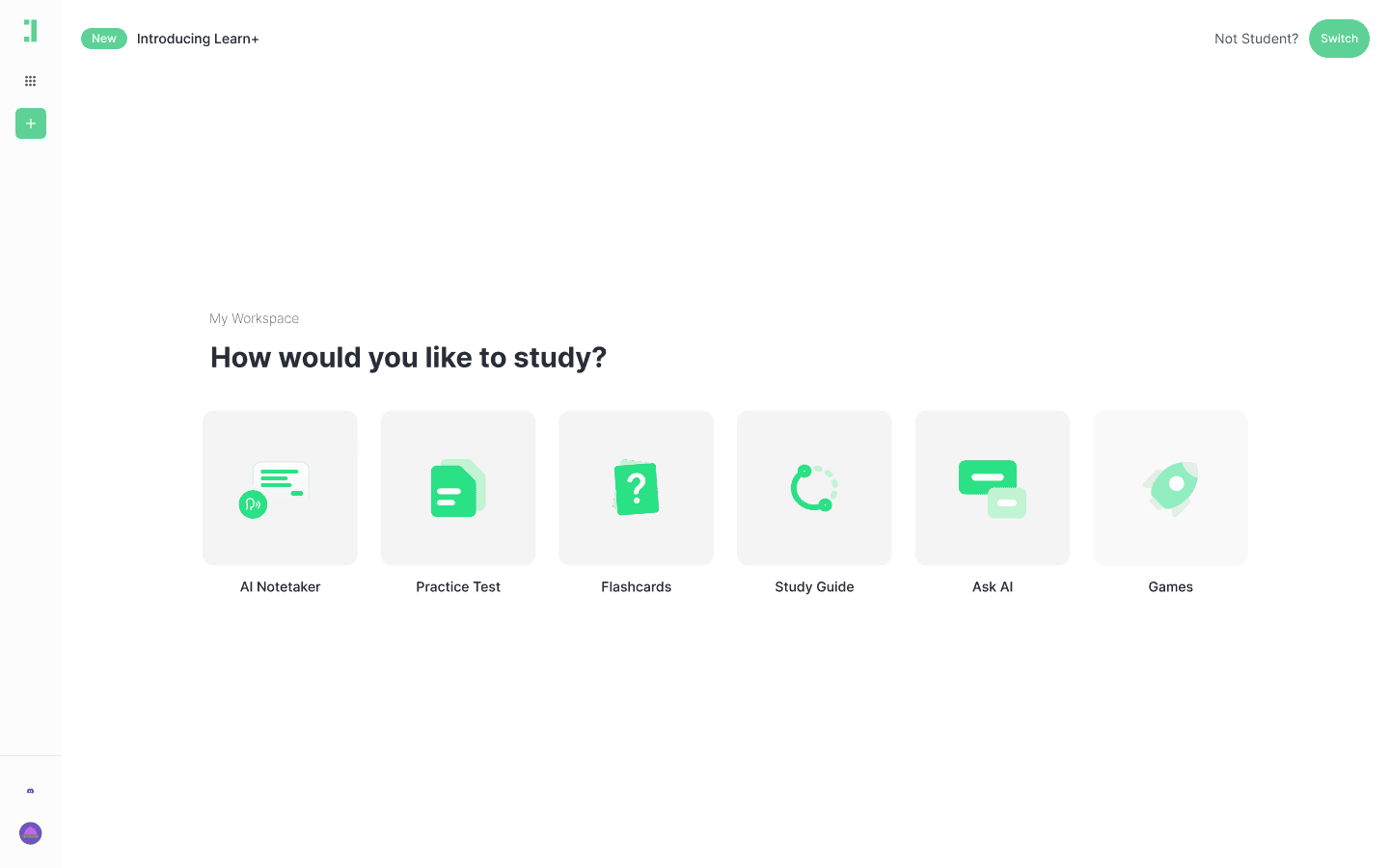
Generate Flashcards for Fourier Analysis
Make Fourier Analysis flashcards from your notes. Generate study materials for Fourier series and transforms.
Generate Flashcards with AI Free
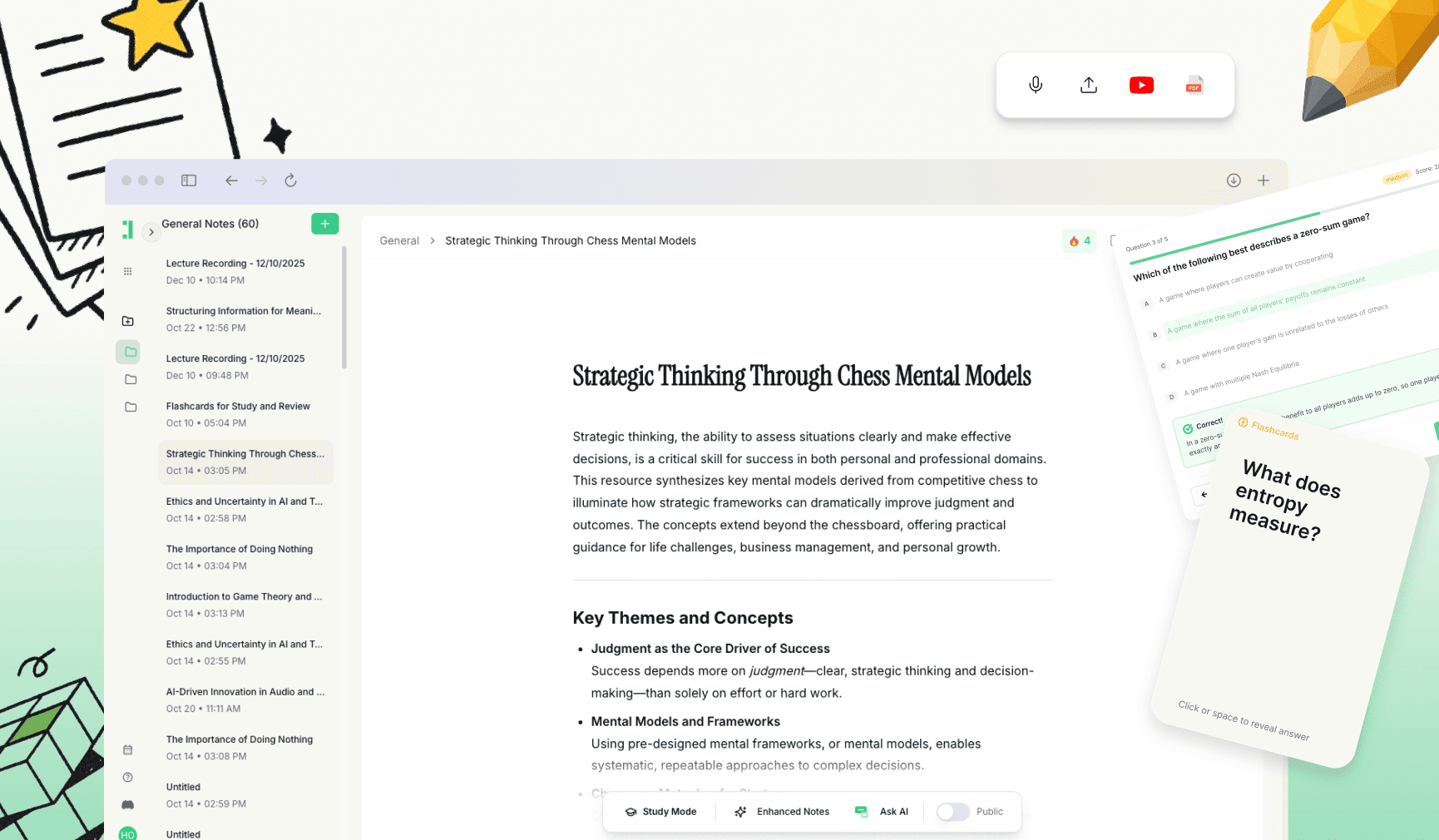
Generate Flashcards for Fourier Analysis
Turn your complex mathematical notes, PDFs, textbook chapters, or lecture slides into Fourier Analysis flashcards so you can review faster and remember more. Understanding frequency domains shouldn't require hours of manual card creation.
Generate Fourier Analysis FlashcardsUpload notes / paste text
With Duetoday, the process is simple: upload your materials, let our AI extract the core concepts, review the generated cards, and start studying immediately to master your engineering or math exams.
What are Fourier Analysis flashcards?
Fourier Analysis flashcards cover the fundamental mathematical tools used to decompose functions into trigonometric components. These cards include key terms like orthogonality, Dirichlet conditions, Fourier coefficients, and the relationship between time and frequency domains.
Instead of passively rereading dense proofs, these flashcards force you to test your knowledge of convergence, symmetry properties, and transform pairs, building the neural pathways needed for rapid recall during exams.
If you already have notes, Duetoday can generate a clean deck in minutes.
Why flashcards work for Fourier Analysis
Fourier Analysis requires a mix of rote memorization for transform pairs and deep conceptual understanding of signal decomposition. Flashcards bridge this gap by using active recall and spaced repetition to ensure you don't forget complex formulas.
Memorize Fourier Transform pairs without cramming.
Distinguish between Continuous-Time (CTFT) vs. Discrete-Time (DTFT).
Learn the steps of the Fast Fourier Transform (FFT) algorithm.
Practice applying properties like linearity, scaling, and time-shifting.
What to include in your Fourier Analysis flashcards
Effective flashcards follow the "one idea per card" rule. For a subject as technical as Fourier Analysis, focusing on specific properties and question-based prompts is the most efficient strategy.
Definitions & Key Terms: "What is the Gibb's Phenomenon?" or "Define Parseval's Theorem."
Processes & Steps: "What are the three conditions for a Fourier Series to converge?"
Comparisons: "How does the Discrete Fourier Transform (DFT) differ from the DTFT?"
Application: "What is the frequency shift of a signal multiplied by a complex exponential?"
Example prompts: "State the modulation property," "What is the result of convolving two signals in the frequency domain?", and "Define the Nyquist-Shannon sampling theorem."
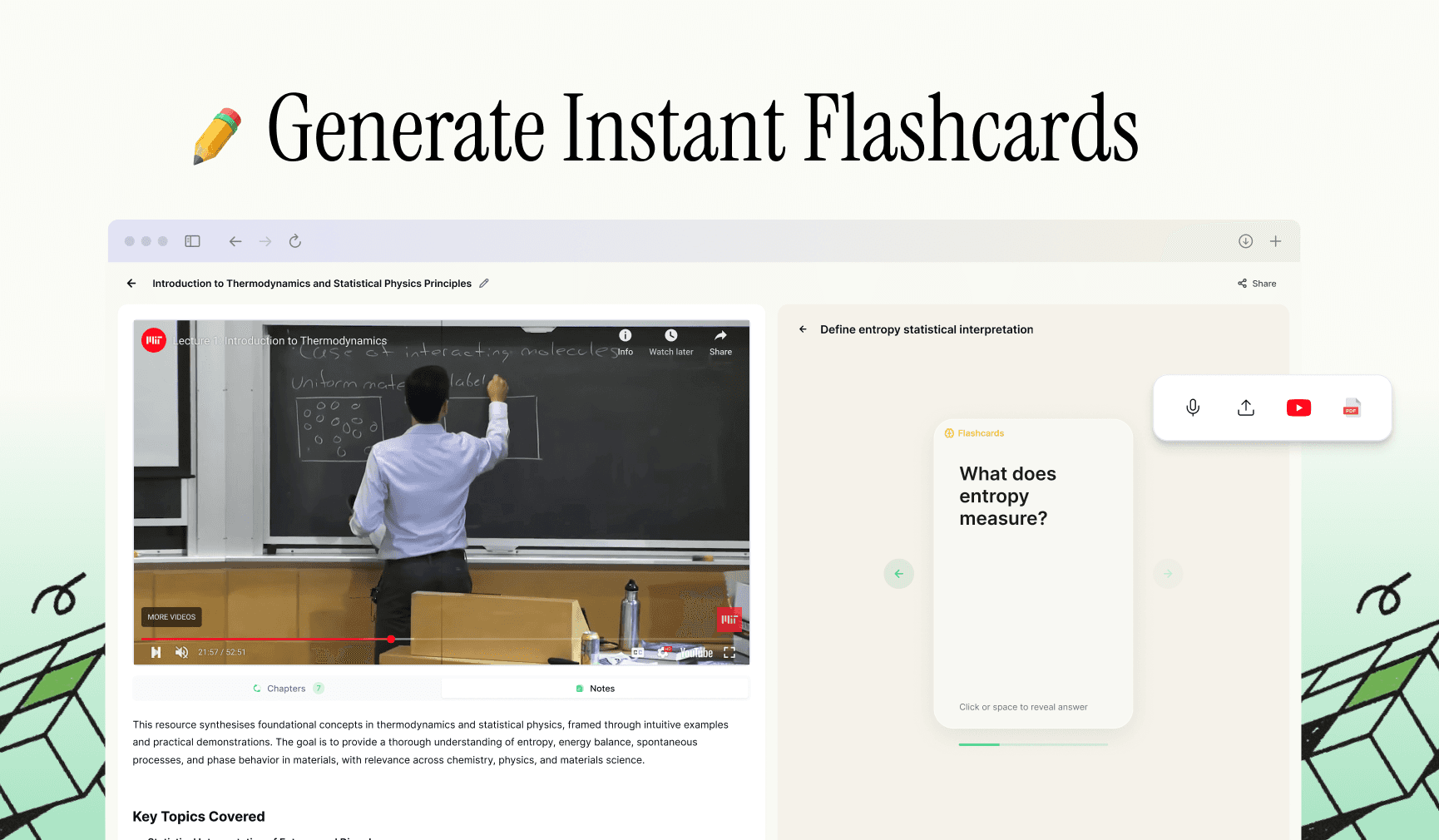
How to study Fourier Analysis with flashcards
Mastering Fourier Analysis requires a two-pass approach. First, you must ensure you understand the derivation, then you use flashcards to automate the recall of properties and pairs so you can solve problems faster.
Make a deck from your lecture notes or textbook chapters using Duetoday.
Do a quick initial sweep to identify which properties (like convolution or duality) confuse you.
Review these "weak cards" daily to move them into long-term memory.
Mix in difficult integration identities and transform pairs.
Perform a final mixed review session before your exam to ensure total mastery.
Generate Fourier Analysis flashcards automatically in Duetoday
Manually writing out LaTeX formulas and drawing signal diagrams on physical cards is slow and frustrating. Most students spend more time making the cards than actually studying them.
Duetoday changes that. Simply upload your PDF or paste your digital notes, and our AI generates high-quality flashcards instantly. You can then edit them for clarity and start your study session right away.
Upload your Fourier Analysis textbook or PDF slides.
Click "Generate Flashcards."
Review, refine, and start your active recall session.
Generate Fourier Analysis Flashcards in Duetoday
Start with your notes and get a deck you can actually use today.
Common Fourier Analysis flashcard mistakes
Many students create poor cards that hinder their progress. Avoid these pitfalls:
Cards are too long: Don't put an entire derivation on one card; break it into logical steps.
Ignoring conditions: Always include the interval or symmetry conditions required for a specific formula.
Neglecting properties: Don't just learn the transforms; make cards for the time-shifting and frequency-scaling properties.
No visual context: Use cards to prompt you to sketch what a specific transform looks like in the frequency domain.
Ready to generate your Fourier Analysis flashcards?
Stop rereading and start recalling. Turn your complex math materials into a structured study plan with Duetoday.
Start Generating Flashcards
Works with notes, PDFs, slides, and transcripts.
FAQ
How many flashcards do I need for Fourier Analysis? Typically, a comprehensive deck covers 40-60 cards focusing on formulas, properties, and theorem conditions.
What’s the best format for Fourier Analysis flashcards? Question/Answer format works best for properties, while "Fill in the blank" is excellent for memorizing transform pairs.
How often should I review Fourier Analysis flashcards? Review daily when first learning the material, then transition to every 3-4 days as you become more confident.
Should I make cards from a textbook or lecture notes? Use lecture notes for exam-specific content and textbooks for foundational definitions and formal proofs.
How do I stop forgetting Fourier properties after a few days? Spaced repetition is the only way—by reviewing the cards exactly when you are about to forget them, you strengthen the memory.
What if my flashcards feel too easy? Add "application" cards that ask you to solve a mental math step or combine two different properties together.
Can I generate Fourier Analysis flashcards from a PDF? Yes, Duetoday is designed to parse complex technical PDFs and transform them into structured flashcards.
Are digital flashcards better than paper for Fourier Analysis? Digital is better because they support mathematical formatting and use algorithms to automate your review schedule.
How long does it take to make a full Fourier deck? Manually it takes hours; with Duetoday, it takes less than 60 seconds.
Can Duetoday organize my flashcards by topic? Yes, you can categorize your cards into sub-topics like "Fourier Series," "CTFT," and "DFT" for targeted study.

Duetoday is an AI-powered learning OS that turns your study materials into personalised, bite-sized study guides, cheat sheets, and active learning flows.