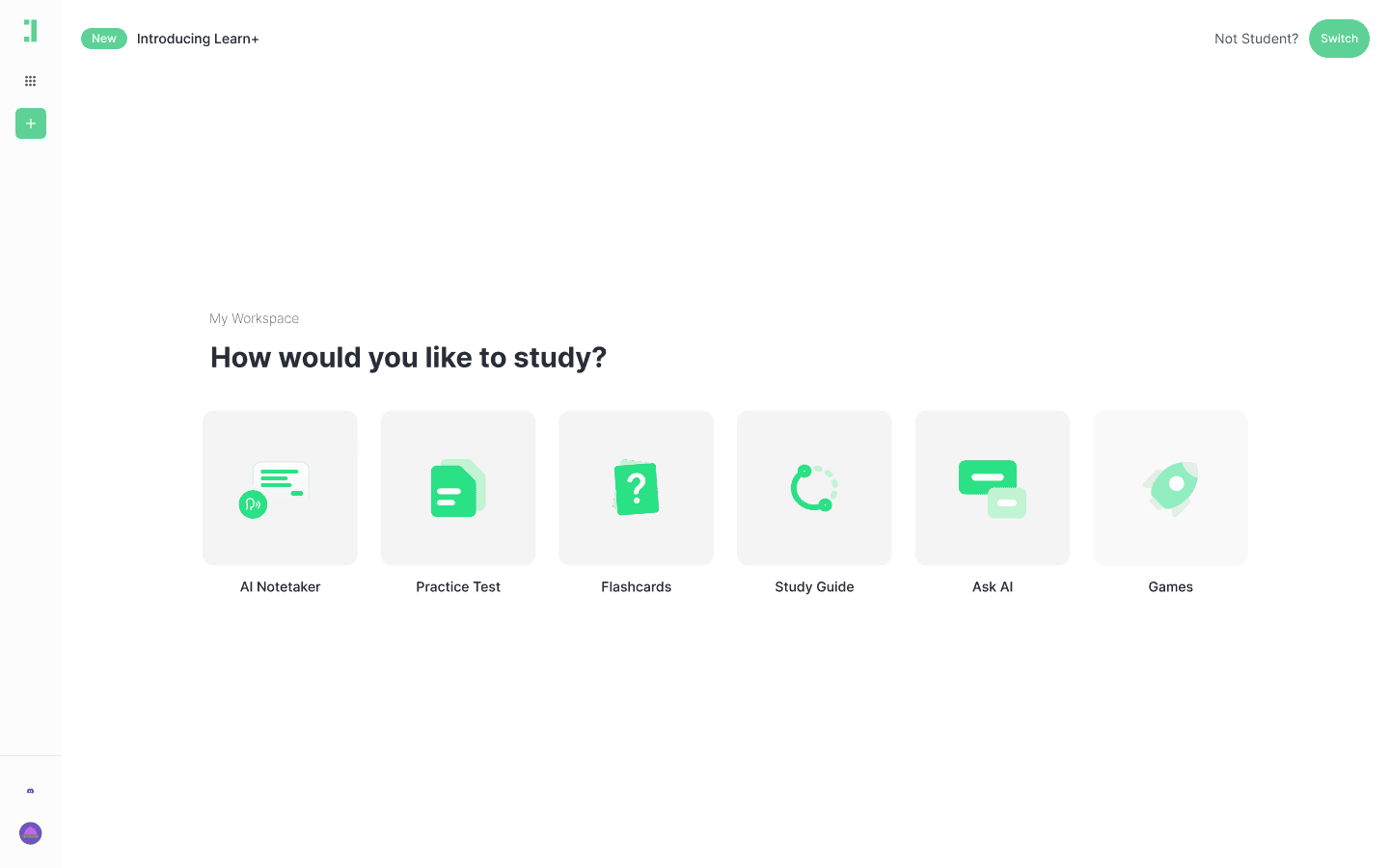
Generate Flashcards for Formal Languages
Learn how to make or generate Formal Languages flashcards. This guide covers automated decks for theory of computation.
Generate Flashcards with AI Free
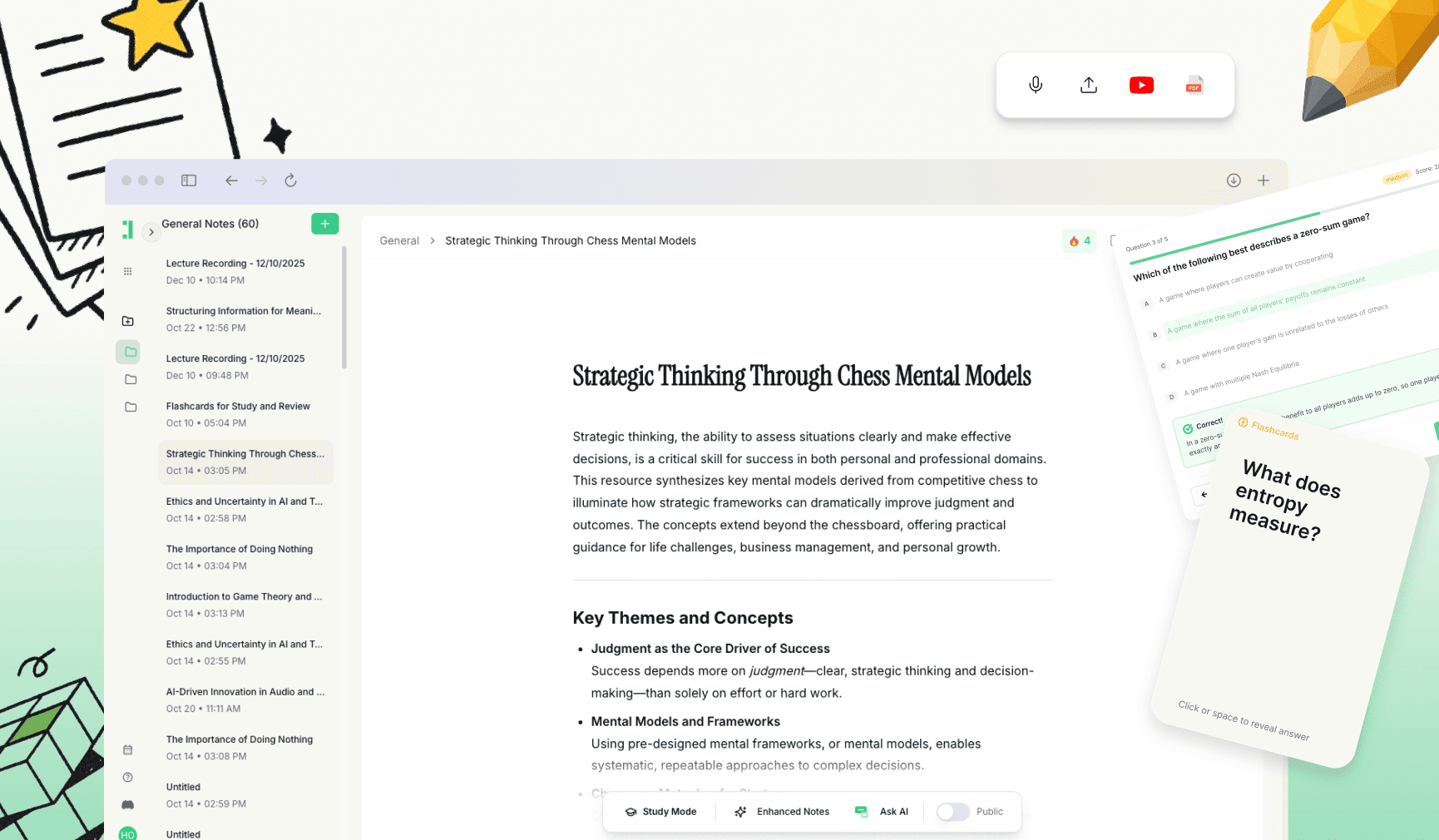
What are Formal Languages flashcards?
Formal Languages flashcards are digital study tools designed to help you master the mathematical structures used to describe languages in computer science. These cards cover essential concepts such as regular expressions, context-free grammars, automata theory, and the Chomsky hierarchy. Instead of passively reading complex proofs, these flashcards force you to define boundaries, identify language types, and recall conversion algorithms.
The main outcome of using these flashcards is moving beyond recognition to actual recall. By testing your ability to distinguish between a Deterministic Finite Automaton (DFA) and a Non-deterministic one, or identifying if a language is recursive, you build the mental shortcuts needed for exams and technical interviews. If you already have lecture notes, Duetoday can generate a clean deck in minutes.
Why flashcards are one of the best ways to study Formal Languages
Formal Languages is a subject rooted in rigid definitions and logical relationships. Flashcards are ideal because they break down dense mathematical notation into bite-sized, digestible challenges. This approach leverages active recall to strengthen the neural pathways associated with complex symbols and state transitions.
Spaced repetition allows you to focus on the properties you find most confusing—like the Pumping Lemma or closure properties—without wasting time on concepts you’ve already mastered.
Memorize the Chomsky hierarchy without mixing up levels.
Differentiate between context-free and context-sensitive languages.
Learn state transition rules and symbol mappings step-by-step.
Practice identifying language classes from set-builder notation quickly.
What to include in your Formal Languages flashcards
Effective Formal Languages cards follow the one idea per card rule. Avoid putting an entire proof on one card; instead, ask about a specific step or a necessary condition for that proof. High-quality cards are always question-based to trigger the brain’s retrieval process.
Focus on four main categories to ensure your deck is comprehensive:
Definitions & Key Terms: What is an alphabet? Define a terminal symbol.
Processes & Steps: What are the four steps to convert an NFA to a DFA?
Comparisons: What is the primary difference between a Mealy machine and a Moore machine?
Application: Is the language {a^n b^n | n ≥ 0} regular or context-free?
Example prompts include: What is the pumping length?, State the Myhill-Nerode Theorem, and Does a PDA use a stack or a queue?
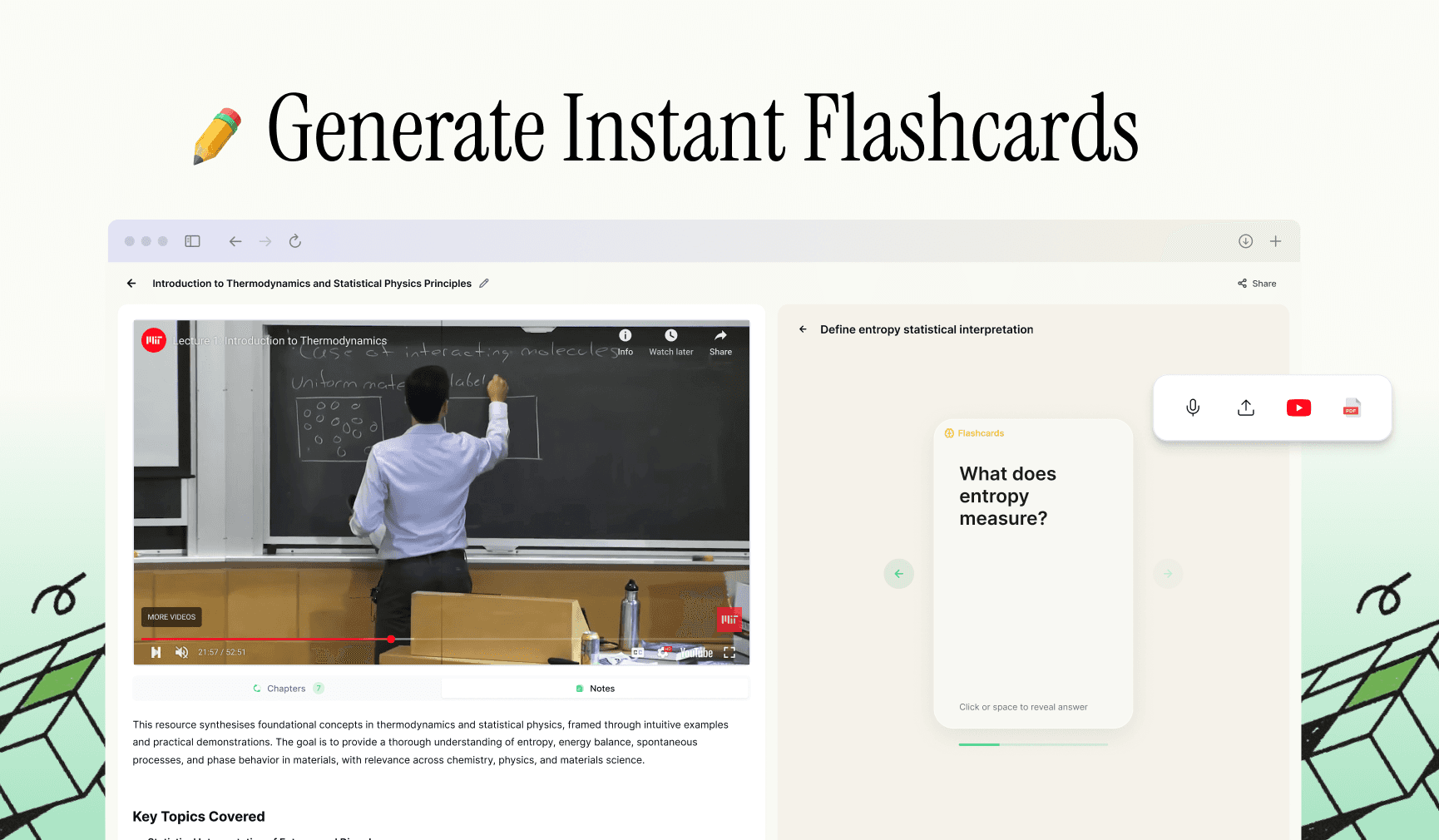
How to study Formal Languages with flashcards
To master this subject, use a two-pass approach. First, generate your deck from your textbooks or slides to ensure all symbols and theorems are captured accurately. Then, move into repetitive review rounds where you filter your performance. Don't just look at the answer; write the transition or symbol down to ensure your memory is precise.
Review in short, focused sessions. Because Formal Languages requires high logical overhead, 15-minute bursts are often more effective than marathon sessions. Repeating the difficult proofs and properties more often will ensure they stick before your next quiz.
Generate a deck from your lecture PDFs or text snippets.
Perform a fast first pass to identify which language types confuse you.
Review the weak cards daily to solidify the logic.
Mix in application cards where you have to classify a specific string.
Conduct a final randomized review of all machine types before exams.
Generate Formal Languages flashcards automatically in Duetoday
Creating flashcards manually for Formal Languages is a tedious process, especially when dealing with Greek letters and complex state diagrams. It’s easy to get bogged down in the formatting rather than the learning. Duetoday eliminates this friction by automating the creation process.
Simply upload your study materials—whether they are handwritten notes converted to PDF, lecture slides, or textbook chapters—and our AI extracts the core logic to create a study-ready deck instantly. You can then edit the cards for clarity and jump straight into your first review session.
Upload or paste your Formal Languages material.
Click Generate Flashcards icon.
Review, edit, and start mastering automata.
Common Formal Languages flashcard mistakes
Many students create cards that are too wordy, making it hard to find the core answer. In Formal Languages, a card that is too long often leads to partial credit in your head, which isn't enough for a technical exam. You need to be exact with your definitions.
Cards are too long: Split a complex machine description into multiple cards for each component.
Only memorizing terms: Ensure you include cards that ask why a language is not regular.
Ignoring closure properties: Make specific cards for union, intersection, and complement results.
No variety: Include both visual (diagram description) and symbolic (mathematical) cards.
Ready to generate your Formal Languages flashcards?
Stop wasting hours copying definitions from slides. Upload your notes to Duetoday, generate your deck, and start using active recall to master the theory of computation. It works with PDFs, lecture transcripts, and your own typed notes.
FAQ
How many flashcards do I need for Formal Languages? A typical semester-long course usually requires between 150 to 300 cards to cover machine types, grammar rules, and closure properties thoroughly.
What’s the best format for Formal Languages flashcards? Question-and-answer format is best. For example: Front: What machine accepts Regular Languages? Back: Deterministic Finite Automata (DFA).
How often should I review Formal Languages flashcards? Review new cards daily for the first week. Once you feel confident, use a spaced repetition schedule to revisit them every 3 to 5 days.
Should I make cards from a textbook or slides? Both are useful. Textbooks usually provide formal definitions and proofs, while lecture slides often highlight the specific examples your instructor finds most important.
How do I stop forgetting the Pumping Lemma? Use multiple cards for the lemma: one for the definition, one for the conditions (u, v, w), and one for the actual application steps.
What if my flashcards feel too easy? Add Application cards that require you to solve a short problem or classify a complex language instead of just defining a term.
Can I generate Formal Languages flashcards from a PDF? Yes, Duetoday can read your textbook or lecture PDFs and instantly convert the key points into a flashcard deck.
Are digital flashcards better than paper for this subject? Digital is often better because you can easily include complex symbols and use automated spaced repetition algorithms to save time.
How long does it take to make a full deck? Manually, it can take hours. With Duetoday, you can generate a comprehensive deck in less than a minute after uploading your notes.
Can Duetoday organize my flashcards by machine type? Yes, you can generate specific decks for Finite Automata, Pushdown Automata, or Turing Machines to keep your study sessions organized.

Duetoday is an AI-powered learning OS that turns your study materials into personalised, bite-sized study guides, cheat sheets, and active learning flows.