Generate Flashcards for Fluid Mechanics
Make Fluid Mechanics flashcards easily. This guide shows how to generate study sets for engineering and physics subjects.
Generate Flashcards with AI Free
What are Fluid Mechanics flashcards?
Fluid Mechanics flashcards are specialized study tools designed to break down the complex physics of liquids and gases into digestible, testable units. They cover essential concepts like hydrostatics, fluid dynamics, Bernoulli’s principle, and Reynolds number. Instead of staring at dense equations until your eyes glaze over, these cards force you to recall specific variables, units, and assumptions.
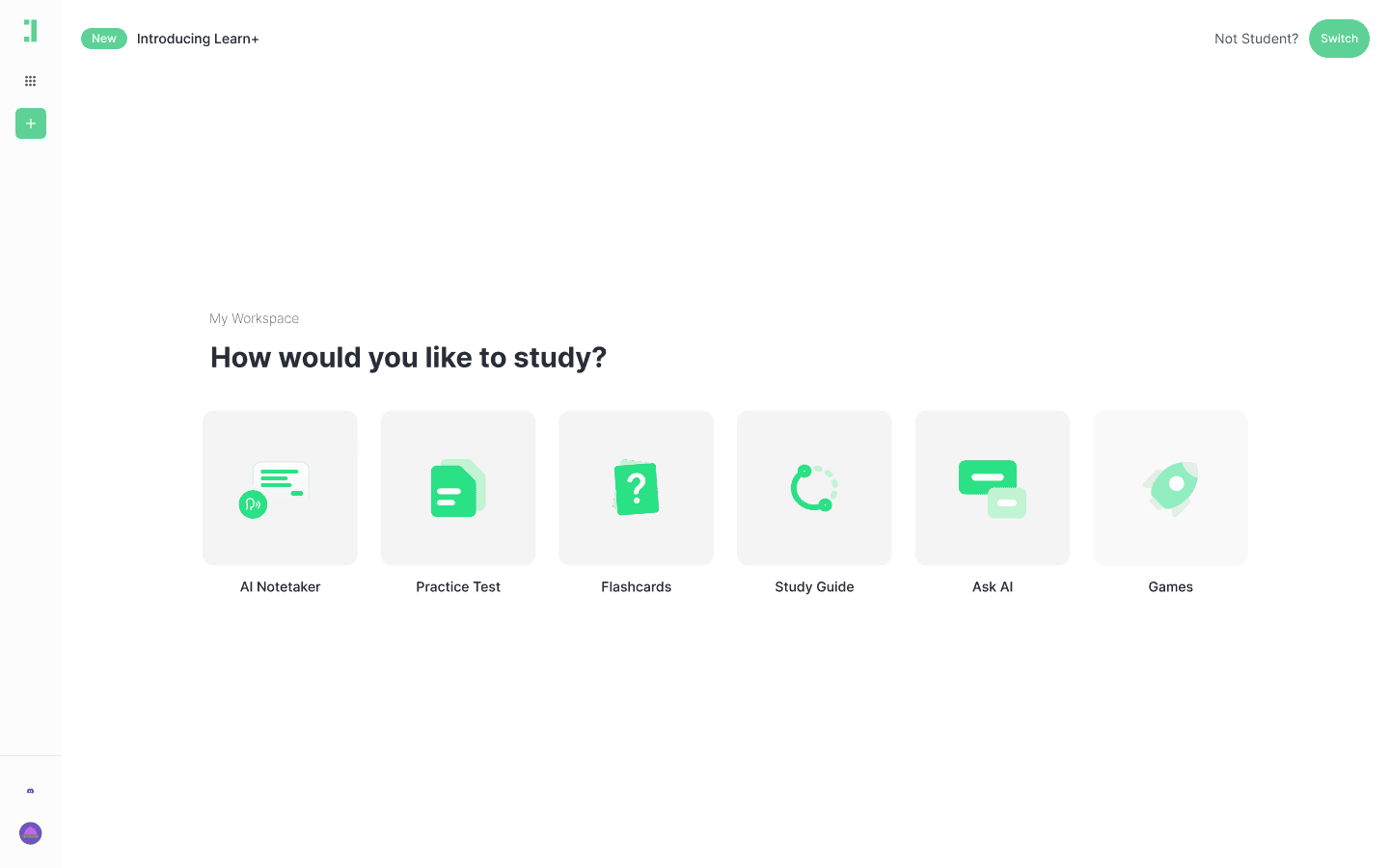
Fluid Mechanics is a highly visual and mathematical subject. Effective flashcards translate these abstract systems into clear questions and answers. The outcome is simple: instead of passively rereading your textbook, you actively test your brain to build long-term memory and intuitive understanding. If you already have notes or a syllabus, Duetoday can generate a clean deck in minutes so you can skip the formatting and start learning.
Why flashcards are one of the best ways to study Fluid Mechanics
Fluid Mechanics requires a mix of rote memorization for properties and deep conceptual understanding for flow behaviors. Flashcards are perfect for this because they utilize active recall—the process of retrieving information from your brain—which is much more effective than passive reading. By using spaced repetition, you ensure that you revisit the hardest concepts like turbulence and viscosity just as you are about to forget them.
Memorize Reynolds number ranges for laminar vs. turbulent flow without cramming.
Separate similar concepts like dynamic viscosity vs. kinematic viscosity.
Learn derivation steps for the Navier-Stokes equations one stage at a time.
Practice applying the Continuity Equation or Bernoulli's equation to different piping scenarios.
What to include in your Fluid Mechanics flashcards
The secret to high-quality Fluid Mechanics cards is the “atomic principle”: one idea per card. If a card is too busy, you'll feel like you know the answer when you only know parts of it. Focus on turning your formulas into questions and your diagrams into descriptions. Using a mix of qualitative and quantitative prompts ensures you understand both the 'how' and the 'why' behind fluid behavior.
Definitions & key terms: "What is the definition of a Newtonian fluid?" or "Define specific gravity."
Processes & steps: "What are the four assumptions needed for Bernoulli’s equation to be valid?"
Comparisons: "How does absolute pressure differ from gauge pressure?"
Application: "If the pipe diameter doubles, what happens to the fluid velocity?"
Example prompts: "State Archimedes' Principle," "Write the formula for the Darcy-Weisbach equation," "What does a high Weber number signify?", "Define streamline, streakline, and pathline."
How to study Fluid Mechanics with flashcards (a simple system)
Studying engineering subjects requires a "two-pass" approach. First, generate your deck from your lecture slides or textbook chapters using Duetoday. Do an initial pass to filter out what you already know, then focus your energy on the difficult derivations and non-intuitive concepts like vorticity or boundary layer thickness.
Make a deck from your notes or generate it automatically from your PDF textbook.
Do one quick round to find weak spots in your formula retention.
Review the hardest cards (like dimensionless numbers) daily for a week.
Mix in a few practice problems to apply the constants you just memorized.
Do a final mixed review before your midterm or final exam.
Generate Fluid Mechanics flashcards automatically in Duetoday
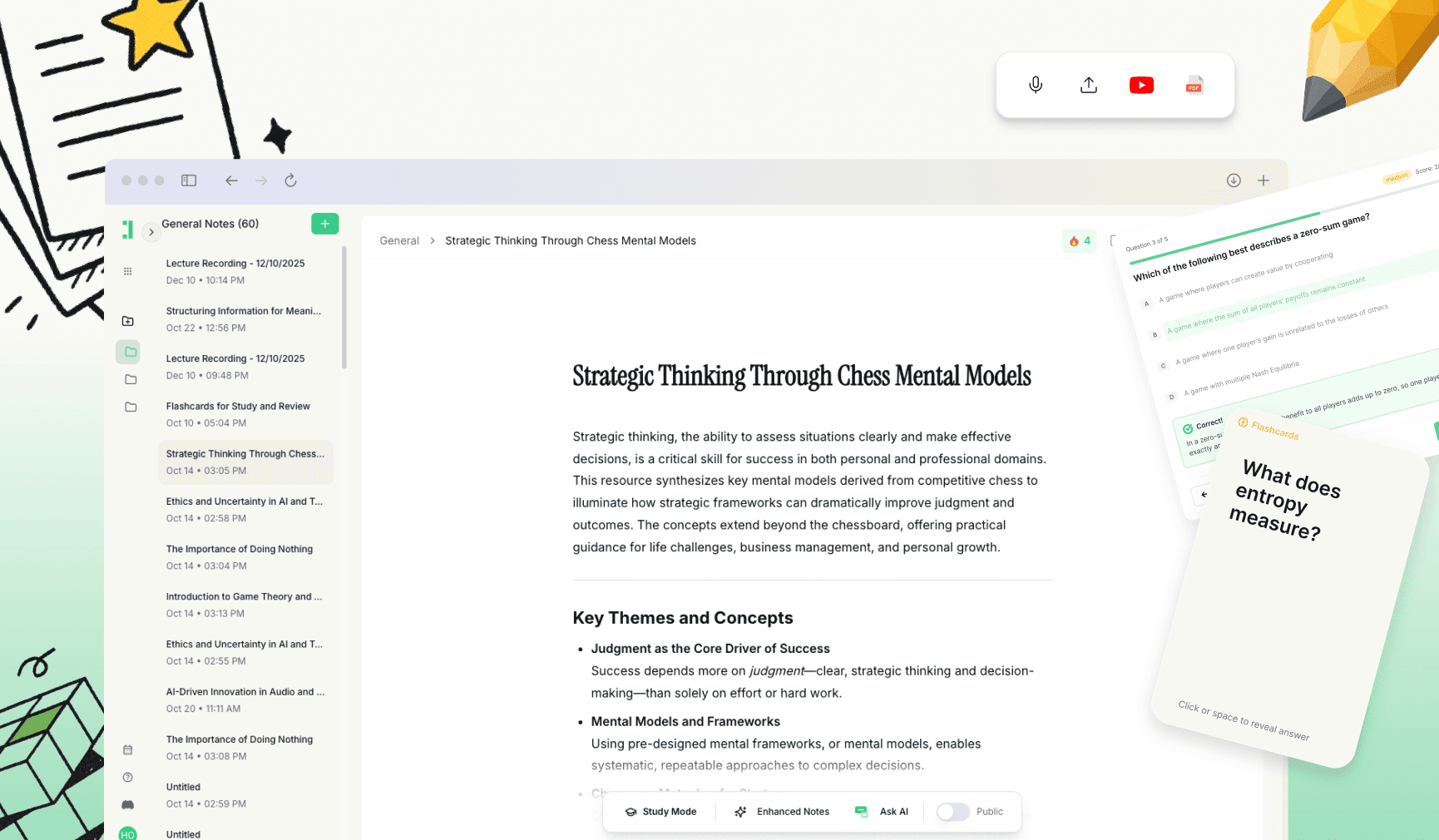
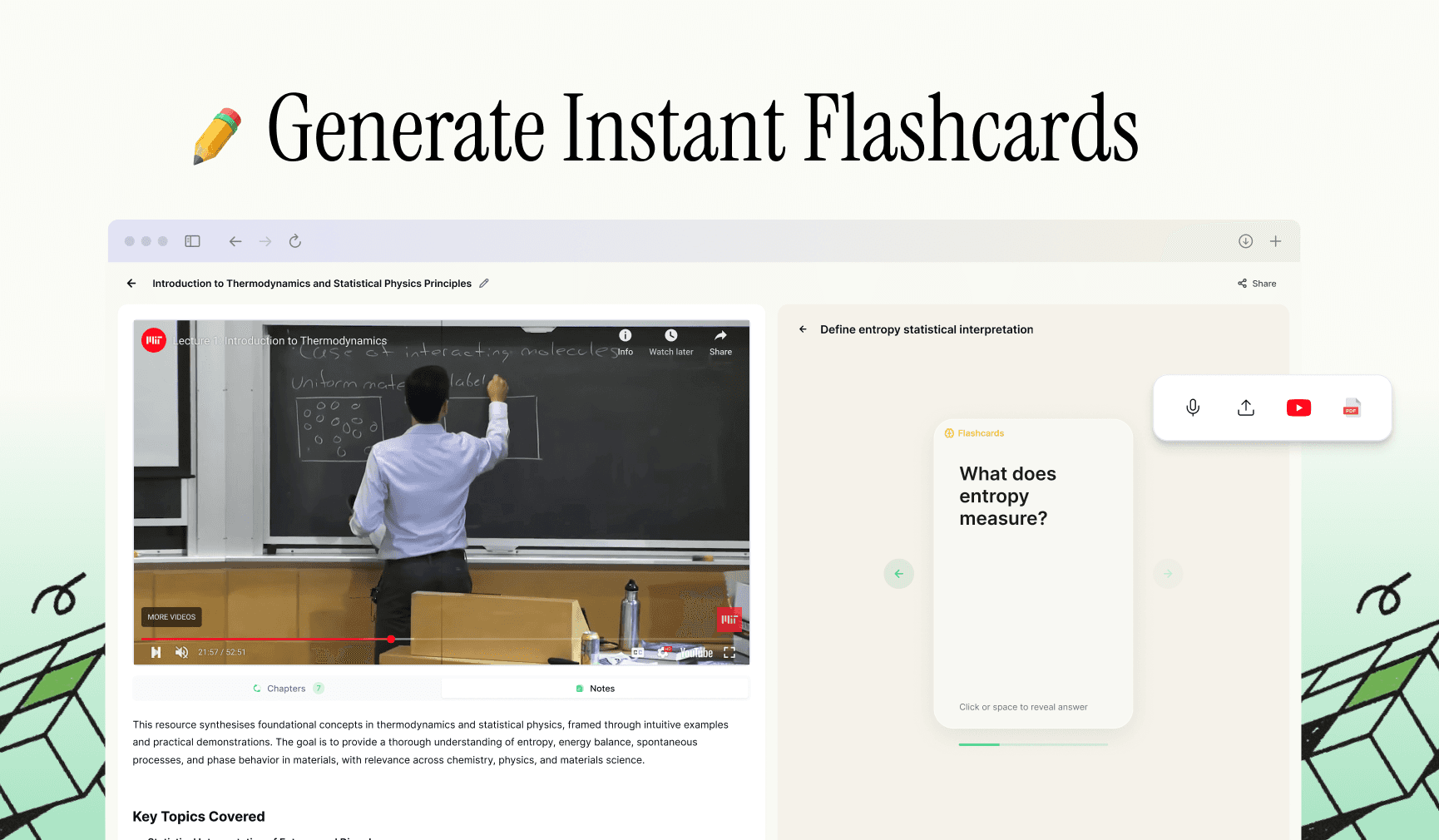
Making engineering flashcards manually is a pain. You have to type out complex formulas, draw diagrams, and organize hundreds of terms—which often takes longer than actually studying. Duetoday eliminates this friction. Simply upload your Fluid Mechanics PDF, lecture notes, or slides, and our AI identifies the core concepts to create a structured deck for you. Start with your notes and get a deck you can actually use today.
Common Fluid Mechanics flashcard mistakes
Cards are too long: Don't put the whole Navier-Stokes derivation on one card; break it into individual steps.
Ignoring units: Always include the units for constants (like density or viscosity) on the back of the card.
Only memorizing formulas: Ensure you have cards that explain the physical reality behind the math.
No review schedule: Don't wait until the night before the exam; review your fluid properties regularly.
FAQ
How many flashcards do I need for Fluid Mechanics? Typically, a single chapter might require 20-40 cards. A full semester course usually results in a deck of 200-300 cards covering everything from statics to compressible flow.
What’s the best format for these flashcards? Question-and-answer format is best. Use the front for the concept or variable and the back for the definition, formula, and units.
How often should I review? Aim for 15-20 minutes daily. Spaced repetition works best when you touch the material frequently rather than in one long session.
Should I make cards from a textbook or slides? Use both. Slides usually highlight what the professor thinks is important for the exam, while textbooks provide the formal definitions and constants.
How do I stop forgetting formulas? Use 'cloze deletion' cards where you leave a blank space in the formula (e.g., F = P * _ ) to force your brain to fill in the missing piece.
Can I generate flashcards from a PDF? Yes, Duetoday is designed to read your Fluid Mechanics PDFs and extract the most relevant terms and equations into cards automatically.
Are digital cards better than paper? For engineering, digital is often better because you can easily include complex diagrams and use AI to organize your study schedule.
How long does it take to create a deck? Manually, it can take hours. With Duetoday, you can generate a full chapter's worth of cards in under 60 seconds.

Duetoday is an AI-powered learning OS that turns your study materials into personalised, bite-sized study guides, cheat sheets, and active learning flows.