Generate Flashcards for Evolution
Generate evolution flashcards in seconds! Turn notes into study decks. Try it for free today.
Generate Flashcards with AI Free
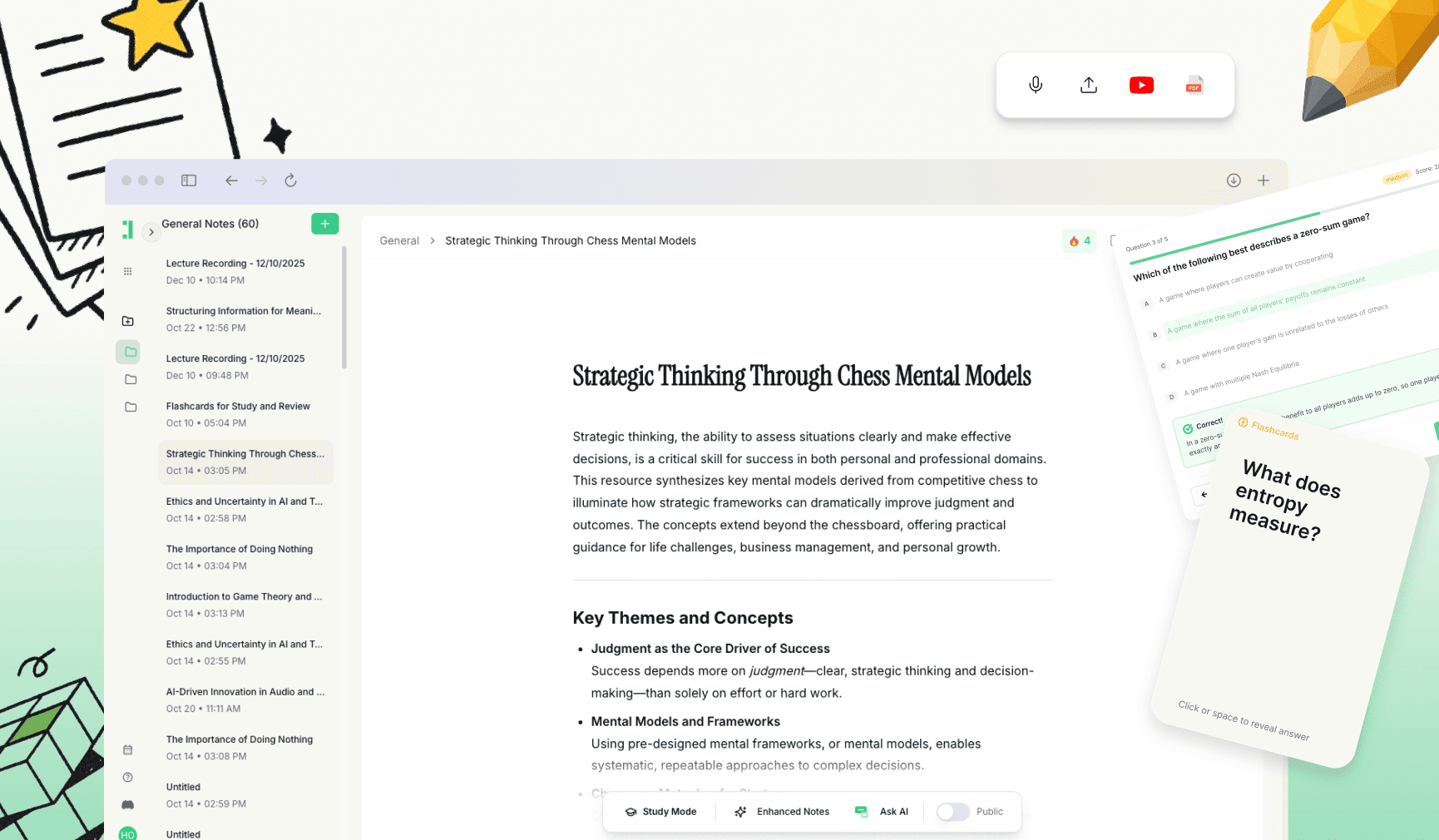
Turn Your Evolution Notes into High-Quality Flashcards
Turn your notes, PDFs, slides, or lectures into evolution flashcards so you can review faster and remember more. Whether you are studying Darwinian theory or molecular clock hypothesis, our AI helps you focus on what matters most.
Generate Evolution FlashcardsUpload notes / paste text
In Duetoday, the process is simple: upload your materials or paste your lecture notes, and our AI instantly generates a comprehensive deck. You can then review, edit, and begin your study session immediately to maximize retention.
What are evolution flashcards?
Evolution flashcards cover the fundamental principles of biological change over time, including key terms like natural selection, adaptation, speciation, and common descent. They break down complex mechanisms like the Hardy-Weinberg equilibrium or evolutionary developmental biology into digestible bites.
Instead of passively rereading your textbook, these flashcards force you to pull information from your memory. This builds stronger neural connections and helps you identify exactly which concepts—like the difference between homologous and analogous structures—you haven't mastered yet.
Soft CTA: If you already have notes, Duetoday can generate a clean deck in minutes.
Why flashcards are one of the best ways to study evolution
Evolution is a subject built on specific vocabulary, chronological sequences, and the application of rules to biological scenarios. Flashcards are perfectly suited for this because they promote active recall and spaced repetition, moving information from short-term to long-term memory.
Remember key terms like 'allopatric speciation' without cramming.
Separate similar concepts, such as bottleneck effect vs. founder effect.
Learn evolutionary timelines and fossil record sequences step-by-step.
Practice applying natural selection rules to hypothetical populations.

What to include in your evolution flashcards
Effective evolution flashcards follow the principle of 'one idea per card.' By keeping questions specific, you avoid the trap of recognizing a paragraph without actually knowing the material.
Definitions & key terms: "What is genetic drift?" or "Define fitness in an evolutionary context."
Processes & steps: "What are the four conditions required for natural selection?"
Comparisons: "How does microevolution differ from macroevolution?"
Application: "If a population is in Hardy-Weinberg equilibrium, what happens to allele frequencies over time?"
How to study evolution with flashcards (a simple system)
Use a two-pass approach to master the material. First, use Duetoday to build your deck from your syllabus or notes. Then, perform a 'diagnostic' round where you go through every card once to see what you know.
Focus your energy on the cards you miss. Modern study science shows that reviewing these 'weak' cards in short, daily bursts is far more effective than an 8-hour marathon session the night before a biology exam.
Make a deck from your notes (or generate it from content).
Do one quick round to find weak spots.
Review weak cards daily for a few days.
Mix in a few harder cards each session.
Do a final mixed review before quizzes/exams.
Generate evolution flashcards automatically in Duetoday
Making cards manually is slow, messy, and often results in cards that are too long to be useful. Duetoday automates the tedious part so you can get straight to the learning. Upload your PDF, lecture slides, or even a transcript of a video, and let the AI extract the core concepts for you.
Upload or paste your evolution material.
Click Generate Flashcards.
Review, edit, and start studying.
Common evolution flashcard mistakes (and how to fix them)
Many students create cards that are too wordy, which leads to 'recognition' rather than 'recall.' If you see a wall of text, your brain picks out keywords without understanding the process. Break complex topics like the 'endosymbiotic theory' into smaller, sequential questions. Also, ensure you aren't just memorizing definitions—create cards that ask why a certain evolutionary pressure leads to a specific outcome.
FAQ
How many flashcards do I need for evolution? Usually, a comprehensive unit on evolution requires 50–100 cards to cover all mechanisms, evidence, and historical theories.
What’s the best format for evolution flashcards? Question and answer format works best, especially for 'Selection' types and 'Species' definitions.
How often should I review evolution flashcards? Review new cards daily for the first three days, then extend the interval as you become more confident.
Should I make cards from a textbook or slides? Both are useful, but lecture slides usually highlight the specific concepts your professor deems exam-worthy.
How do I stop forgetting evolution terms? Use Duetoday's spaced repetition system to ensure you're prompted to review a term just as you're about to forget it.
What if my flashcards feel too easy? Try adding 'Application' cards where you have to predict an outcome based on a scenario.
Can I generate evolution flashcards from a PDF? Yes, Duetoday can process biology textbooks and research PDFs into structured flashcard decks instantly.
Are digital flashcards better than paper? Yes, because digital tools can track your progress and automatically re-show you the cards you struggle with most.
How long does it take to make a full evolution deck? Manually it could take hours; with Duetoday, it takes less than a minute.
Can Duetoday organize my flashcards? Yes, Duetoday categorizes your cards by topic so you can focus your study sessions on specific themes within evolution.

Duetoday is an AI-powered learning OS that turns your study materials into personalised, bite-sized study guides, cheat sheets, and active learning flows.