Generate Flashcards for Enzymology
Make and generate Enzymology flashcards to master enzyme kinetics, inhibition, and biochemistry through active recall.
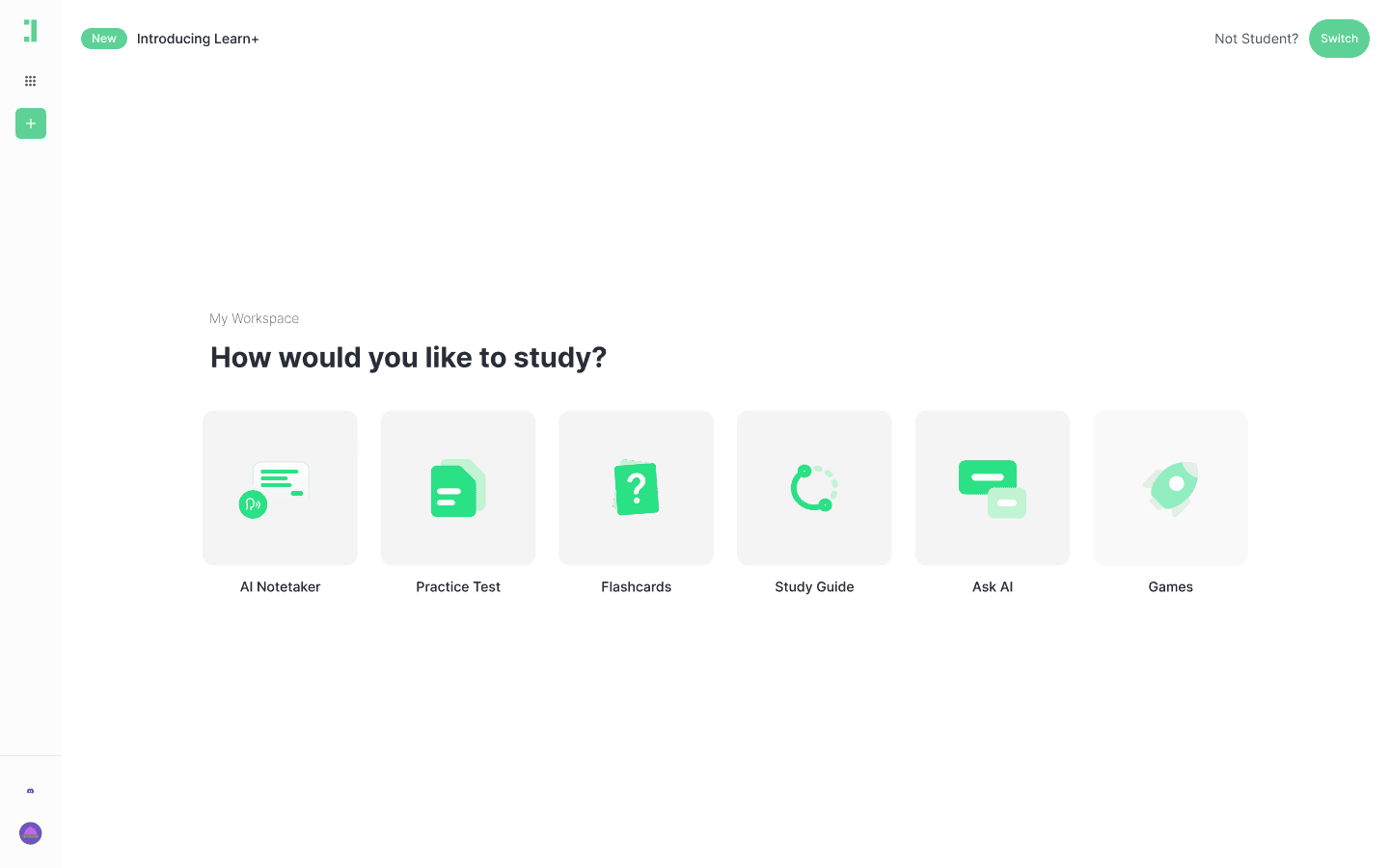
Generate Flashcards with AI Free
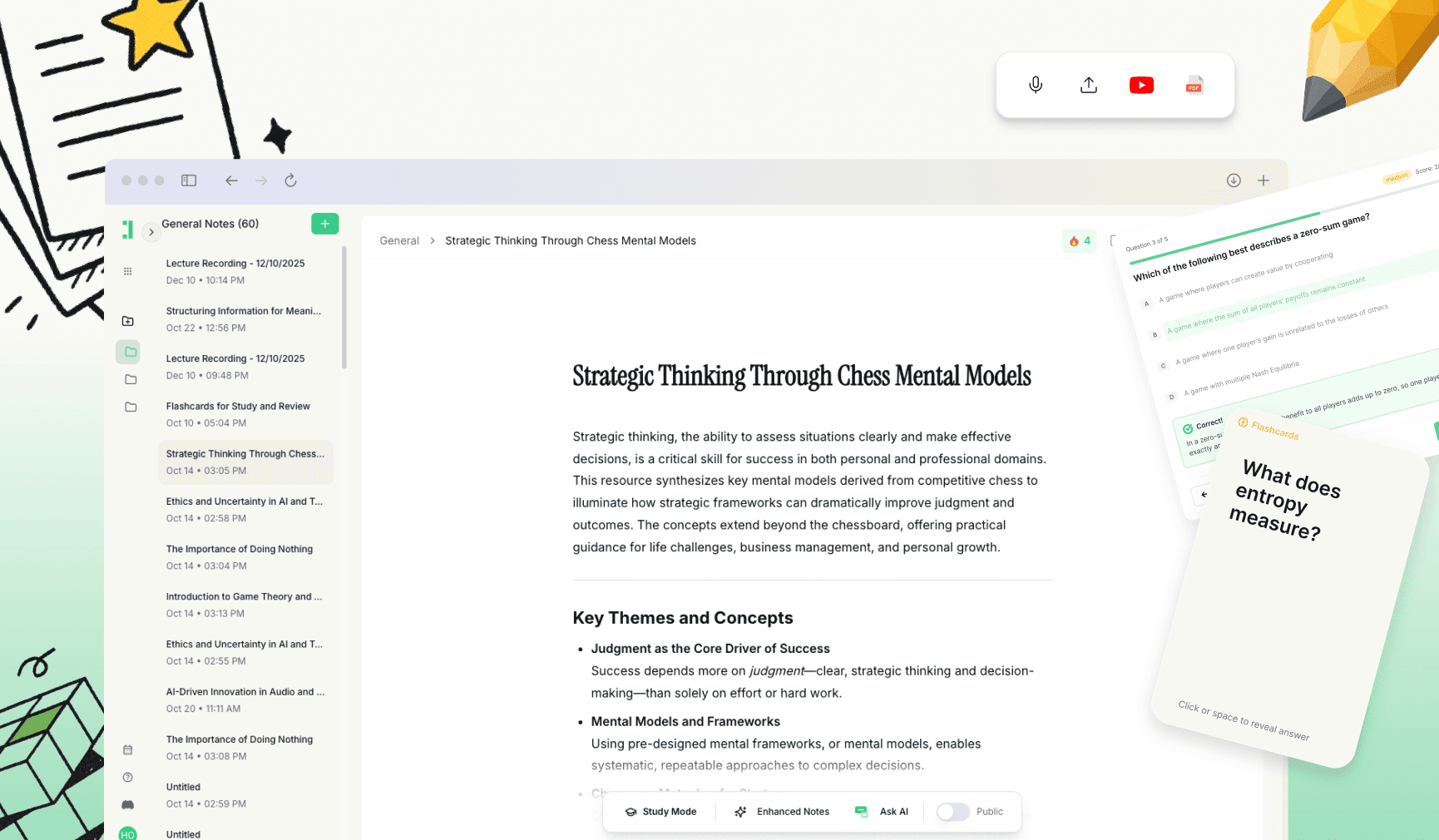
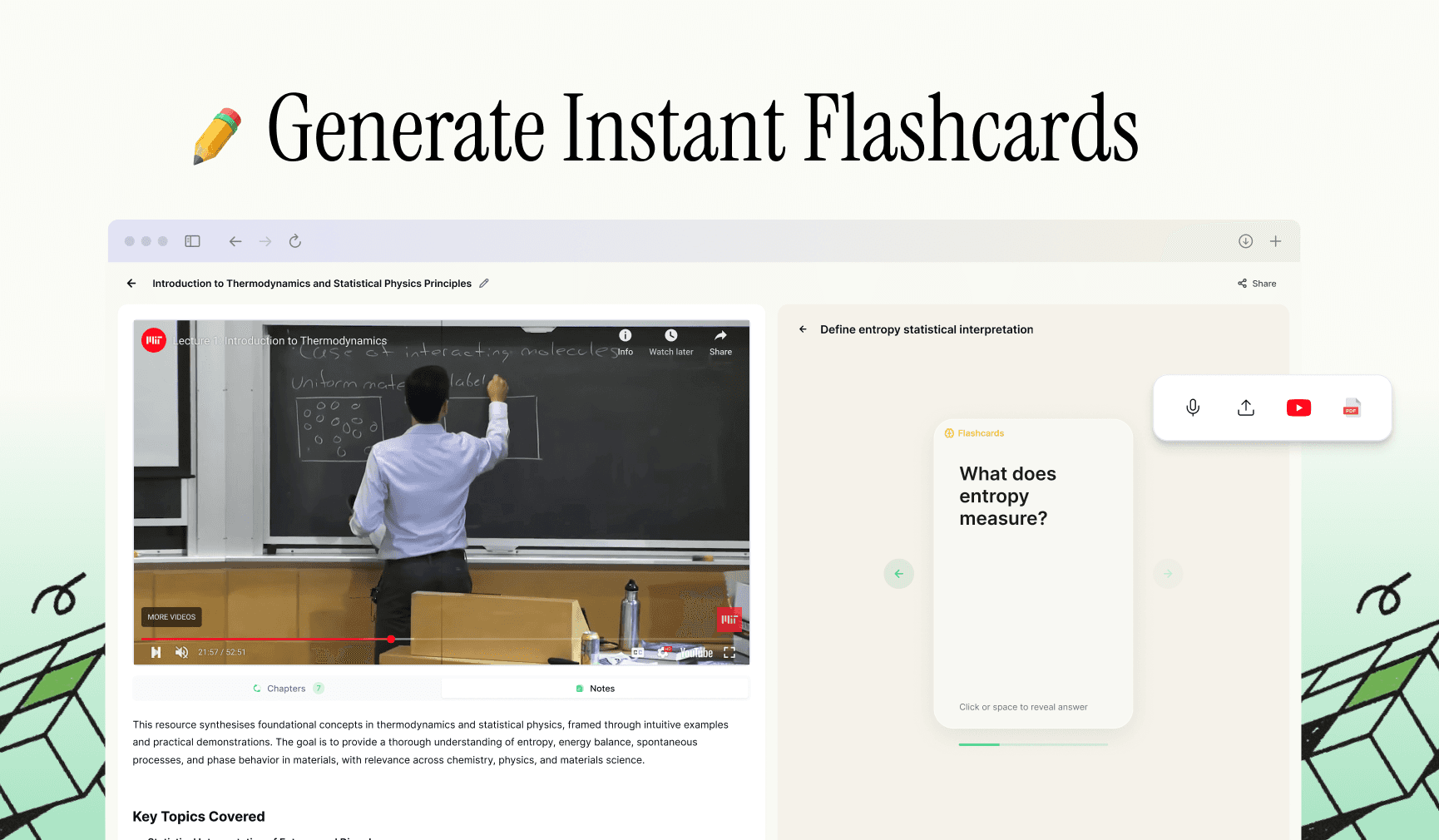
Turn your notes, PDFs, slides, or lectures into Enzymology flashcards so you can review faster and remember more.
Stop spending hours manually writing out complex biochemical pathways and kinetics formulas. With Duetoday, you can upload your study materials and instantly generate organized flashcards designed to help you master the science of enzymes.
Generate Enzymology FlashcardsUpload notes / paste text
In Duetoday, the process is simple: you upload your source material, our AI generates a structured deck, and you review or edit the cards before starting your study session.
What are Enzymology flashcards?
Enzymology flashcards cover the specific mechanisms, classification, and kinetics of biological catalysts. They break down complex topics like the Michaelis-Menten equation, types of reversible and irreversible inhibition, and the structural components of active sites into bite-sized, testable questions.
The outcome is a shift from passive reading to active testing. Instead of looking at a diagram of an induced fit model, you are forced to explain the concept from memory, which builds significantly stronger neural pathways. If you already have notes, Duetoday can generate a clean deck in minutes.
Why flashcards are one of the best ways to study Enzymology
Enzymology requires a mix of rote memorization for nomenclature and deep conceptual understanding for kinetics and thermodynamics. Flashcards bridge this gap by forcing you to recall specific details without the help of context clues from your textbook.
By using active recall and spaced repetition, you ensure that you don't just recognize an enzyme name, but that you can actually explain its function and regulatory mechanisms on command.
Remember key terms like apoenzyme, holoenzyme, and prosthetic groups without cramming.
Separate similar concepts like competitive vs. non-competitive inhibition.
Learn multi-step catalytic cycles and metabolic pathways step-by-step.
Practice applying the Michaelis-Menten formula to solve for Vmax or Km quickly.
What to include in your Enzymology flashcards
Effective flashcards follow the atomic rule: one specific idea per card. When studying enzymes, you should focus on question-based prompts that require an active explanation rather than just a definition.
We recommend using four main card types to cover the subject comprehensively: definitions for terminology, processes for catalytic mechanisms, comparisons for inhibitors, and application for kinetics problems.
Definitions: What is the turnover number (kcat)?
Processes: What are the four stages of the catalytic cycle for chymotrypsin?
Comparisons: How does uncompetitive inhibition affect Vmax compared to non-competitive?
Application: If the substrate concentration is much higher than Km, what is the reaction rate?
Example prompts: Define the Lineweaver-Burk plot, What is the role of a cofactor in enzyme activity? or Explain the transition state theory.
How to study Enzymology with flashcards (a simple system)
Mastering this subject requires a two-pass approach. First, build your deck based on your specific course syllabus, then review it in focused rounds to identify your knowledge gaps.
Instead of an all-night cram session, use short, frequent reviews. This allows your brain to consolidate the complex mathematical relationships found in enzyme kinetics over time.
Make a deck from your notes or generate it automatically from your textbook PDFs.
Do one quick round to find weak spots, such as specific inhibition types.
Review weak cards daily for three to five days.
Mix in a few harder kinetics formulas in each session to maintain proficiency.
Do a final mixed review of all enzyme classes before your exam.
Generate Enzymology flashcards automatically in Duetoday
Making cards manually is slow, messy, and inconsistent. When you're dealing with complex chemical structures and mathematical proofs, handwriting cards can take hours away from actual studying. Duetoday simplifies this by converting your study materials into ready-to-use flashcards instantly.
Upload or paste your Enzymology lecture slides, notes, or research papers.
Click Generate Flashcards to let the AI analyze the key concepts.
Review, edit, and start studying your custom deck immediately.
Generate Enzymology Flashcards in Duetoday
Start with your notes and get a deck you can actually use today.
Common Enzymology flashcard mistakes (and how to fix them)
The most common mistake students make is creating cards that are too wordy. If a card contains an entire paragraph about the induced-fit model, you'll likely stop reading it and start skimming.
Cards are too long: Split complex mechanisms into one idea per card.
Only memorizing words: Add Why? prompts to understand the logic behind enzyme regulation.
Confusing Vmax and Km: Create specific comparison cards to highlight their differences.
No review schedule: Ensure you repeat the tough cards more often than the easy ones.
Ready to generate your Enzymology flashcards?
Don't waste time rereading. Upload your notes, generate a deck, and start mastering enzyme kinetics with active recall.
Start Generating Flashcards
Works with notes, PDFs, slides, and transcripts.
FAQ
How many flashcards do I need for Enzymology? Most introductory courses require between 150 to 300 cards to cover all enzyme classes, kinetics formulas, and metabolic regulations effectively.
What’s the best format for Enzymology flashcards? A mix of Front/Back definitions and Clozure (fill-in-the-blank) cards for formulas and chemical pathways works best for this subject.
How often should I review Enzymology flashcards? Ideally, review your deck daily for at least 15 minutes. Use spaced repetition so that you see the harder kinetics cards more frequently.
Should I make cards from a textbook or slides? Use lecture slides for the core concepts emphasized by your professor, and use the textbook to fill in details on specific catalytic mechanisms.
How do I stop forgetting enzyme names after a few days? Group enzymes by their class (e.g., Hydrolases, Ligases) and use flashcards to test both the name and the specific reaction they catalyze.
What if my flashcards feel too easy? If you are getting every card right, start adding Application cards where you have to predict how an enzyme would behave under different pH or temperature conditions.
Can I generate Enzymology flashcards from a PDF automatically? Yes, Duetoday allows you to upload any Enzymology PDF and will extract the key terms, mechanisms, and formulas into a study-ready deck.
Are digital flashcards better than paper for Enzymology? Digital cards are generally better because they allow for the easy integration of complex diagrams and the use of automated spaced repetition algorithms.
How long does it take to make a full Enzymology deck? Manually it could take 5-10 hours, but with Duetoday’s AI generation, you can have a comprehensive deck ready in less than 2 minutes.
Can Duetoday organize my flashcards for me? Yes, Duetoday categorizes your generated cards by sub-topic, such as Kinetics, Inhibition, and Specific Mechanisms, to keep your study sessions organized.

Duetoday is an AI-powered learning OS that turns your study materials into personalised, bite-sized study guides, cheat sheets, and active learning flows.