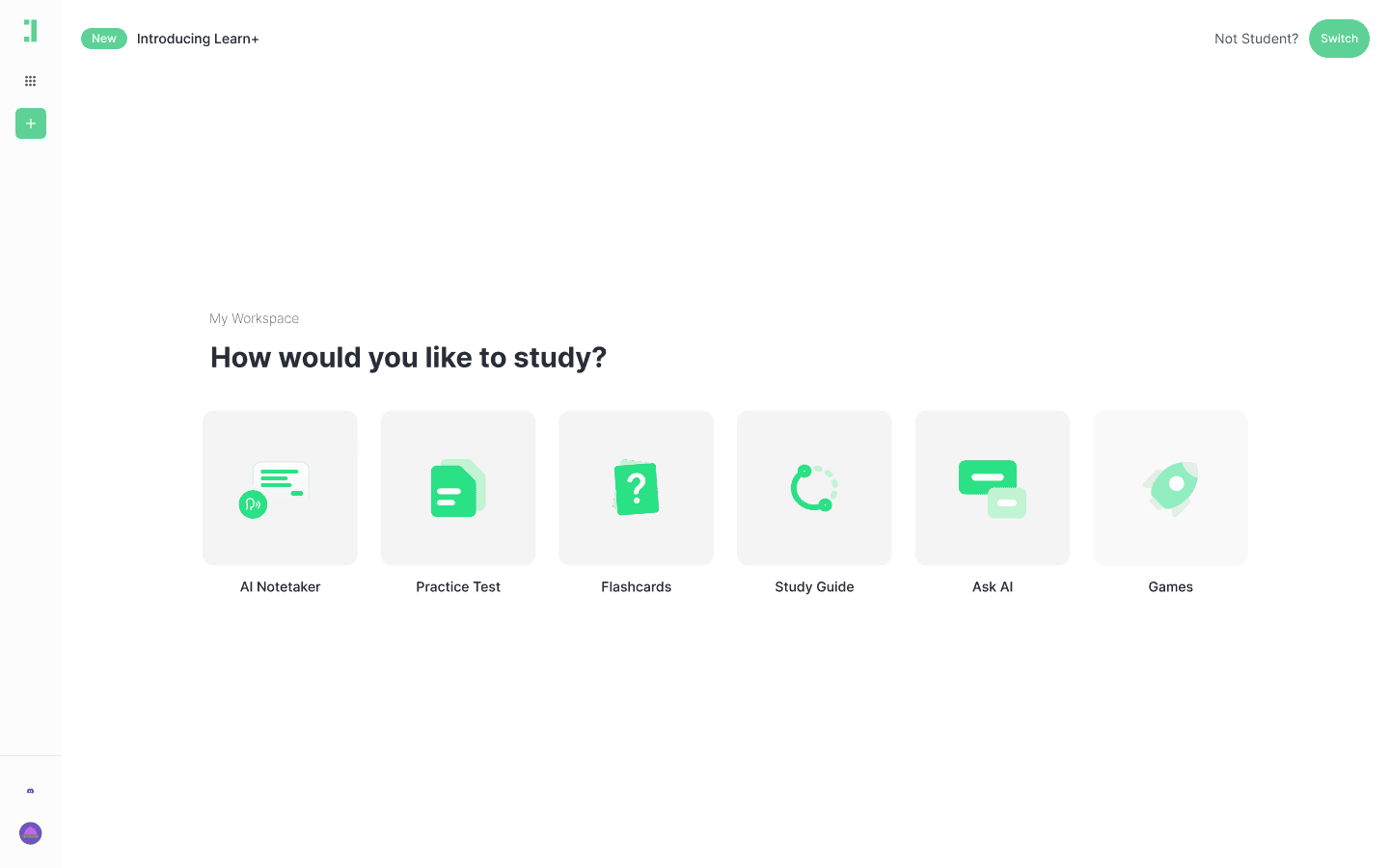
Generate Flashcards for Enzymes
Generate high-quality Enzyme flashcards in seconds using AI. Try it for free today!
Generate Flashcards with AI Free
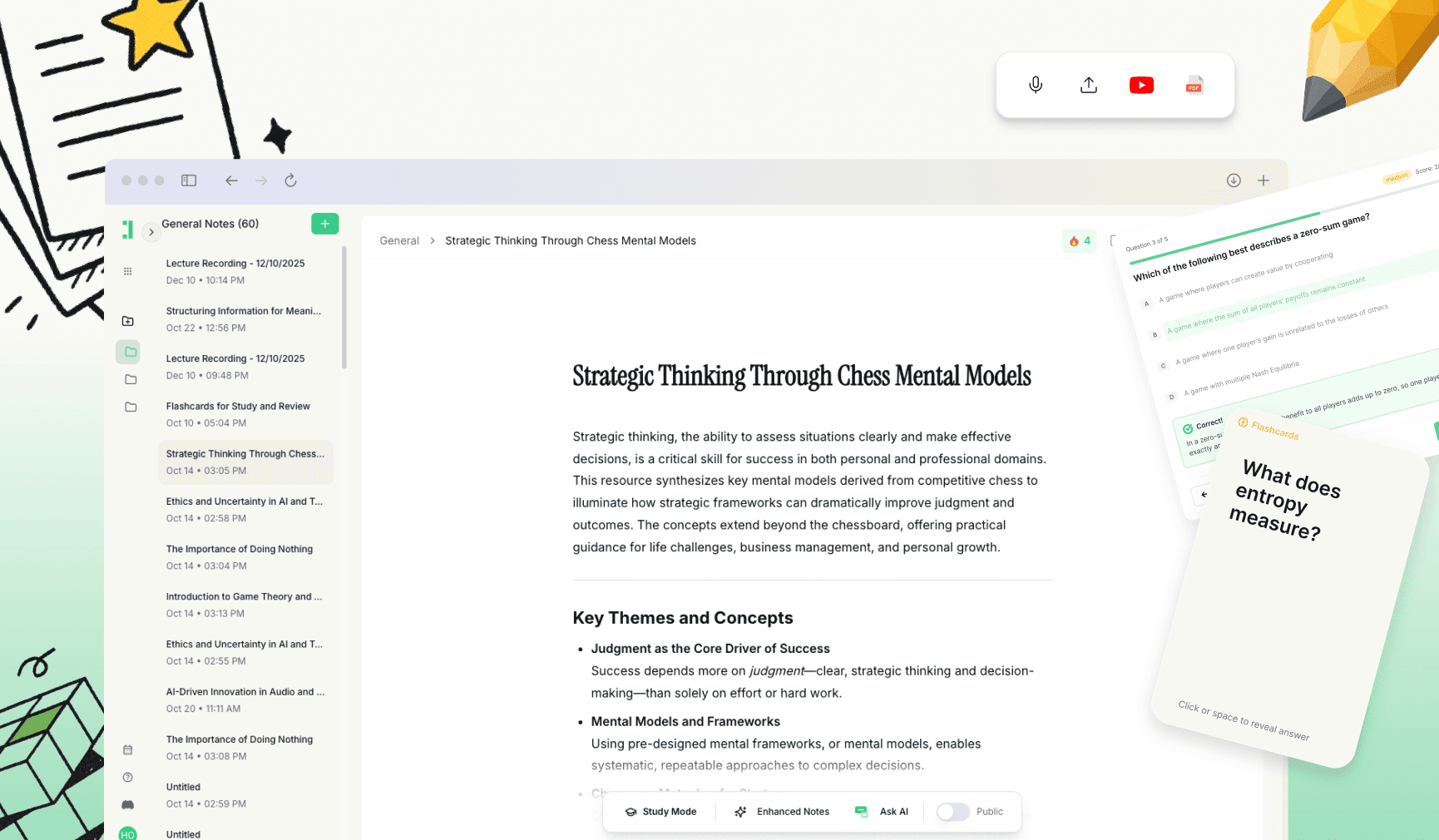
Generate Flashcards for Enzymes
Turn your notes, PDFs, slides, or lectures into Enzymes flashcards so you can review faster and remember more. Mastering complex biological catalysts doesn't have to mean hours of manual card-making.
Generate Enzymes FlashcardsUpload notes / paste text
In Duetoday, the process is seamless: simply upload your biology materials, and our AI instantly generates a comprehensive deck. You can then review, edit, and begin your study session immediately to lock in key concepts.
What are Enzymes flashcards?
Enzymes flashcards are targeted study tools that cover the essential mechanics of biological catalysts. They focus on key terms like substrates and active sites, reaction formulas, the steps of the induced-fit model, and the critical differences between various types of inhibition.
The outcome is a shift from passive reading to active testing. Instead of rereading a textbook chapter on metabolic pathways, you test your knowledge of how temperature, pH, and concentration affect reaction rates, building stronger neural pathways for long-term recall.
If you already have notes, Duetoday can generate a clean deck in minutes.
Why flashcards are one of the best ways to study Enzymes
Enzymes require a mix of rote memorization for nomenclature and deep conceptual understanding for kinetics. Flashcards force your brain to retrieve this information under pressure, which is exactly what happens during an exam.
By using active recall and spaced repetition, you ensure that you aren't just recognizing the word "allosteric," but actually explaining how it regulates a pathway without looking at your notes.
Remember complex suffix-based names without cramming
Separate similar concepts (e.g., Competitive vs. Non-competitive inhibition)
Learn catalytic processes step-by-step (E-S complex formation to product release)
Practice applying the Michaelis-Menten constant (Km) quickly
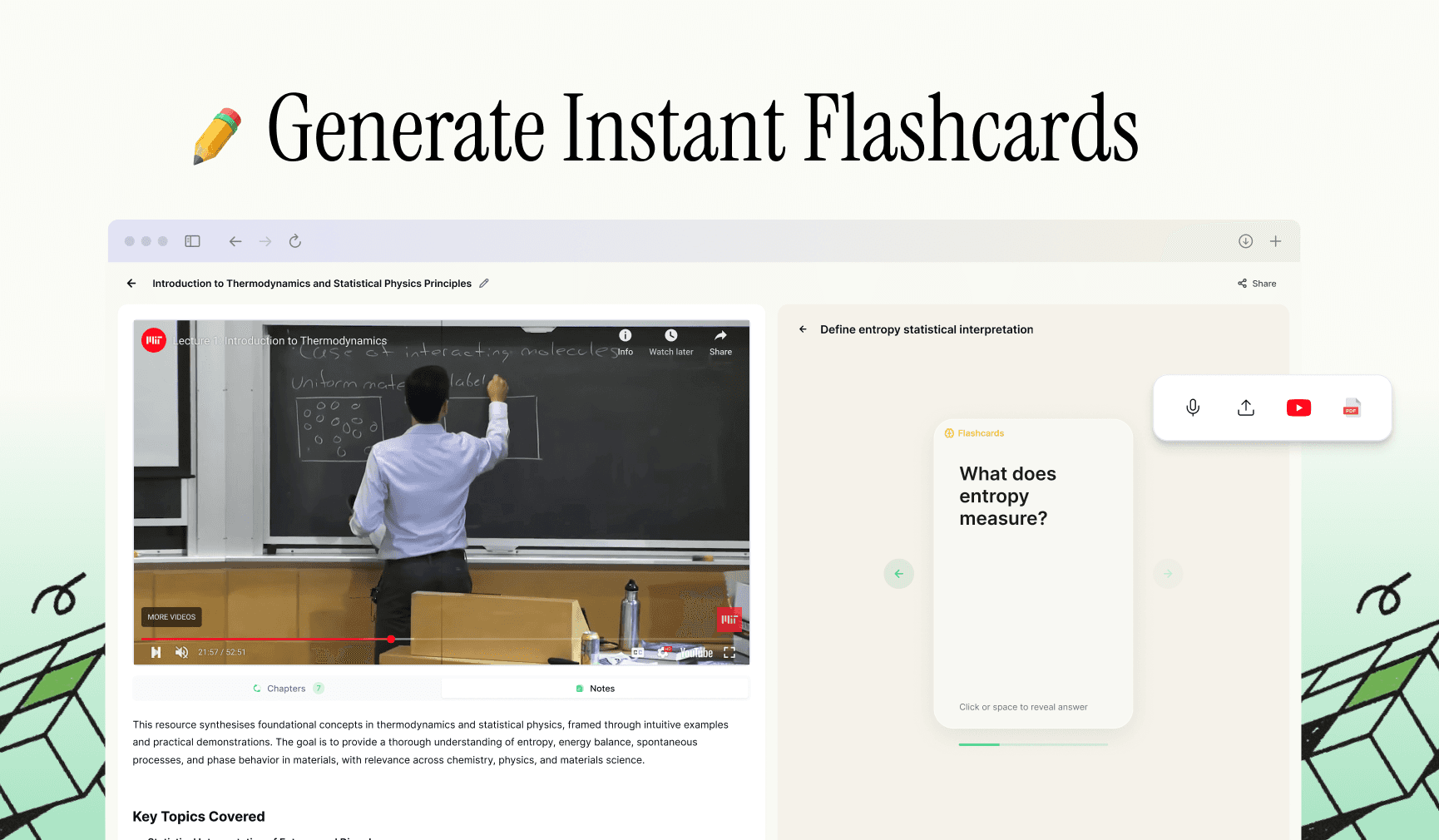
What to include in your Enzymes flashcards
Effective flashcards follow the "atomic" rule: one idea per card. Convert your dense biology paragraphs into specific questions that trigger a single, clear answer.
Definitions & key terms: "What is the activation energy?" "Define a coenzyme."
Processes & steps: "What happens to the enzyme shape in the induced-fit model?"
Comparisons: "How is an apoenzyme different from a holoenzyme?"
Application: "What happens to Vmax if the temperature exceeds the optimum?"
Example prompts for your deck:
Define the 'Active Site'.
What is the function of a ribozyme?
List three factors that lead to protein denaturation.
What does a high Km value indicate about enzyme affinity?
Identify the role of a prosthetic group.
How does a non-competitive inhibitor affect Vmax?
How to study Enzymes with flashcards (a simple system)
Start with a "two-pass" approach. Use your first pass to build the deck and gauge your baseline knowledge, then move into focused rounds to master the content.
Make a deck from your notes (or generate it from content using Duetoday).
Do one quick round to find weak spots (e.g., specific inhibition types).
Review weak cards daily for a few days until they feel easy.
Mix in a few harder cards, like enzymatic equations, each session.
Do a final mixed review before your midterm or final exam.
Generate Enzymes flashcards automatically in Duetoday
Making cards manually is slow and often results in cards that are too wordy to be useful. Duetoday automates the tedious part so you can focus on learning.
Upload or paste your Enzymes material (PDFs, slides, or transcripts)
Click "Generate Flashcards"
Review, edit, and start studying immediately
Generate Enzymes Flashcards in Duetoday
Start with your notes and get a deck you can actually use today.
Common Enzymes flashcard mistakes (and how to fix them)
Cards are too long: Don't put the whole catalytic cycle on one card; split it into stages.
Only memorizing definitions: Add "why" prompts, such as "Why do enzymes lower activation energy?"
Confusing the 'inhibitions': Create comparison cards specifically for Competitive vs. Uncompetitive.
Ignoring graphs: Include cards that ask you to describe the slope of a Lineweaver-Burk plot.
Ready to generate your Enzymes flashcards?
Stop rereading your biology textbook. Upload your notes, generate your deck, and start mastering enzyme kinetics with active recall.
Start Generating Flashcards
Works with notes, PDFs, slides, and transcripts.
FAQ
How many flashcards do I need for Enzymes?
A solid introductory deck usually consists of 40-60 cards covering definitions, kinetics, and regulation. Advanced biochemistry may require 100+ cards.
What’s the best format for Enzymes flashcards?
Question-and-answer is best. One side should ask a specific question like "How does pH affect enzyme structure?" rather than just saying "Enzymes and pH."
How often should I review Enzymes flashcards?
Review daily leading up to an exam. Once mastered, use spaced repetition to review them once every few weeks to keep the knowledge fresh.
Should I make cards from a textbook or lecture notes?
Both. Use lecture notes for what your professor emphasizes and textbooks to clarify complex mechanisms like allosteric regulation.
How do I stop forgetting enzyme names after a few days?
Review the cards using active recall. Don't just look at the answer; say it out loud before flipping the card.
What if my flashcards feel too easy?
If they feel easy, move to application questions. Instead of "What is an inhibitor?", ask "How would you reverse the effects of a competitive inhibitor?"
Can I generate Enzymes flashcards from a PDF automatically?
Yes, Duetoday can scan your biology PDFs or lab manuals and instantly extract key concepts into a structured flashcard deck.
Are digital flashcards better than paper for Enzymes?
Digital cards are generally better because they allow for easier organization and use algorithms to show you the cards you struggle with more often.
How long does it take to make a full Enzymes deck?
Manually, it can take hours. With Duetoday's AI, you can generate a high-quality deck in under 60 seconds.
Can Duetoday help me organize my Enzymes cards by sub-topic?
Yes, you can tag or categorize your cards into groups like 'Kinetics,' 'Inhibition,' and 'Classification' for more focused study sessions.

Duetoday is an AI-powered learning OS that turns your study materials into personalised, bite-sized study guides, cheat sheets, and active learning flows.