Generate Flashcards for Environmental Chemistry
Make and generate Environmental Chemistry flashcards to study chemical cycles, pollutants, and reaction pathways with ease.
Generate Flashcards with AI Free
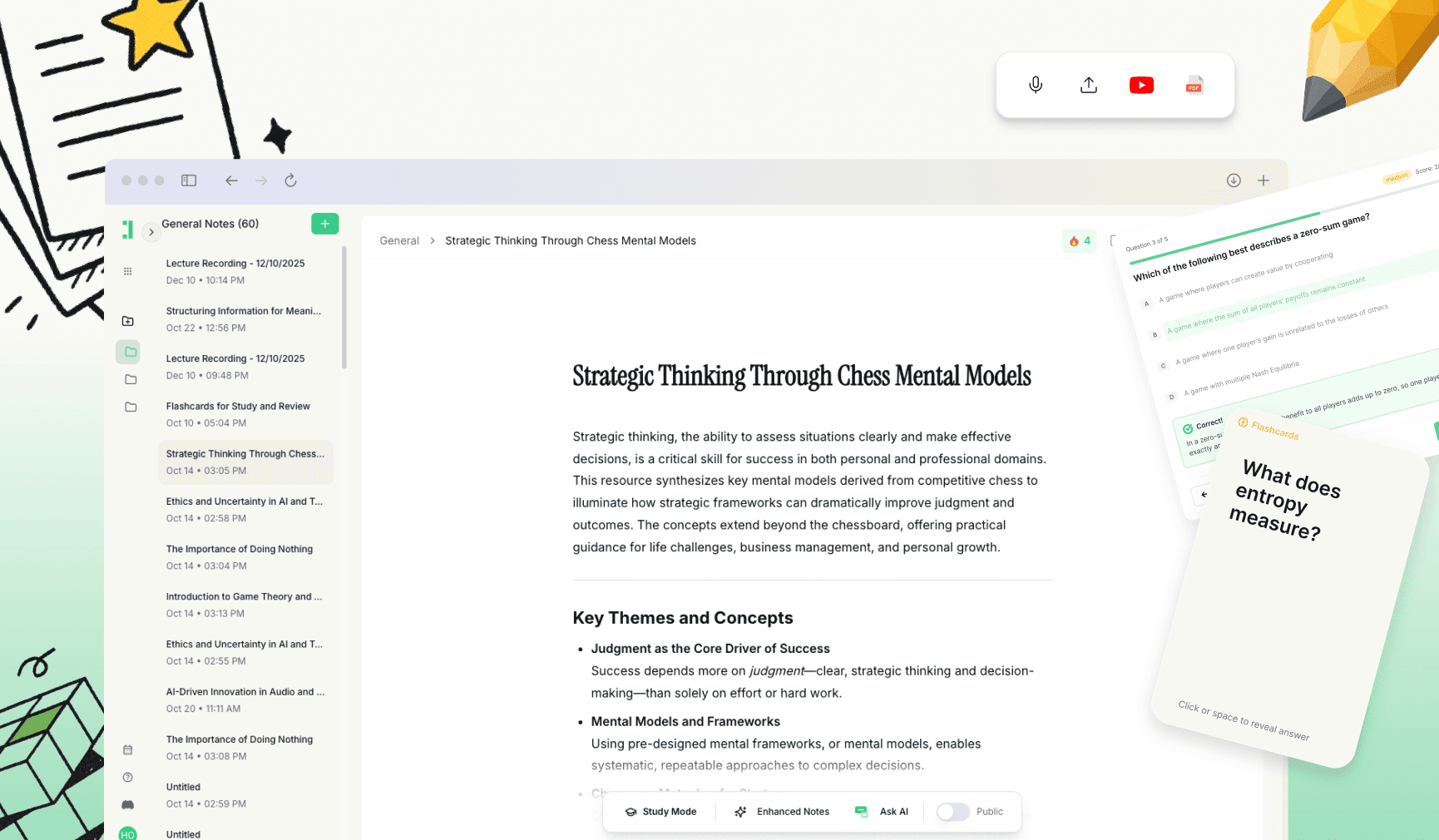
What are Environmental Chemistry flashcards?
Environmental Chemistry flashcards are targeted study tools that break down the complex chemical processes occurring in our soil, water, and atmosphere into bite-sized, digestible questions. These cards cover essential topics such as aquatic chemistry, thermodynamic cycles, pollutant degradation, and green chemistry principles.
Instead of passively rereading dense textbooks, these flashcards force you to engage in active recall. By testing your knowledge on specific reactions or environmental regulations, you build stronger neural pathways and ensure you can retrieve this information during exams. If you already have lecture notes or lab reports, Duetoday can generate a clean, organized deck in minutes.
Why flashcards are one of the best ways to study Environmental Chemistry
Environmental Chemistry requires a mix of memorizing specific chemical structures and understanding broad ecological cycles. Flashcards bridge this gap by allowing you to isolate individual variables and see how they interact within a system. They help you master the nomenclature of pollutants while simultaneously practicing the stoichiometry of atmospheric reactions.
Remember complex chemical cycles (Nitrogen, Carbon, Phosphorus) without cramming.
Separate similar concepts like Bioaccumulation vs. Biomagnification.
Learn degradation pathways step-by-step for organic pollutants.
Practice applying environmental formulas for pH, alkalinity, and gas solubility.
What to include in your Environmental Chemistry flashcards
The most effective Environmental Chemistry flashcards follow the atomic rule: one idea per card. This prevents you from glazing over complex details. Your deck should balance theoretical definitions with practical application scenarios to simulate real-world environmental monitoring.
Definitions & Key Terms: What is the definition of Chemical Oxygen Demand (COD)?
Processes & Steps: What are the four stages of wastewater treatment?
Comparisons: How does Stratospheric Ozone differ from Tropospheric Ozone?
Application: What happens to the solubility of CO2 in water as temperature increases?
Example prompts for your deck: 'Identify the primary source of anthropogenic SO2', 'Explain the Greenhouse Effect in three sentences', or 'Calculate the pOH of a solution with a given H+ concentration'.
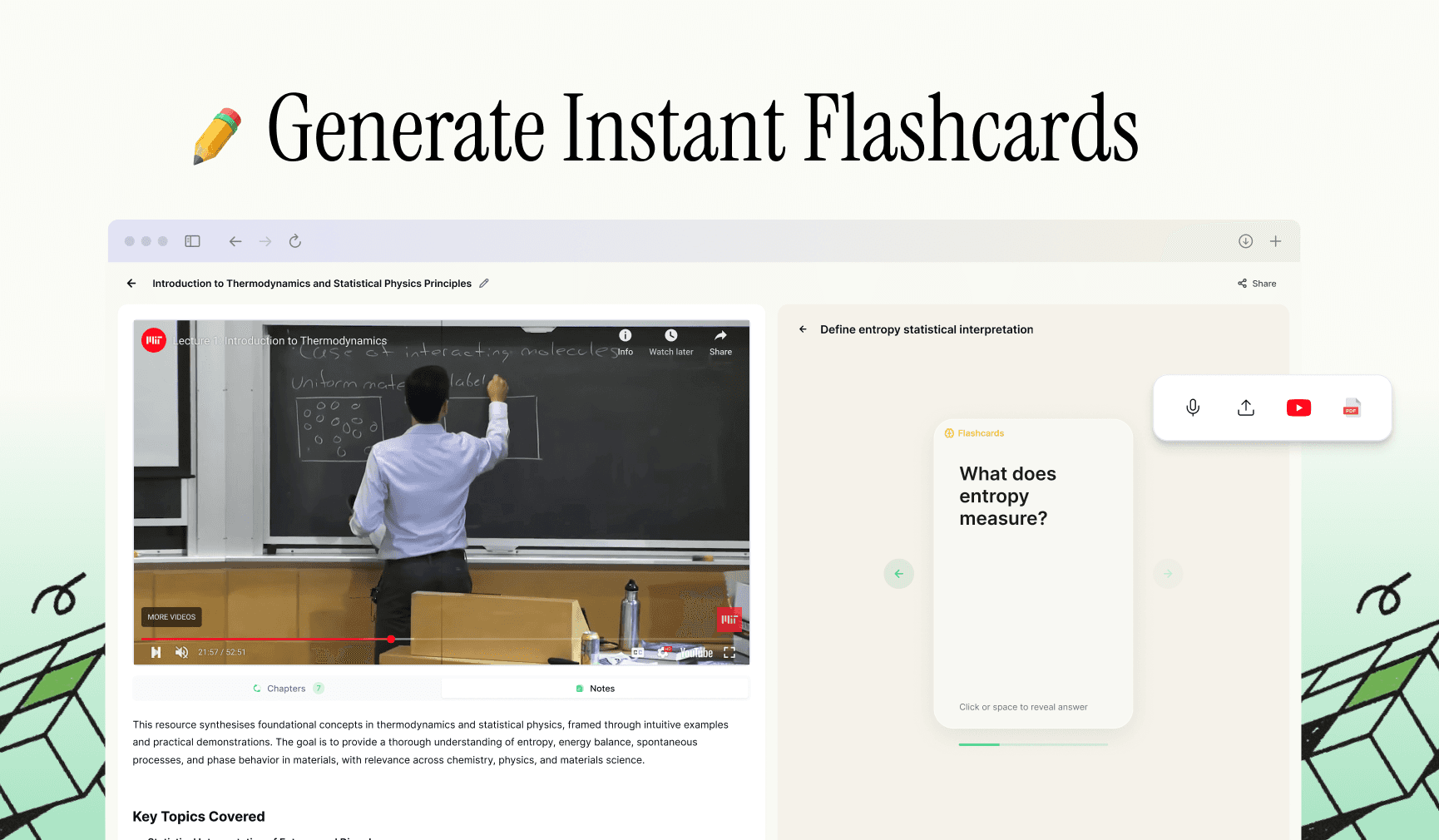
How to study Environmental Chemistry with flashcards
Success in Environmental Chemistry comes from consistency. Start with a two-pass approach: first, use Duetoday to build a comprehensive deck from your syllabus. In the first pass, go through every card to identify which chemical reactions or laws are tripping you up. In the second pass, focus exclusively on those difficult areas.
Make a deck from your lab reports or textbook chapters using Duetoday.
Do one quick round to find weak spots in your understanding of toxicity levels.
Review weak cards daily using spaced repetition to move them to long-term memory.
Mix in harder application-based cards (like predicting reaction products) each session.
Do a final mixed review of all environmental chapters before your midterm or final.
Generate Environmental Chemistry flashcards automatically in Duetoday
Manually writing out flashcards for Environmental Chemistry is time-consuming and often results in cards that are too wordy to be useful. Duetoday solves this by using AI to scan your materials and extract the most high-yield information for you.
Simply upload your PDFs, lecture slides, or field notes. Duetoday’s AI identifies key pollutants, formulas, and cycles to create a professional study deck in seconds. You can then edit these cards to add personal notes or specific examples from your class.
Upload or paste your Environmental Chemistry material
Click 'Generate Flashcards'
Review, edit, and start studying with active recall
Common Environmental Chemistry flashcard mistakes
Many students create cards that are essentially paragraphs. If a card takes more than 10 seconds to read, it’s too long. Another common pitfall is focusing only on vocabulary while ignoring the mathematical side of chemistry. Ensure your deck includes solve for x type questions to stay sharp for the quantitative parts of your exam.
Cards are too long: Split complex cycles into individual stages.
Only memorizing words: Add 'Draw the structure' or 'Predict the outcome' prompts.
Ignoring units: Always include units for concentration and pressure on your cards.
No review schedule: Spaced repetition is the only way to retain chemical formulas long-term.
Ready to generate your Environmental Chemistry flashcards?
Stop rereading and start recalling. Turn your complex chemistry notes into a structured study plan today. Upload your material and get a deck you can actually use to ace your next exam.
FAQ
How many flashcards do I need for Environmental Chemistry? Typically, 50-70 cards per chapter are sufficient to cover key pollutants, reactions, and cycles without becoming overwhelming.
What’s the best format for Environmental Chemistry flashcards? A question-and-answer format works best, especially for defining EPA standards or chemical reaction products.
How often should I review my cards? Aim for 15-20 minutes daily. Environmental Chemistry contains many specific numbers and formulas that require frequent exposure to memorize.
Should I make cards from a textbook or my own notes? Both. Use textbooks for broad concepts and your own lecture notes for the specific examples your professor emphasizes.
How do I stop forgetting reaction cycles after a few days? Use spaced repetition. Duetoday helps ensure you see the cards you struggle with more frequently than the ones you’ve mastered.
What if my flashcards feel too easy or too hard? If they are too easy, add 'Why' or 'How' questions. If they are too hard, break the concept down into two or three smaller cards.
Can I generate flashcards from a PDF of a lab report? Yes, Duetoday can analyze laboratory data and findings to create questions about methodology and results.
Are digital flashcards better than paper for Environmental Chemistry? Digital is often better for this subject because you can easily include complex chemical structures and update cards as you learn more.
How long does it take to create a full deck? With Duetoday, it takes less than a minute to generate a deck from a standard lecture or chapter.
Can Duetoday organize my cards by topic? Yes, the AI categorizes information so your deck stays organized by chapters like 'Atmospheric Chemistry' or 'Water Treatment'.

Duetoday is an AI-powered learning OS that turns your study materials into personalised, bite-sized study guides, cheat sheets, and active learning flows.