Generate Flashcards for Enthalpy and Entropy
Generate Enthalpy and Entropy flashcards in seconds with AI. Study smarter. Try for free!
Generate Flashcards with AI Free
Generate Flashcards for Enthalpy and Entropy
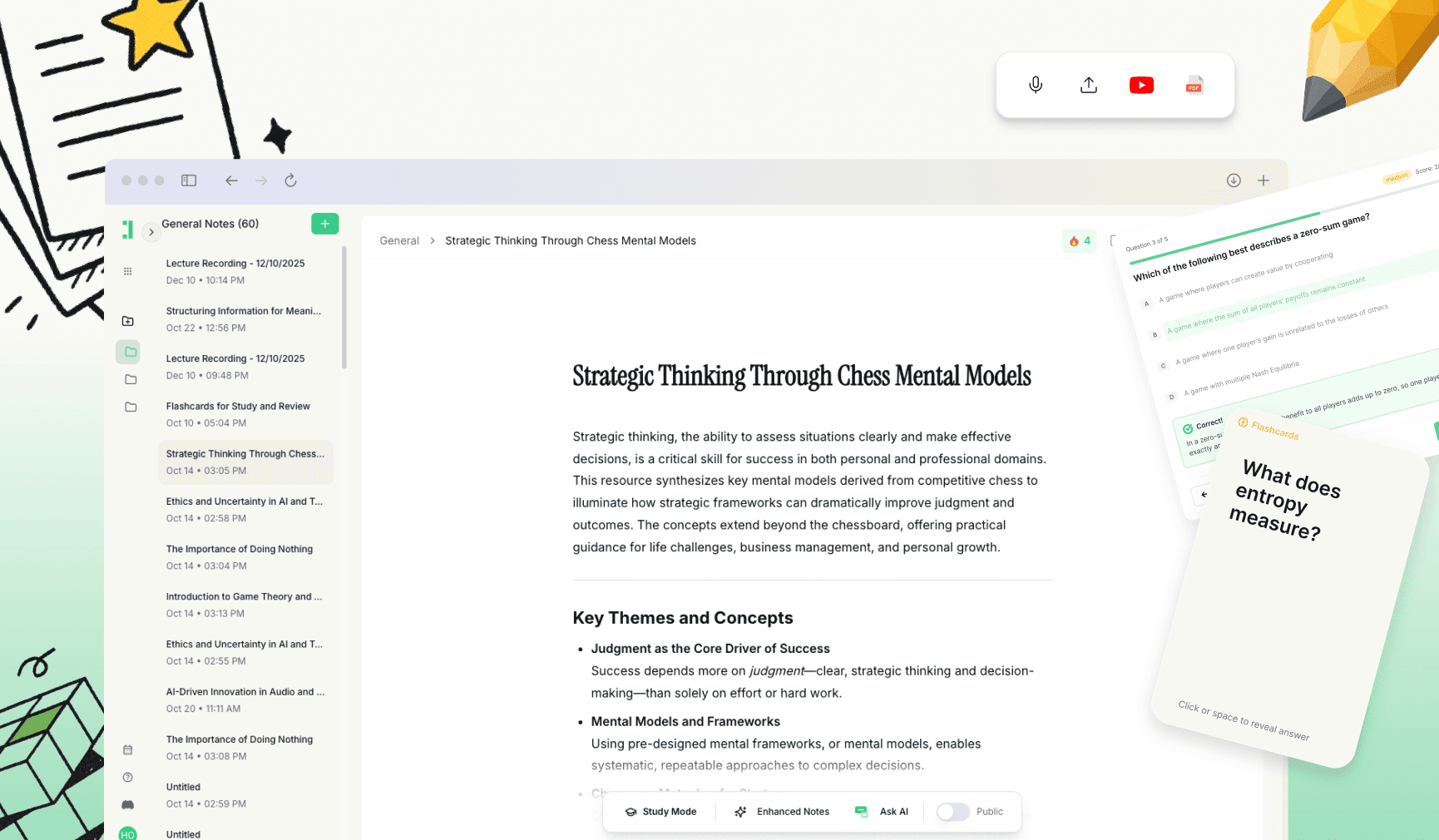
Turn your notes, PDFs, slides, or chemistry lectures into Enthalpy and Entropy flashcards so you can review faster and remember more. Whether you are tackling thermodynamics for the first time or preparing for a final exam, active recall is the fastest way to master the laws of energy.
Generate Enthalpy and Entropy FlashcardsUpload notes / paste text
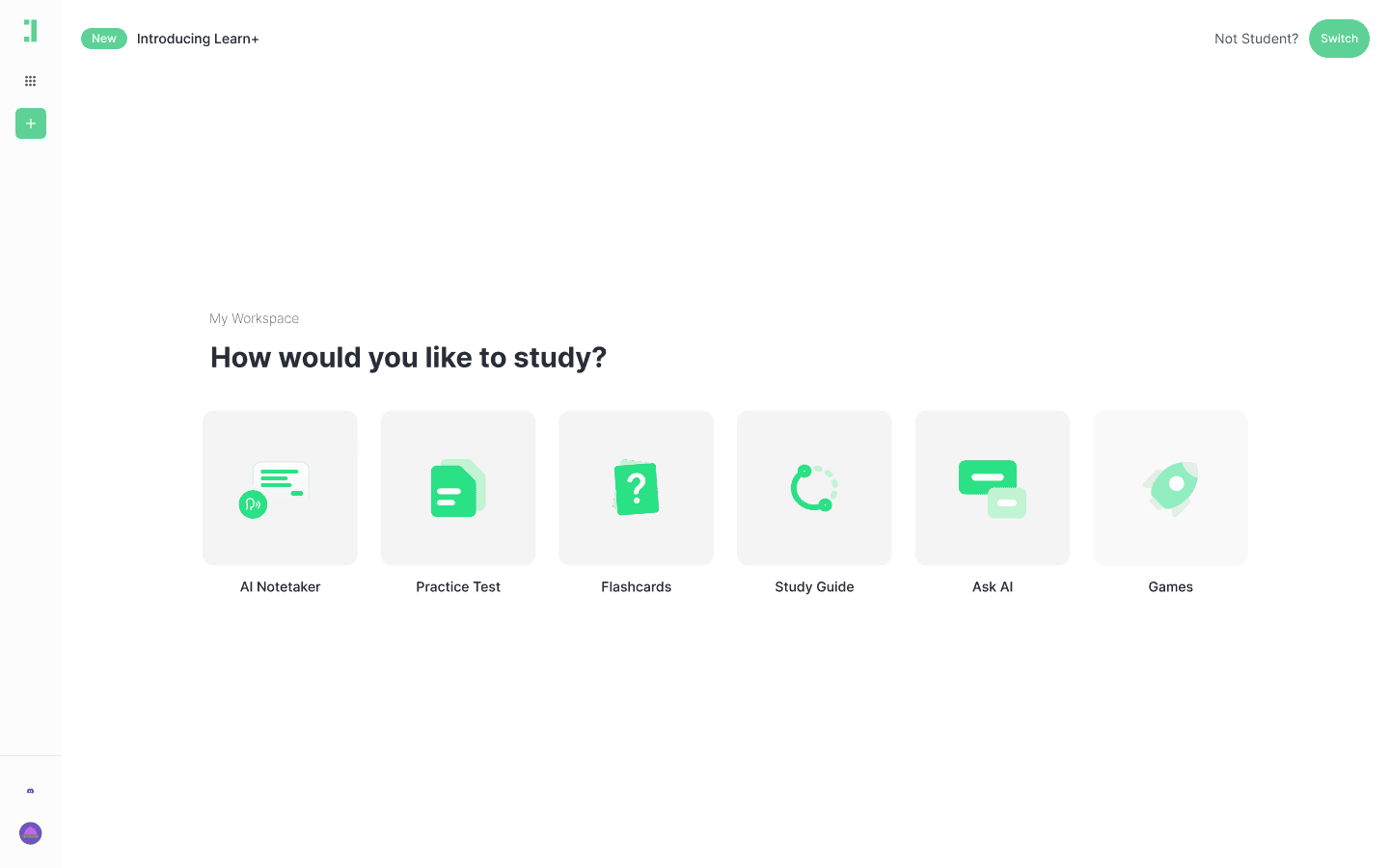
In Duetoday, the process is simple: upload your study materials, and our AI instantly identifies key thermodynamic principles to generate a custom deck. You can then review, edit, and study your cards immediately.
What are Enthalpy and Entropy flashcards?
Enthalpy and Entropy flashcards cover the fundamental drivers of chemical reactions. They break down complex topics like heat exchange (ΔH), molecular disorder (ΔS), Hess’s Law, and the relationship between energy and spontaneity. These cards translate abstract formulas into clear, testable questions.
The outcome is a shift from passive reading to active testing. Instead of staring at a textbook, you are training your brain to distinguish between endothermic and exothermic processes or calculate Gibbs Free Energy on the fly. If you already have notes, Duetoday can generate a clean deck in minutes.
Why flashcards are one of the best ways to study Enthalpy and Entropy
Thermodynamics requires a mix of rote memorization for definitions and logical application for calculations. Flashcards bridge this gap by isolating individual concepts, preventing you from feeling overwhelmed by long chapters. By using active recall and spaced repetition, you ensure that the sign conventions (+ vs -) for energy changes become second nature.
Remember key thermodynamic terms without cramming
Separate similar concepts (e.g., Enthalpy vs. Internal Energy)
Learn processes step-by-step (calculating ΔH using bond enthalpies)
Practice applying rules like the Second Law of Thermodynamics quickly
What to include in your Enthalpy and Entropy flashcards
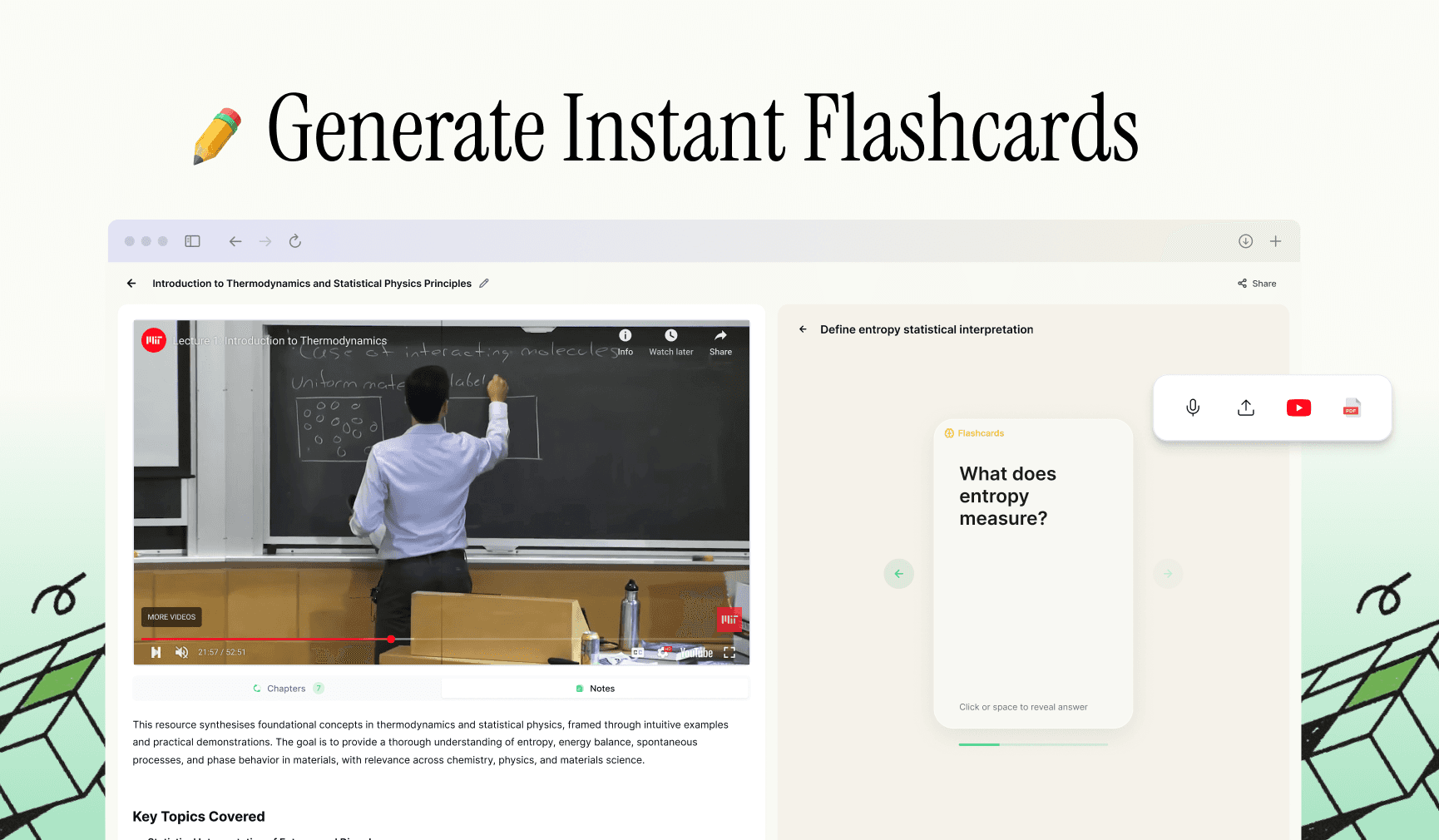
Effective chemistry flashcards follow the principle of "one idea per card." Keep your questions focused so you can answer them in seconds rather than minutes. This keeps your momentum high and your focus sharp.
Definitions & key terms: "What is the definition of standard enthalpy of formation?"
Processes & steps: "What are the steps to apply Hess’s Law to a reaction cycle?"
Comparisons: "How does an increase in temperature affect entropy in a gaseous system?"
Application: "If ΔH is negative and ΔS is positive, is the reaction spontaneous?"
Try these example prompts: "Define an exothermic reaction in terms of heat flow," "What does a positive ΔS value indicate about randomness?" and "State the formula for Gibbs Free Energy."
How to study Enthalpy and Entropy with flashcards
Start with a two-pass approach. First, generate your deck from your lecture slides or textbook chapters. Then, do a rapid-fire round to identify which enthalpy signs or entropy trends are tripping you up. Focus your energy on those "weak" cards over the next few days while mixing in easier cards to maintain your confidence.
Make a deck from your notes or generate it from your PDF.
Do one quick round to find weak spots in your understanding.
Review weak cards daily to cement the concepts.
Mix in harder calculation-based cards each session.
Do a final mixed review before your chemistry quiz or exam.
Generate Enthalpy and Entropy flashcards automatically in Duetoday
Making cards manually is slow and messy, especially when dealing with chemical equations and delta symbols. Duetoday automates the busywork. Just upload your chemistry PDF or paste your lecture notes, and our AI builds a structured deck for you. Start with your notes and get a deck you can actually use today.
Common Enthalpy and Entropy flashcard mistakes
Most students make the mistake of creating cards that are too wordy. If a card contains an entire paragraph about the laws of thermodynamics, you'll end up memorizing the text instead of the concept. Keep them snappy, split complex cycles into multiple cards, and always include the units (like kJ/mol) to avoid simple errors during exams.
FAQ
How many flashcards do I need for Enthalpy and Entropy? Usually 30 to 50 cards are enough to cover the core definitions, sign conventions, and major formulas for a standard unit.
What’s the best format for Enthalpy and Entropy flashcards? Question-and-answer format works best. For example: 'Question: Is evaporation endothermic or exothermic? Answer: Endothermic.'
How often should I review these flashcards? Review daily for the first three days, then use spaced repetition to check back every few days until the exam.
Should I make cards from a textbook or lecture notes? Use both. Lecture notes tell you what the professor prioritizes, while textbooks provide the precise definitions for enthalpy and entropy.
How do I stop forgetting the signs for ΔG after a few days? Create comparison cards specifically for the four scenarios of ΔH and ΔS to visualize when a reaction is always or never spontaneous.
Can I generate flashcards from a chemistry PDF? Yes, Duetoday can scan your chemistry PDFs and extract the most important enthalpy and entropy data into cards.
Are digital flashcards better than paper? Yes, digital cards allow for easier editing and use AI-driven spaced repetition to show you the hardest cards more often.
Can Duetoday handle chemical symbols? Absolutely, Duetoday is designed to recognize and organize scientific terminology and symbols accurately.

Duetoday is an AI-powered learning OS that turns your study materials into personalised, bite-sized study guides, cheat sheets, and active learning flows.