Generate Flashcards for E1 vs E2
Master E1 vs E2 reactions easily. Convert your Orgo notes into AI flashcards. Try out free today!
Generate Flashcards with AI Free

Generate Flashcards for E1 vs E2
Turn your organic chemistry notes, PDFs, slides, or textbook chapters into E1 vs E2 flashcards so you can review faster and remember more. Whether you are struggling with solvent effects or substrate stability, Duetoday helps you master these mechanisms instantly.
Generate E1 vs E2 FlashcardsUpload Notes / Paste Text
In Duetoday, the process is simple: upload your organic chemistry materials, and our AI generates high-quality cards. You can then review, edit, and study them using active recall to ensure you never mix up elimination pathways again.
What are E1 vs E2 flashcards?
E1 vs E2 flashcards are specialized study tools designed to help you differentiate between Unimolecular (E1) and Bimolecular (E2) elimination reactions. These cards cover essential variables like substrate structure (primary vs. tertiary), base strength, solvent types, and transition states.
Instead of passively rereading your textbook, these flashcards force you to test your knowledge on regioselectivity, Zaitsev’s rule, and anti-periplanar requirements. If you already have lecture notes, Duetoday can generate a clean deck in minutes so you can focus on mastering the material.
Why flashcards work for E1 vs E2
Organic chemistry is built on recognizing patterns and applying rules to different molecules. E1 and E2 reactions are often confused because they occur under similar conditions. Flashcards use active recall and spaced repetition to help you distinguish these mechanisms quickly.
Identify the rate-determining step for each mechanism
Distinguish between strong and weak bases instantly
Master the geometric requirements for E2 (anti-periplanar)
Predict major products using Zaitsev vs. Hofmann rules
Recognize when carbocation rearrangements occur in E1
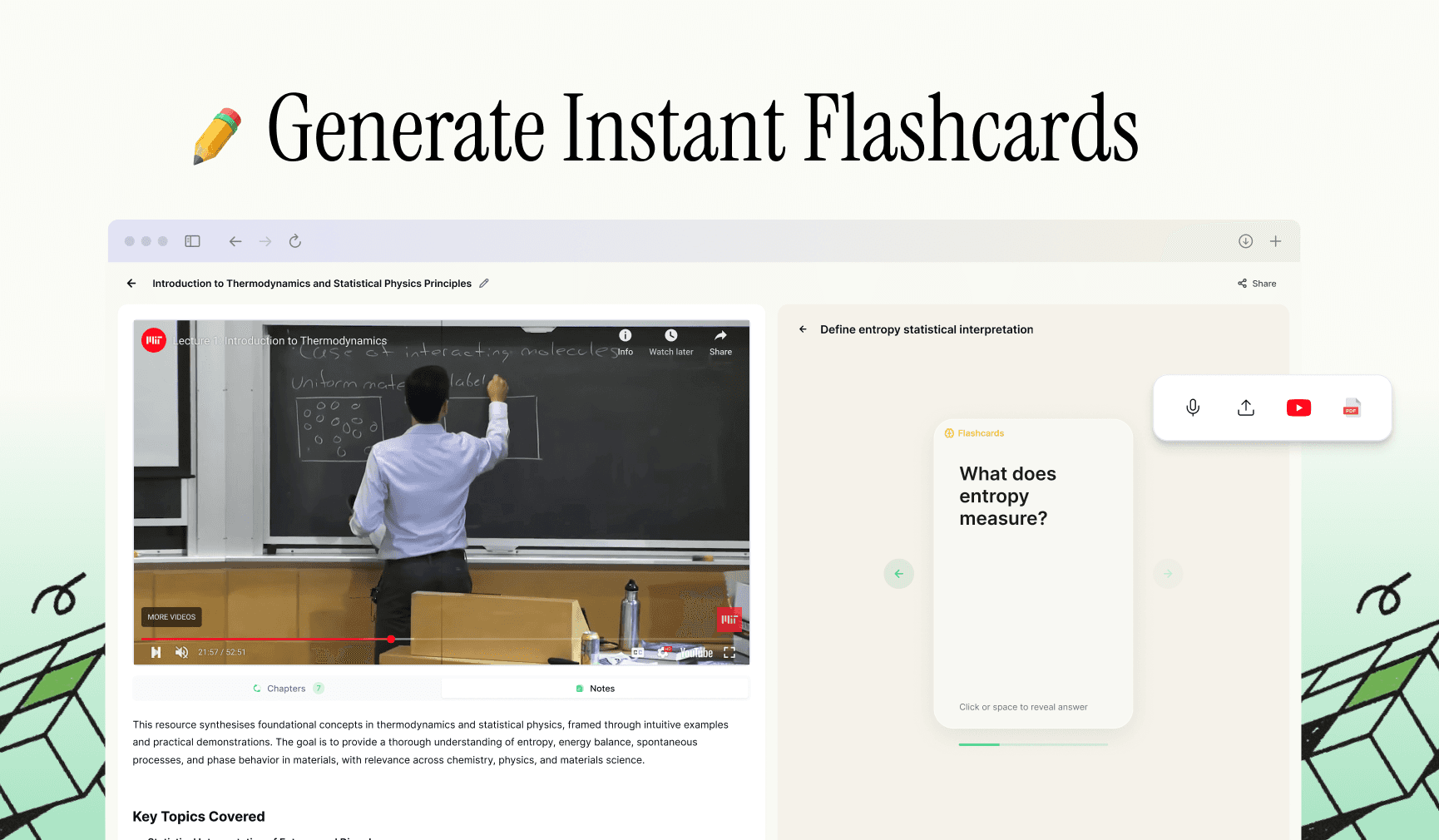
What to include in your E1 vs E2 flashcards
Effective organic chemistry flashcards follow the "one idea per card" rule. They should be question-based to simulate the problem-solving you'll do on an exam. Focus on four main categories: kinetics, reagents, stereochemistry, and solvent effects.
Definitions & Regiochemistry: "What is Zaitsev's rule?" "Define a dehydrohalogenation reaction."
Processes & Mechanisms: "What is the rate law for an E2 reaction?" "Is E1 a concerted or stepwise process?"
Comparisons: "How does base strength differ between E1 and E2?" "Comparing E1 vs SN1 conditions."
Application: "What is the product of 2-bromo-2-methylbutane with NaOEt?" "When is the Hofmann product major?"
How to study E1 vs E2 with flashcards
Don't just flip through your cards; use a "two-pass" system. Start by building your deck from your syllabus and notes. In your first pass, identify which concepts—like stereospecificity—are the hardest for you to recall.
Refine your study by doing quick, 10-minute sessions daily. Focus on the "weak" cards that you get wrong, repeating them more often than the ones you've mastered. Before your exam, do a mixed review of E1, E2, SN1, and SN2 to ensure you can tell them all apart in a random sequence.
Generate E1 vs E2 flashcards automatically in Duetoday
Manually drawing out reaction mechanisms and writing cards is slow and takes away from actual study time. Duetoday automates the tedious part of studying so you can get straight to the practice.
Upload your Orgo I/II notes or PDF slides
Click Generate Flashcards
Review, edit for clarity, and start studying immediately
Generate E1 vs E2 Flashcards in Duetoday
Start with your notes and get a deck you can actually use today to ace your next midterm.
Common E1 vs E2 flashcard mistakes
Many students make their cards too dense, which prevents quick recall. Avoid these common pitfalls:
Writing the whole mechanism on one card: Split it into steps.
Only memorizing definitions: Include cards that ask you to predict a product.
Ignoring stereochemistry: Ensure you have cards specifically for anti-periplanar geometry.
Skipping solvent effects: Add cards for polar protic vs. polar aprotic impacts.
Ready to generate your E1 vs E2 flashcards?
Stop rereading and start recalling. Upload your notes, generate your deck, and master organic chemistry mechanisms with ease.
Start Generating Flashcards
FAQ
How many flashcards do I need for E1 vs E2? Usually 20–30 cards are enough to cover the kinetics, mechanisms, reagents, and regioselectivity for both reaction types.
What’s the best format for E1 vs E2 flashcards? Question-and-answer format is best. Use one side for the reagent/substrate and the other for the mechanism type or product.
How often should I review E1 vs E2 flashcards? Review them daily for the first week, then use spaced repetition to review every few days until the exam.
Should I make cards from a textbook or lecture notes? Use lecture notes for specific exam requirements (like which bases your professor prefers) and textbooks for general mechanism steps.
How do I stop forgetting the difference between E1 and E2? Use comparison cards that ask specifically: 'Which one requires a strong base?' This highlights the direct contrast.
Can I generate E1 vs E2 flashcards from a PDF automatically? Yes, Duetoday can read your O-Chem PDFs and extract the key reaction rules into cards instantly.
Are digital flashcards better than paper for Orgo? Digital cards are often better because you can easily include images of molecular structures and use AI to generate them instantly.
How long does it take to make a full E1 vs E2 deck? With Duetoday, it takes less than a minute. Manually, it might take an hour to write and draw them all.
Can Duetoday organize my cards into folders? Yes, you can categorize your cards by chapter or reaction type (e.g., Elimination vs. Substitution).

Duetoday is an AI-powered learning OS that turns your study materials into personalised, bite-sized study guides, cheat sheets, and active learning flows.