Generate Flashcards for Discrete Structures
Generate or make Discrete Structures flashcards to master logic and sets using this AI-powered study guide.
Generate Flashcards with AI Free
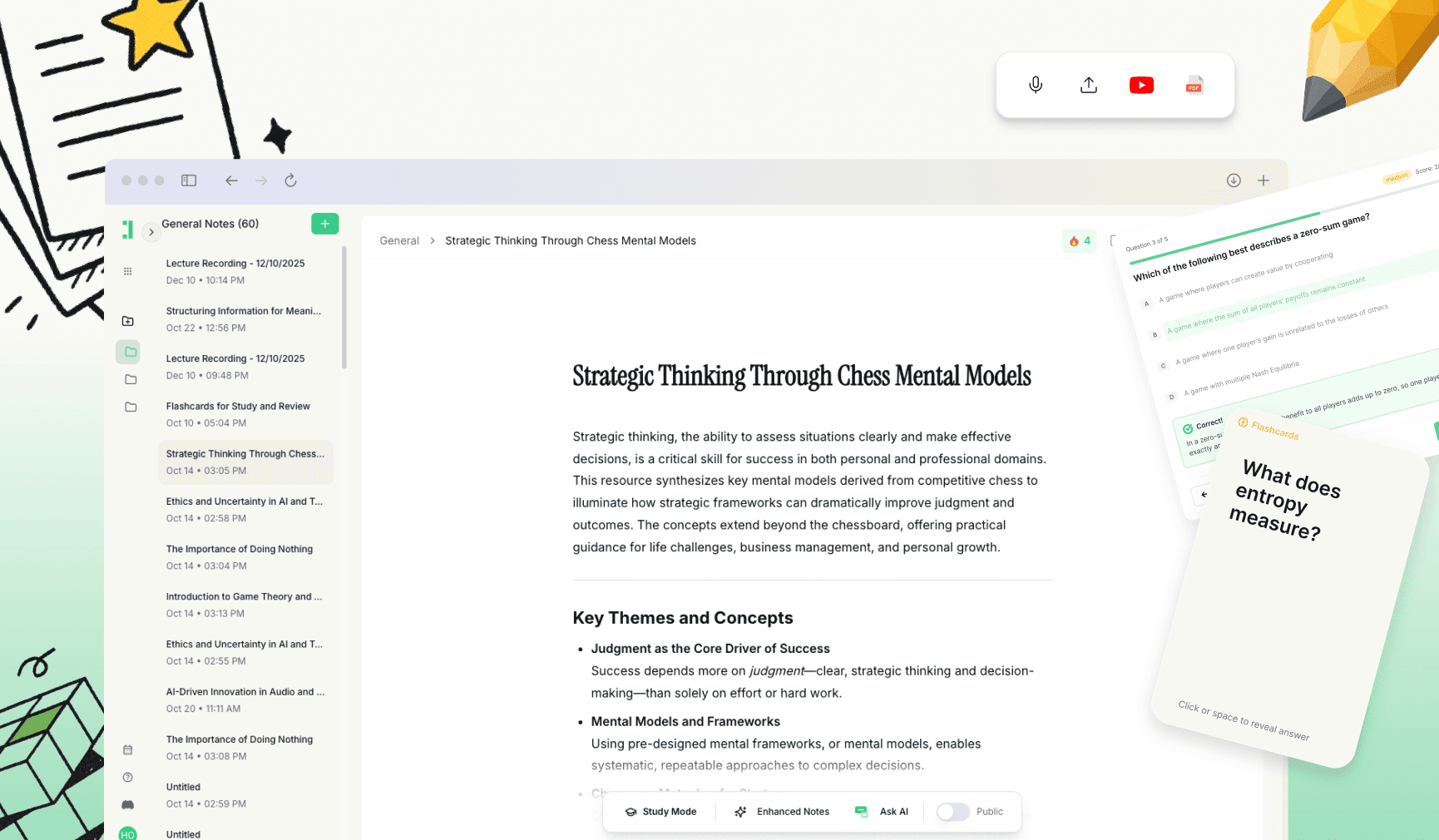
What are Discrete Structures flashcards?
Discrete Structures flashcards are targeted study tools designed to help you master the mathematical foundations of computer science. These flashcards cover critical topics such as formal logic, set theory, graph theory, combinatorics, and probability. Instead of staring at complex proofs, these cards break down dense theorems into digestible questions and answers.
The primary outcome of using flashcards for this subject is active recall. By testing yourself on truth tables, set identities, or Big O notation, you build the mental pathways necessary to solve problems during exams. If you already have lecture notes or textbook chapters, Duetoday can generate a clean deck in minutes, saving you hours of manual formatting.
Why flashcards are one of the best ways to study Discrete Structures
Discrete Structures requires a mix of rote memorization for symbols and deep understanding for logical sequences. Flashcards bridge this gap by forcing you to retrieve information rather than just recognizing it on a page.
Remember complex logic symbols and truth table outcomes without cramming.
Separate similar concepts like injections, surjections, and bijections.
Learn recursive processes and algorithmic stages step-by-step.
Practice applying modular arithmetic rules and counting formulas quickly.
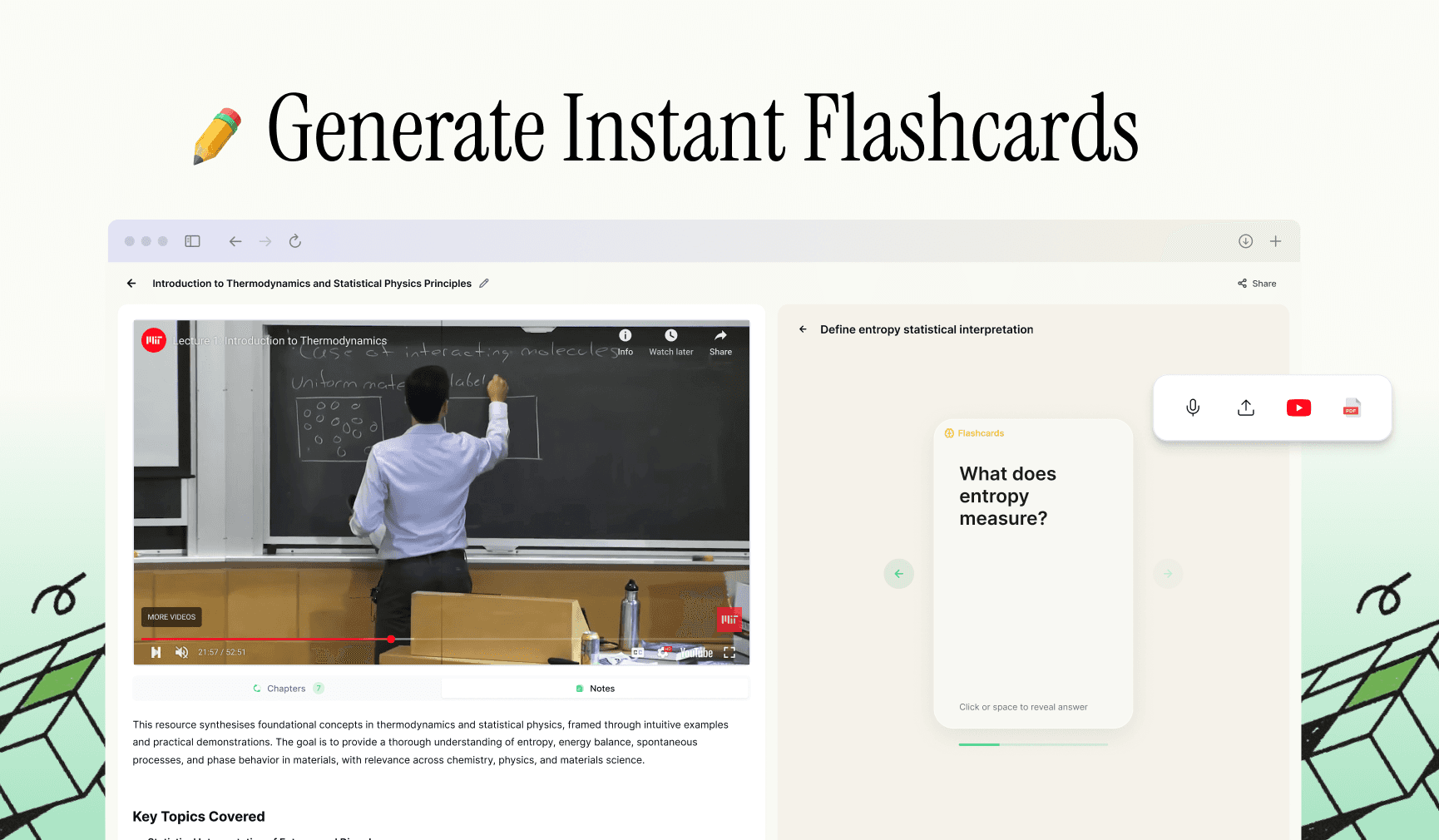
What to include in your Discrete Structures flashcards
Effective Discrete Structures flashcards follow the atomic rule: one idea per card. This ensures you aren't overwhelmed by multi-step proofs in a single session. Focus on categorizing your cards into four main types: definitions, processes, comparisons, and applications.
Definitions: What is an equivalence relation? Define a bipartite graph.
Processes: What is the first step in a proof by induction?
Comparisons: What is the difference between a walk and a path in graph theory?
Application: Apply De Morgan’s Law to ¬(P ∧ Q).
How to study Discrete Structures with flashcards
The best approach is the two-pass system. First, generate your deck from your syllabus and do a quick pass to identify which logical laws or graph properties are tripping you up. Then, focus your energy on those weak cards using spaced repetition.
Make a deck from your notes or generate it automatically from your PDF.
Do a quick round to flag difficult proofs or formulas.
Review these weak cards daily to move them into long-term memory.
Mix in different topics (e.g., probability and logic) to build mental flexibility.
Conduct a final mixed review before your midterm or final exam.
Generate Discrete Structures flashcards automatically in Duetoday
Manually writing out truth tables and drawing graphs on paper cards is incredibly slow. Duetoday streamlines this by letting you upload your course materials and transforming them into study-ready decks instantly. Stop rereading your textbook and start practicing the actual material you'll be tested on.
Upload your Discrete Structures PDFs or lecture slides.
Click Generate Flashcards to see AI create your deck.
Review, edit, and start your active recall session immediately.
FAQ
How many flashcards do I need for Discrete Structures? Most students find that 100-150 cards per major unit (like Logic or Set Theory) provide comprehensive coverage without being overwhelming.
What’s the best format for Discrete Structures flashcards? Question-and-answer format is best for definitions, while cloze deletion (fill-in-the-blank) works well for completing theorems or logical identities.
How often should I review my cards? Aim for short 15-minute sessions daily. Consistency is more important than duration when it comes to mathematical logic.
Should I make cards from a textbook or slides? Use lecture slides first, as they highlight what your professor deems most important, then supplement with textbook definitions for clarity.
How do I stop forgetting formulas after a few days? Spaced repetition is the key. Duetoday helps you repeat the harder formulas more frequently until they stick.
What if my flashcards feel too easy? If a card is too easy, it might be too simple. Try adding an Application card that asks you to use that formula in a specific problem context.
Can I generate Discrete Structures flashcards from a PDF? Yes, Duetoday is designed to parse complex PDFs and turn the text and concepts into structured flashcards automatically.
Are digital cards better than paper? For Discrete Structures, digital cards are superior because they allow for faster organization of complex categories like Venn diagrams and Trees.
How long does it take to make a full deck? With Duetoday, you can generate a full deck from a chapter PDF in less than a minute.
Can Duetoday organize my cards for me? Yes, Duetoday categorizes your generated cards by topic so you can focus on specific areas like Graph Theory or Combinatorics.

Duetoday is an AI-powered learning OS that turns your study materials into personalised, bite-sized study guides, cheat sheets, and active learning flows.