Generate Flashcards for Discrete Mathematics
Make study-ready Discrete Mathematics flashcards from your notes. Generate flashcards for logic, proofs, and sets with Duetoday.
Generate Flashcards with AI Free
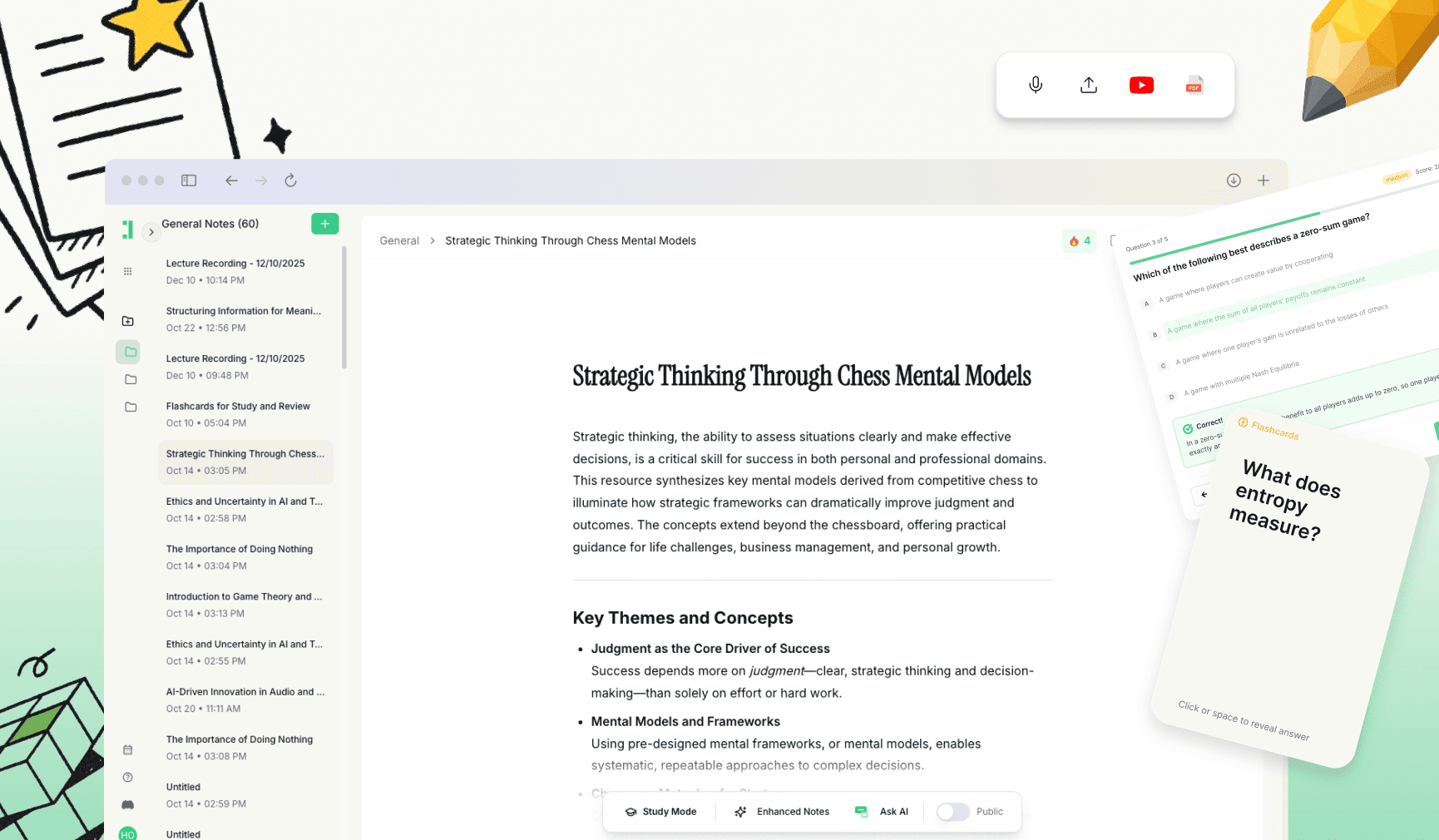
Generate Flashcards for Discrete Mathematics
Turn your complex proofs, logic tables, and set theory notes into Discrete Mathematics flashcards so you can review faster and remember more. Whether you are struggling with combinatorics or mastering graph theory, Duetoday helps you convert dense material into digestible study sets.
Generate Discrete Mathematics FlashcardsUpload notes / paste text
Using Duetoday is simple: upload your course materials, let our AI extract the core concepts, and instantly receive a deck of flashcards ready for active recall and spaced repetition.
What are Discrete Mathematics flashcards?
Discrete Mathematics flashcards cover the fundamental building blocks of computer science and abstract math, including propositional logic, set theory, functions, relations, and counting techniques. These cards distill complex theorems and algorithms into clear questions and answers.
Instead of passively rereading your textbook, these flashcards force you to retrieve information from memory, which is the fastest way to build long-term recall for exam day. If you already have notes, Duetoday can generate a clean deck in minutes.
Why flashcards work for Discrete Mathematics
Discrete Mathematics relies heavily on understanding specific definitions, logical sequences, and structural relationships. Flashcards are uniquely suited for this subject because they break down abstract logic into concrete, manageable pieces of information.
Remember Boolean algebra rules and truth tables without cramming.
Separate similar concepts like injective, surjective, and bijective functions.
Learn recursive sequences and induction steps phase-by-phase.
Practice applying counting principles and probability formulas quickly.
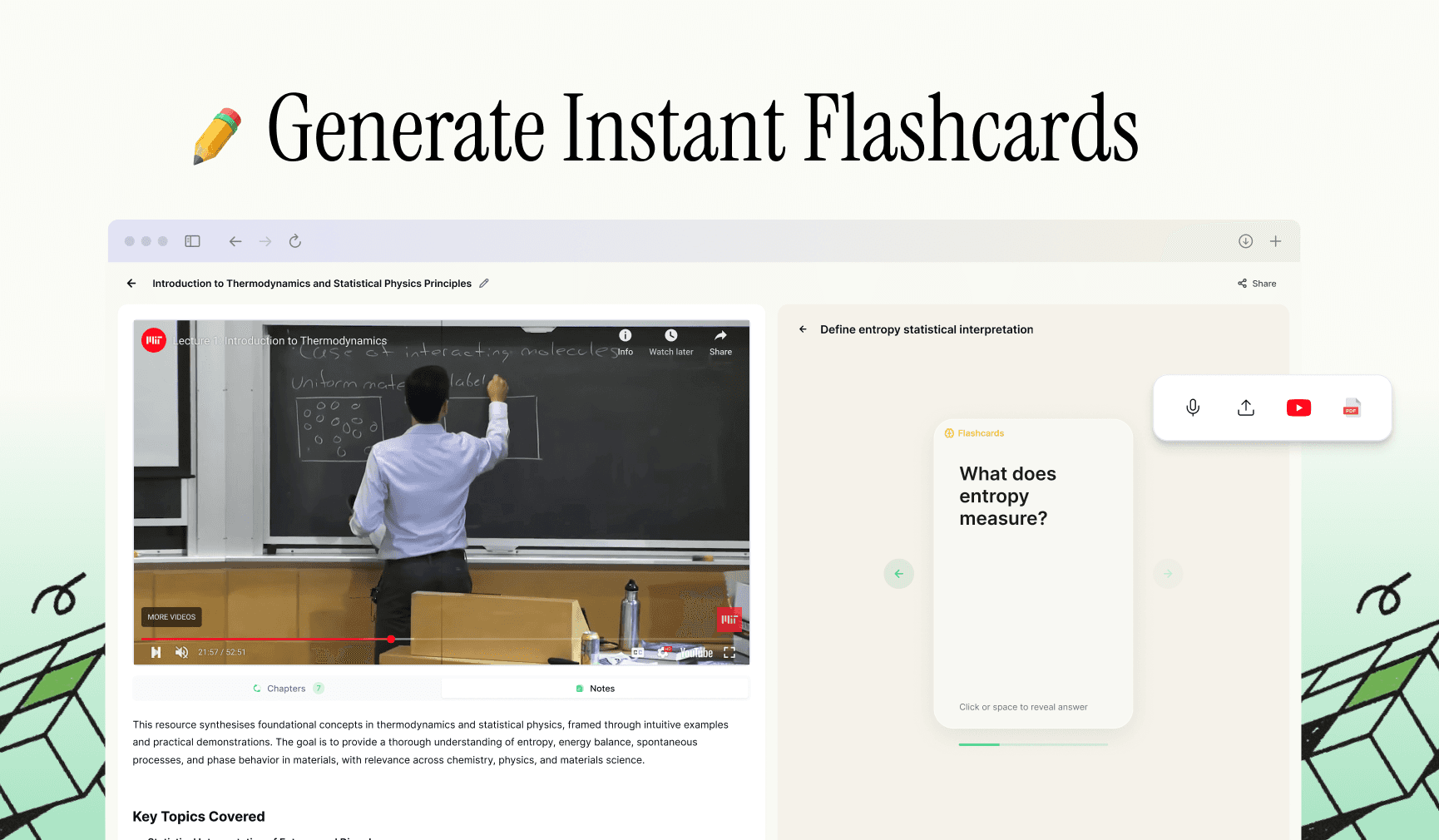
What to include in your Discrete Mathematics flashcards
Effective flashcards follow the "one idea per card" rule. For math, this means focusing on a single property, definition, or step of a proof rather than trying to fit an entire chapter on one card. Using a question-based format ensures your brain is actually working during study sessions.
Definitions & key terms: "What is a power set?" "Define a bipartite graph."
Processes & steps: "What is the first step in a proof by mathematical induction?"
Comparisons: "How does a simple graph differ from a multigraph?"
Application: "Apply De Morgan’s Laws to the expression ¬(P ∧ Q)."
Example prompts include: "State the pigeonhole principle," "What is the Handshaking Lemma formula?" and "Define a tautology in propositional logic."
How to study Discrete Mathematics with flashcards
To master this subject, use a two-pass approach. First, build your deck based on your lecture slides or textbook chapters. Then, move through your rounds of study, focusing on your ability to explain the "why" behind each logical step.
Make a deck from your notes or generate it from your PDF syllabus.
Do one quick round to identify which logic rules or formulas you keep forgetting.
Review weak cards daily to cement the concepts through spaced repetition.
Mix in harder application problems to ensure you aren't just memorizing definitions.
Perform a final mixed review of all topics before your midterm or final exam.
Generate Discrete Mathematics flashcards automatically in Duetoday
Creating math flashcards manually is incredibly slow—drawing graphs and writing out truth tables by hand takes time you could be using to actually study. Duetoday automates this tedious process.
Upload or paste your Discrete Math lecture notes or slides.
Click "Generate Flashcards."
Review, edit, and start studying immediately.
Generate Discrete Mathematics Flashcards in Duetoday
Start with your notes and get a deck you can actually use today to ace your next math quiz.
Common Discrete Mathematics flashcard mistakes
Many students make their cards too wordy, which leads to recognition rather than true recall. Ensure your cards are concise. Avoid simply memorizing the name of a theorem without knowing how to apply it, and never skip the "weak" cards—those are the ones that require the most frequent review.
How many flashcards do I need for Discrete Mathematics?
A typical semester-long course usually requires 150-300 cards to cover logic, sets, functions, and graph theory comprehensively.
What is the best format for Discrete Mathematics flashcards?
The best format is a clear question on the front and a single focused answer or formula on the back to ensure quick, repetitive testing.
How often should I review my flashcards?
You should review your deck daily during the first week of learning new concepts, then transition to every 3-4 days as your recall strengthens.
Should I make cards from a textbook or my lecture notes?
Lecture notes are usually better as they highlight what your specific professor deems important, though textbooks are great for finding extra practice problems.
How do I stop forgetting formulas after a few days?
Use spaced repetition. Duetoday’s system reminds you to review cards just as you are about to forget them, moving them into long-term memory.
What if my flashcards feel too easy?
If they feel easy, you likely have the definitions down. It is time to add "Application" cards that ask you to solve a quick logical problem or identify a graph property.
Can I generate flashcards from a math PDF?
Yes, Duetoday can scan your Discrete Math PDFs and extract the most important definitions and theorems to create a deck instantly.
Are digital flashcards better than paper for math?
Digital cards are often superior because they allow for faster organization, automated review schedules, and the ability to include complex logical symbols easily.
How long does it take to create a full deck?
With Duetoday, you can generate a full deck from a chapter of notes in under a minute, compared to hours of manual writing.
Can Duetoday organize my cards by topic?
Yes, Duetoday organizes your generated cards into specific decks, allowing you to focus on topics like Logic, Number Theory, or Combinatorics individually.

Duetoday is an AI-powered learning OS that turns your study materials into personalised, bite-sized study guides, cheat sheets, and active learning flows.