Generate Flashcards for Digital Logic Design
Make Digital Logic Design flashcards to master Boolean algebra and circuit design with our AI-powered study guide generator.
Generate Flashcards with AI Free
Generate Flashcards for Digital Logic Design
Turn your notes, PDFs, slides, or lectures into Digital Logic Design flashcards so you can review faster and remember more. Understanding complex circuitry and logic gates requires consistent practice, not just passive reading.
Generate Digital Logic Design Flashcards
Upload notes / paste text
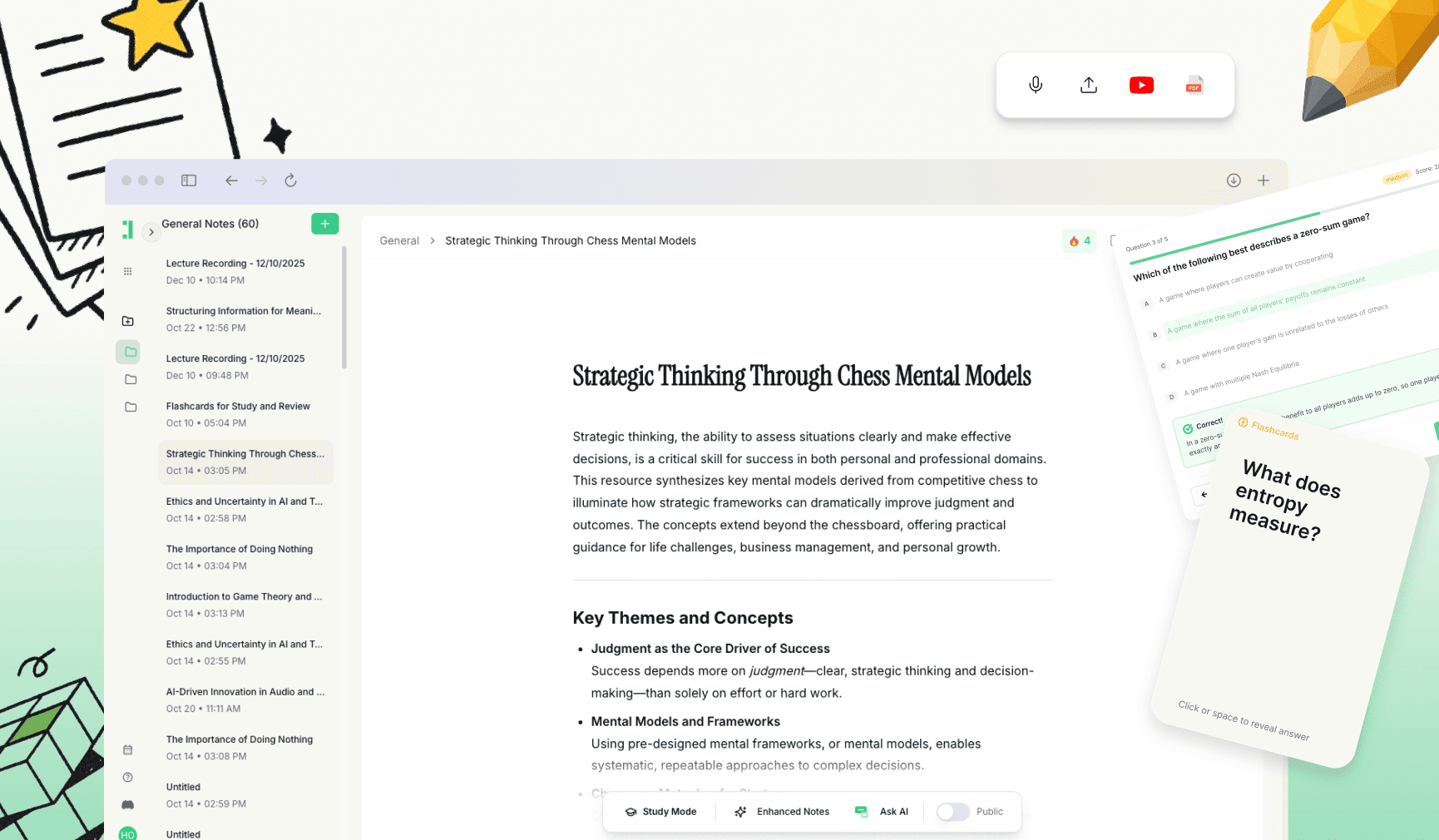
Using Duetoday is simple: upload your study material, click generate, and our AI builds a comprehensive deck. You can then review, edit, and start your study session immediately.
What are Digital Logic Design flashcards?
Digital Logic Design flashcards cover the fundamental building blocks of modern electronics, including Boolean algebra, logic gates, flip-flops, and synchronous sequential circuits. They condense complex diagrams and truth tables into bite-sized questions that test your ability to predict outputs and simplify expressions.
Instead of rereading your textbook over and over, these flashcards force you to engage in active recall. This strengthens the neural pathways associated with hardware design concepts, helping you build a deeper intuition for how digital systems function. If you already have notes, Duetoday can generate a clean deck in minutes.
Why flashcards work for Digital Logic Design
Digital Logic Design requires a mix of rote memorization for symbols and deep conceptual understanding for circuit analysis. Flashcards are perfect for bridging this gap through spaced repetition, ensuring you don't forget the basics while tackling advanced topics.
Remember gate symbols and truth tables without cramming
Separate similar concepts (e.g., Latches vs. Flip-flops)
Learn simplification processes step-by-step (K-Maps, Quine-McCluskey)
Practice applying Boolean laws to minimize circuits quickly
What to include in your Digital Logic Design flashcards
Effective flashcards follow the principle of atomicity—one idea per card. For Digital Logic, this means focusing on specific rules, components, or conversions rather than trying to explain an entire CPU architecture on one card. Use question-based prompts to mimic exam conditions.
Definitions & key terms: What is Propagation Delay? or Define Fan-out in TTL.
Processes & steps: What is the first step in simplifying a 4-variable K-map?
Comparisons: How does a Multiplexer differ from a Demultiplexer?
Application: What is the output of a NAND gate if all inputs are High?
Example prompts: State De Morgan’s First Law, What is the characteristic equation of a J-K Flip-flop?, How many select lines are needed for an 8-to-1 MUX?, and Convert the binary number 1011 to Gray code.
How to study Digital Logic Design with flashcards
Success in Digital Logic comes from a two-pass approach. First, use your flashcards to build a solid foundation of symbols and rules. Second, use them to drill the mechanics of circuit reduction so that you can perform them reflexively during a lab or exam.
Make a deck from your lecture slides or circuit diagrams.
Do one quick round to identify which gates or theorems are confusing.
Review weak cards daily to cement the truth tables in memory.
Mix in timing diagrams and state machine transition cards for variety.
Do a final mixed review before your midterm or final practical.
Generate Digital Logic Design flashcards automatically in Duetoday
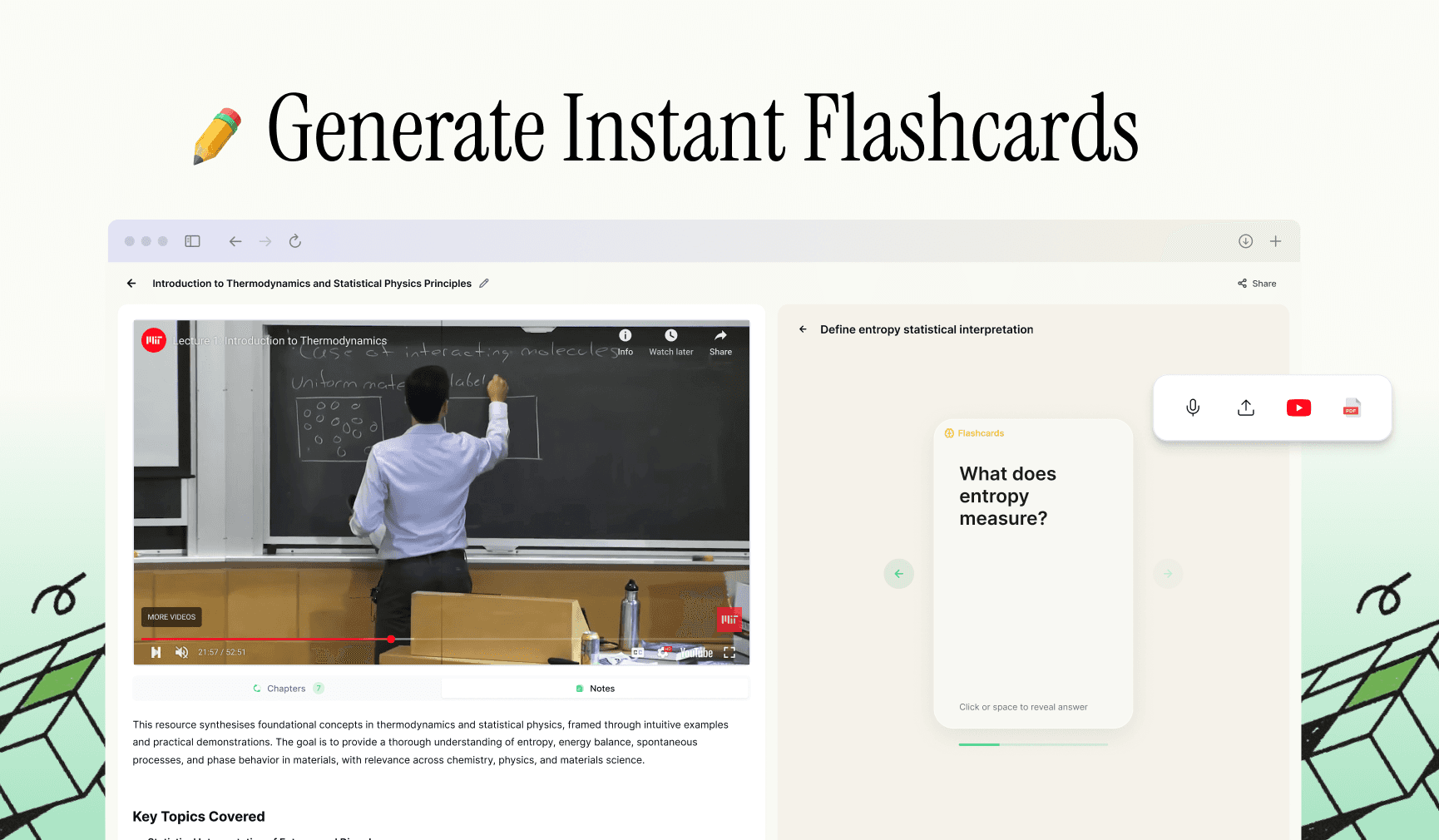
Creating cards manually for a subject involving diagrams and truth tables is slow and tedious. Duetoday streamlines this by extracting the core logic from your files instantly, allowing you to focus on learning rather than formatting.
Upload your Digital Logic PDF, slides, or transcript.
Click Generate Flashcards.
Review your AI-generated deck and start studying.
Generate Digital Logic Design Flashcards in Duetoday
Start with your notes and get a deck you can actually use today. Stop rereading and start recalling.
Common Digital Logic Design flashcard mistakes
Many students make their cards too complex, which leads to frustration. Avoid including large circuit diagrams that require five minutes to analyze; instead, break the circuit down into sub-components or specific functional questions. Also, ensure you aren't just memorizing the words but understanding the underlying logic—add 'why' prompts to your deck to ensure you can explain the behavior of a circuit, not just its name.
FAQ
How many flashcards do I need for Digital Logic Design? A typical semester-long course usually requires 150-250 cards to cover everything from binary arithmetic to sequential state machines.
What’s the best format for these flashcards? Question and answer format works best, especially when including a small logic expression on the front and its simplified version on the back.
How often should I review my cards? Review daily for the first week when learning new Boolean laws, then move to every 3-4 days as you become more comfortable with circuit analysis.
Should I make cards from a textbook or slides? Use lecture slides for local exam terminology and textbooks for more detailed circuit explanations and truth tables.
How do I stop forgetting gate symbols? Use visual cues in your flashcards and repeat the cards that confuse similar gates, like NAND versus NOR, more frequently.
What if my cards feel too easy? If you've mastered basic gates, start adding cards for complex components like Adders, Counters, and ALUs to increase the difficulty.
Can I generate cards from a PDF automatically? Yes, Duetoday is designed to parse technical PDFs and convert the text and logic into structured flashcards automatically.
Are digital flashcards better than paper for this subject? Digital cards are generally better because they allow for the easy inclusion of circuit diagrams and support spaced repetition algorithms.
How long does it take to generate a full deck? With Duetoday, you can turn a 30-page PDF into a comprehensive study deck in less than 60 seconds.
Can Duetoday organize my cards by topic? Yes, the tool can categorize your cards into sections like Combinational Logic, Sequential Logic, and Number Systems for easier study sessions.

Duetoday is an AI-powered learning OS that turns your study materials into personalised, bite-sized study guides, cheat sheets, and active learning flows.