Generate Flashcards for Deep Learning
Make AI-powered flashcards for Deep Learning. Generate study guides for neural networks and machine learning.
Generate Flashcards with AI Free
Generate Flashcards for Deep Learning
Turn your complex machine learning notes, PDFs, slides, or research papers into Deep Learning flashcards so you can review faster and remember more. Whether you are studying neural network architectures or gradient descent optimization, active recall is the key to mastery.
Generate Deep Learning FlashcardsUpload notes / paste text
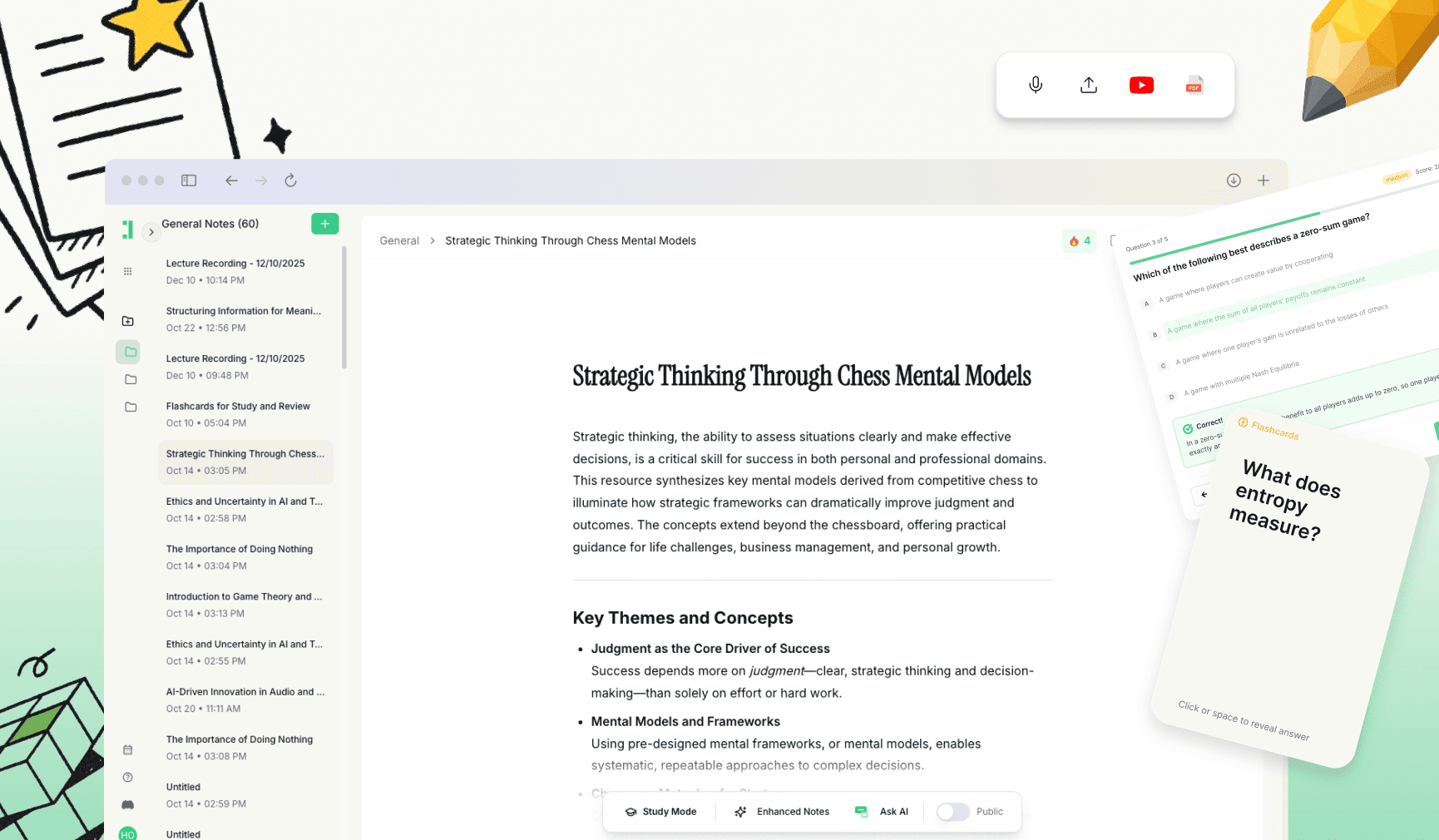
In Duetoday, the process is seamless: simply upload your study material, generate a structured deck, review or edit the cards, and start your study session immediately.
What are Deep Learning flashcards?
Deep Learning flashcards cover the essential building blocks of artificial intelligence, including key terms like backpropagation, activation functions, and hyperparameters. They break down intricate mathematical formulas, training steps, and the differences between architectures like CNNs, RNNs, and Transformers.
Instead of passively rereading your notes on stochastic gradient descent, you test yourself on core principles. This forces your brain to retrieve information, building the neural pathways needed for long-term retention. If you already have lecture notes, Duetoday can generate a clean deck in minutes.
Why flashcards work for Deep Learning
Deep Learning requires a mix of conceptual understanding and mathematical application. Flashcards allow you to isolate specific variables and layers of a model to ensure you understand how they interact.
By using active recall and spaced repetition, you focus more energy on the concepts you struggle with, such as vanishing gradients or overfitting, while maintaining your knowledge of the basics. This prevents the 'illusion of competence' that comes from just looking at a diagram.
Remember high-level architectures without cramming
Separate similar concepts (e.g., L1 vs L2 regularization)
Learn training processes step-by-step (forward pass to backprop)
Practice identifying the right loss function for specific tasks
What to include in your Deep Learning flashcards
Effective Deep Learning flashcards follow the one idea per card rule. They should be question-based and focus on both theory and implementation logic. Use a mix of conceptual questions and technical application prompts.
Definitions & key terms: What is a ReLU activation function?
Processes & steps: What are the four steps of the backpropagation algorithm?
Comparisons: How does a Max Pooling layer differ from an Average Pooling layer?
Application: What happens to the gradient if the learning rate is too high?
Example prompts include: Define the purpose of a Dropout layer, How does Adam optimization differ from SGD? and What is the main advantage of a Transformer over an LSTM?
How to study Deep Learning with flashcards
Deep Learning is best learned through a two-pass approach. First, build your deck based on your source material, then review in specific rounds to reinforce the mathematical logic and architectural design.
Keep your sessions focused and short. Deep Learning is mentally taxing, so repeating difficult cards about cost functions or matrix dimensions daily is more effective than one long session.
Make a deck from your notes or generate it from research papers.
Do one quick round to identify which architectures or formulas you find confusing.
Review these weak cards daily to strengthen your recall.
Mix in harder application scenarios (e.g., debugging a gradient) each session.
Perform a final mixed review before your exams or coding interviews.
Generate Deep Learning flashcards automatically in Duetoday
Manually creating flashcards for a subject as dense as Deep Learning is slow, messy, and inconsistent. Copying LaTeX formulas and drawing layer diagrams by hand takes time away from actual learning.
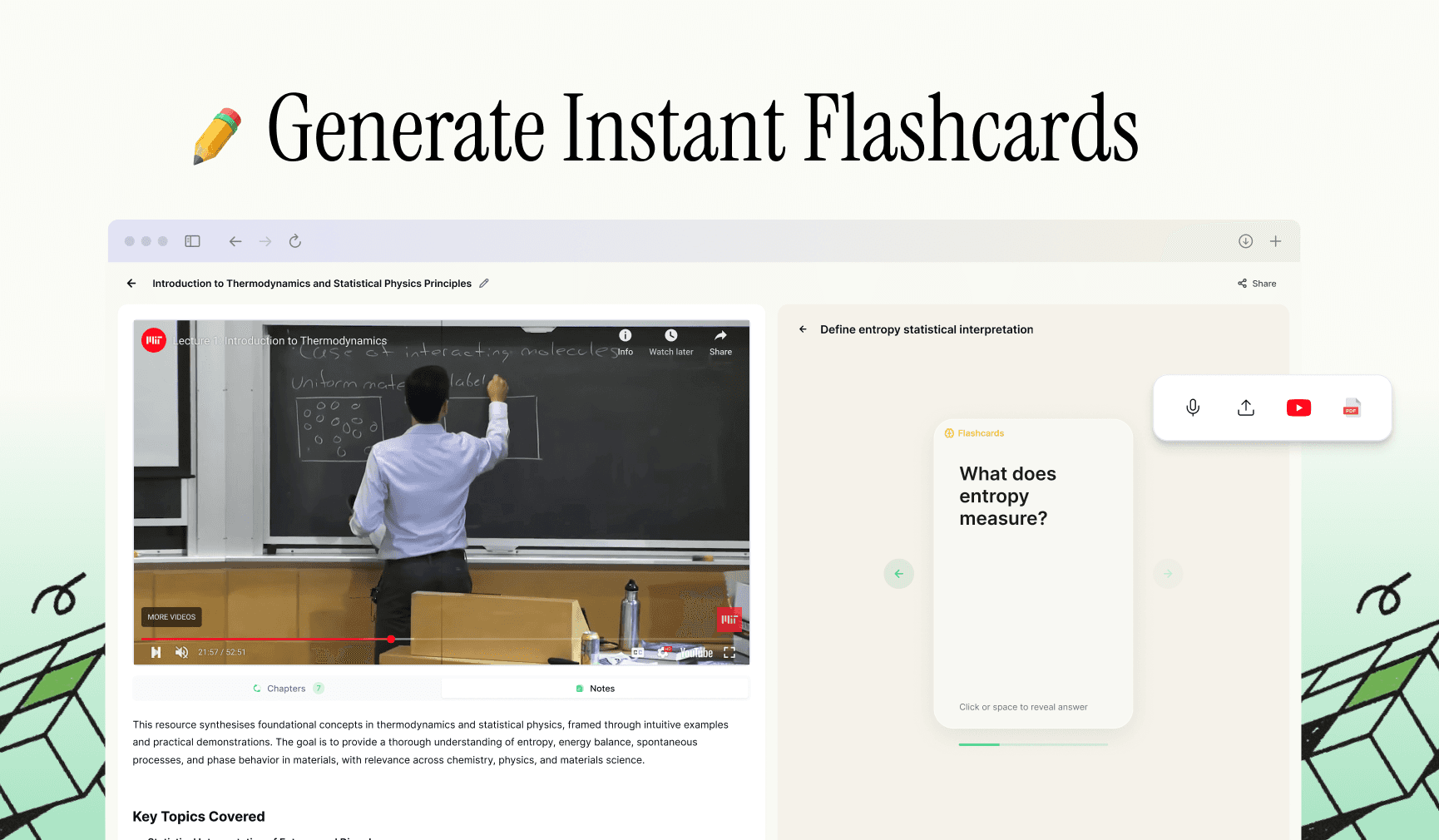
Duetoday solves this by automating the creation process. Simply upload your PDF, slides, or lecture transcripts, and our AI generates high-quality flashcards instantly.
Upload or paste your Deep Learning material
Click Generate Flashcards
Review, edit, and start studying immediately
Generate Deep Learning Flashcards in Duetoday
Start with your notes and get a deck you can actually use today.
Common Deep Learning flashcard mistakes
Most students make the mistake of making cards too wordy or only focusing on vocabulary without the why behind the math.
Cards are too long: Break down the layers of a ResNet into individual cards.
Only memorizing names: Ensure you add explain how this impacts training prompts.
Confusing optimizers: Add specific comparison cards for different optimization techniques.
No review schedule: Spaced repetition is essential for complex AI concepts.
Missing the math: Include cards that test your understanding of derivative chain rules.
Ready to generate your Deep Learning flashcards?
Stop rereading and start recalling. Upload your notes, generate your deck, and master the world of AI with active recall.
Start Generating Flashcards
Works with notes, PDFs, slides, and transcripts.
FAQ
How many flashcards do I need for Deep Learning? For a single unit like CNNs, 20-30 cards are usually enough to cover architectures, filters, and pooling operations.
What’s the best format for Deep Learning flashcards? A mix of conceptual questions and what if scenarios (e.g., What if we remove the non-linear activation?) works best.
How often should I review Deep Learning flashcards? Review daily when first learning a new architecture, then move to every 3-5 days once the concepts stick.
Should I make cards from a textbook or slides? Textbooks are better for detailed theory, while slides are better for high-level summaries and diagrams.
How do I stop forgetting formulas after a few days? Include cards that ask for the 'logic' of the formula rather than just the symbols.
What if my flashcards feel too easy? Add application cards that ask you to choose the best model for a specific dataset or problem.
Can I generate Deep Learning flashcards from a PDF? Yes, Duetoday can read through research papers or textbooks and extract the most important technical concepts.
Are digital flashcards better than paper for Deep Learning? Yes, digital cards handle complex diagrams and mathematical notation much more cleanly.
How long does it take to make a full Deep Learning deck? With Duetoday, it takes less than a minute to generate a full deck from your uploaded notes.
Can Duetoday organize my flashcards by topic? Yes, you can generate separate decks for Neural Networks, Computer Vision, and NLP to keep your studies organized.

Duetoday is an AI-powered learning OS that turns your study materials into personalised, bite-sized study guides, cheat sheets, and active learning flows.