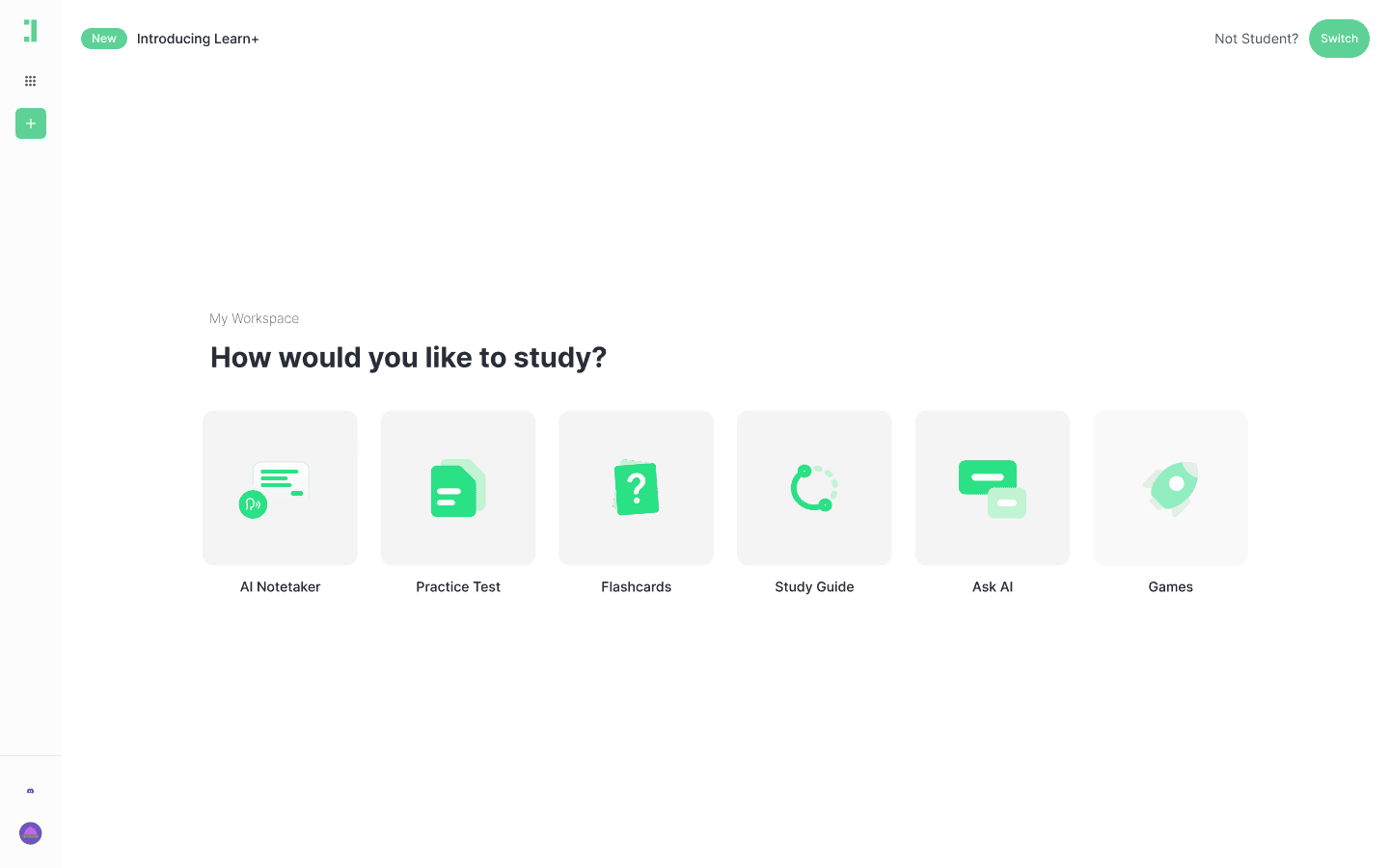
Generate Flashcards for Data Mining
Make Data Mining flashcards to master algorithms and KDD processes. Use our AI guide to generate study materials.
Generate Flashcards with AI Free
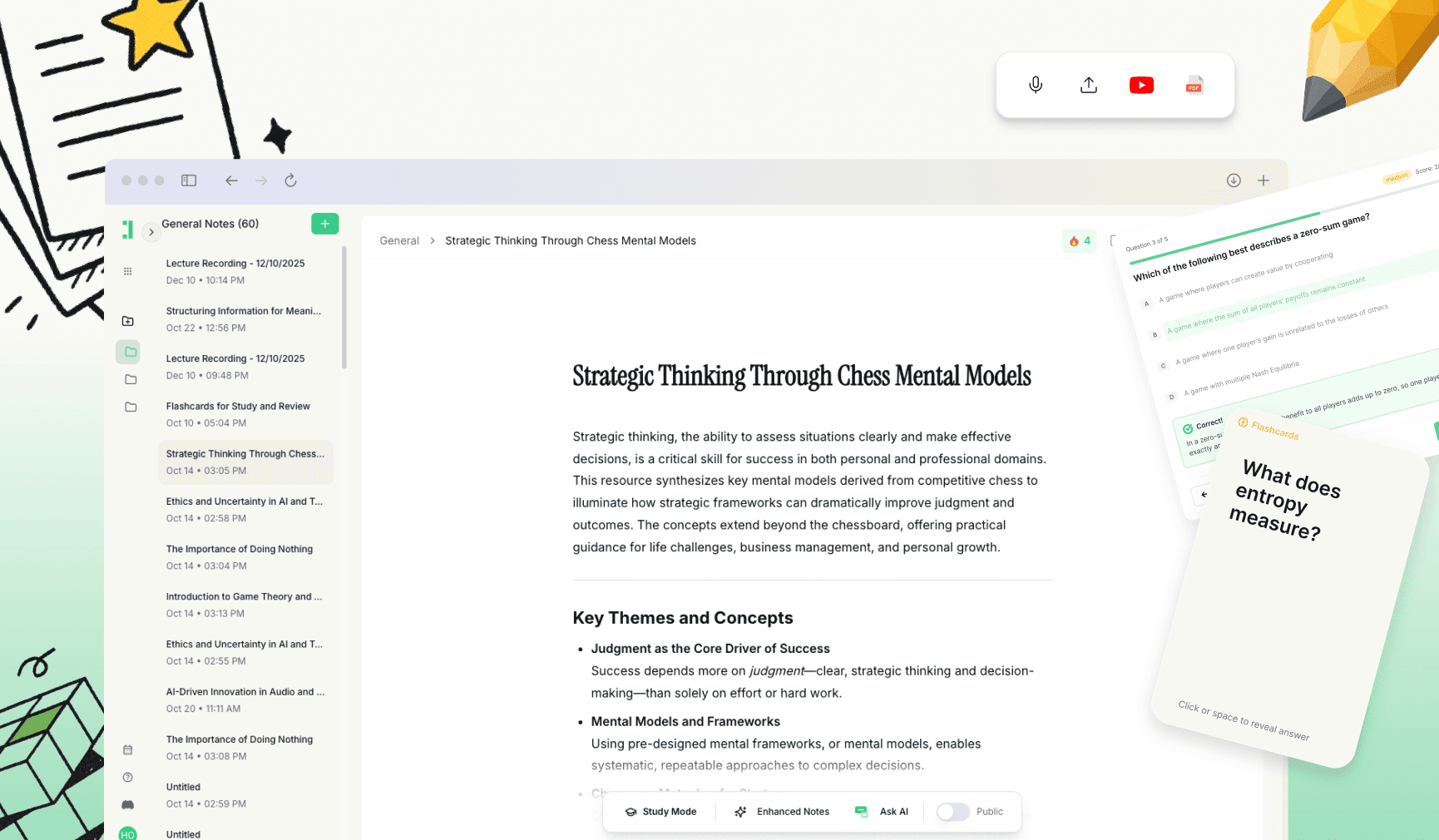
What are Data Mining flashcards?
Data Mining flashcards are concise study tools designed to help you master complex analytical processes, from data preprocessing to predictive modeling. They cover essential concepts like K-means clustering, decision trees, association rules, and outlier detection. Instead of passive reading, these flashcards force you to define terms and explain algorithms from memory.
The main outcome of using these cards is moving beyond recognition to actual mastery. By testing yourself on specific parameters and evaluation metrics, you build the mental agility required for technical exams and real-world data science projects. If you already have lecture notes or textbook chapters, Duetoday can generate a clean deck in minutes.
Why flashcards work for Data Mining
Data Mining requires a mix of theoretical understanding and procedural knowledge. You need to remember specific constraints for different algorithms and the mathematical relationships between data points. Flashcards utilize active recall and spaced repetition to ensure you don't forget the difference between supervised and unsupervised learning techniques.
Identify the right algorithm for specific data types.
Separate similar concepts like classification vs. regression.
Learn multi-step processes like the CRISP-DM lifecycle.
Practice identifying evaluation metrics like precision, recall, and F1-score.
What to include in your Data Mining flashcards
To make your study sessions effective, stick to the one idea per card rule. Use question-based prompts that simulate the kind of problems you will face in exams or technical interviews. Focus on logic over long-winded definitions.
Definitions: What is the curse of dimensionality?
Processes: What are the four main steps of the KDD process?
Comparisons: How does Apriori differ from FP-Growth?
Application: When would you use Euclidean distance over Manhattan distance?
Sample prompts for your deck: Define support and confidence in association rules, What is the role of a pruning stage in a decision tree?, and Explain the difference between a global and local outlier.
How to study Data Mining with flashcards
Success in Data Mining comes from consistency. Start with a two-pass approach: use Duetoday to build your deck from your syllabus, then go through the cards to filter out what you already know. Focus your energy on the algorithms or statistical concepts that feel the most abstract.
Make a deck from your lecture slides or technical documentation.
Do an initial sweep to identify difficult concepts like neural network backpropagation.
Review high-difficulty cards daily using spaced repetition.
Mix conceptual questions with small calculation prompts.
Complete a full deck review 48 hours before your exam.
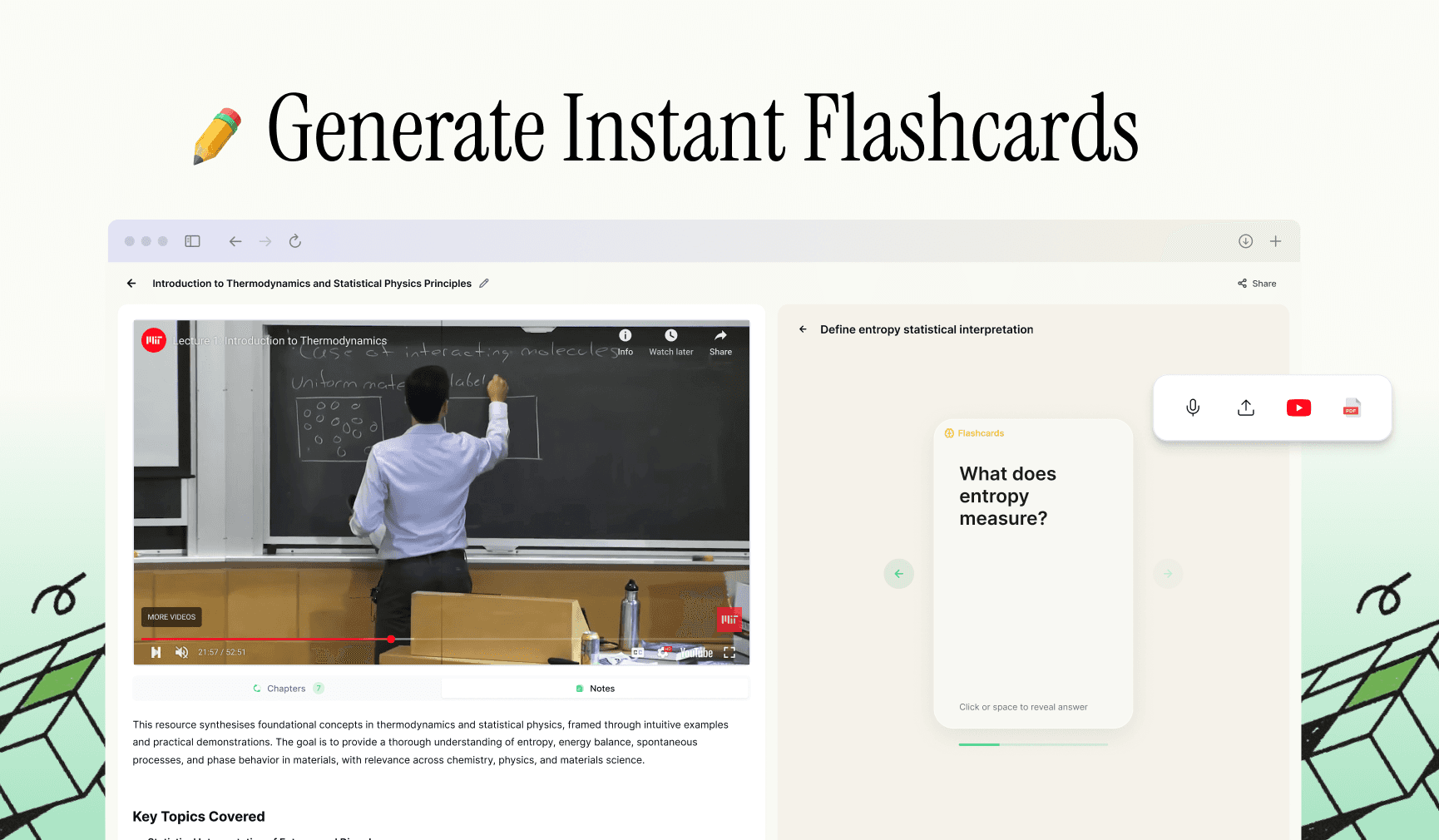
Generate Data Mining flashcards automatically in Duetoday
Manually typing out definitions for dozens of algorithms is a drain on your study time. It’s slow, tedious, and prevents you from actually learning the material. Duetoday automates the creation phase so you can jump straight into active recall.
Simply upload your PDFs, CSV documentation, or lecture transcripts. Our AI analyzes the technical hierarchy of your notes and creates structured question-and-answer pairs that cover the most critical exam topics.
Upload or paste your Data Mining material.
Click Generate Flashcards.
Review, edit, and start your study session instantly.
Common Data Mining flashcard mistakes
Avoid making cards that are too wordy. If a card contains an entire paragraph about Support Vector Machines, you'll end up memorizing the text rather than the core logic. Keep them snappy.
Too much text: Keep cards limited to one specific function or definition.
Ignoring the 'Why': Don't just learn what a tool is; include cards on why you choose it over another.
No visuals: Ensure you describe or link to visual clusters and tree structures.
Static studying: Update your deck as you move from basic theory to advanced neural networks.
FAQ
How many flashcards do I need for Data Mining? Aim for 50 to 100 cards for a standard university-level module to cover algorithms, preprocessing, and evaluation.
What’s the best format for Data Mining flashcards? A mix of 'Concept vs. Definition' and 'Problem vs. Solution' works best for technical subjects like this.
How often should I review my cards? Review new cards daily for the first three days, then extend the interval as your recall improves.
Should I make cards from a textbook or slides? Use lecture slides for the core exam topics and textbooks to clarify complex algorithms like Random Forests.
How do I stop forgetting formulas? Create specific 'Application' cards where you have to identify which part of a formula performs a specific task.
What if my flashcards feel too easy? Combine cards to test your knowledge of how different concepts relate, such as how outliers affect specific clustering methods.
Can I generate flashcards from a PDF automatically? Yes, Duetoday can ingest your Data Mining PDFs and extract key terms and processes into cards.
Are digital flashcards better than paper? Yes, digital cards allow for easier organization of complex technical terms and support spaced repetition algorithms.
How long does it take to make a full deck? With Duetoday, you can generate a comprehensive deck from your notes in less than a minute.
Can Duetoday organize my cards by topic? Yes, the tool categorizes your generated cards so you can study clustering, classification, or association rules separately.

Duetoday is an AI-powered learning OS that turns your study materials into personalised, bite-sized study guides, cheat sheets, and active learning flows.