Generate Flashcards for Cryptography
Make custom flashcards for Cryptography to master encryption, keys, and security protocols through our AI guide.
Generate Flashcards with AI Free
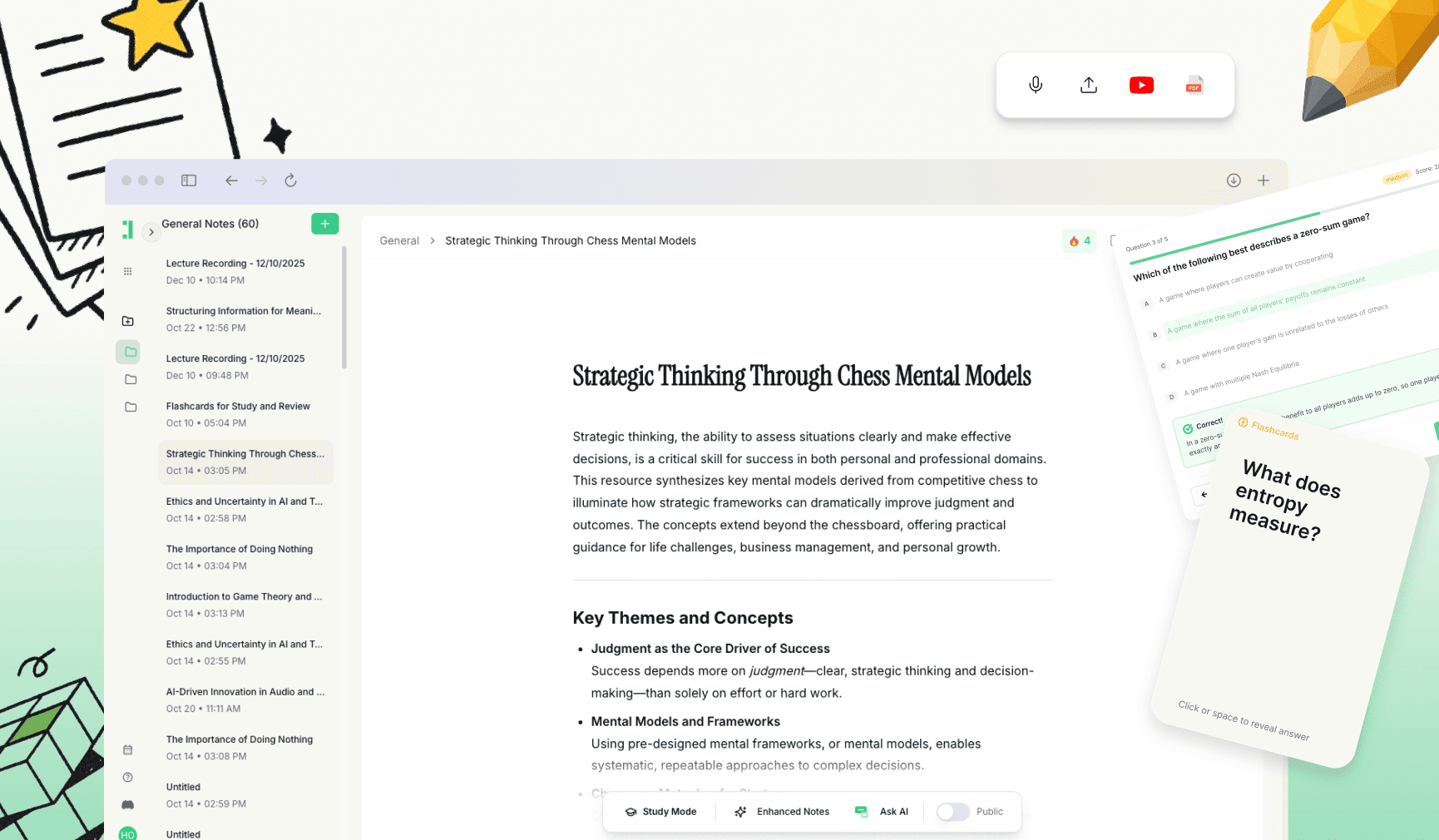
Generate Flashcards for Cryptography
Turn your complex cryptography notes, PDFs, slides, or lecture transcripts into structured Cryptography flashcards so you can review faster and remember more. Whether you are studying RSA algorithms, hash functions, or public-key infrastructure, Duetoday helps you master these difficult concepts without the manual work.
Generate Cryptography FlashcardsUpload notes / paste text
When you use Duetoday, the process is simple: upload your study material, generate your cards, review or edit the content, and start your study session immediately.
What are Cryptography flashcards?
Cryptography flashcards are focused study tools designed to break down dense security concepts into bite-sized, testable units. They cover essential areas such as encryption standards (AES, DES), mathematical foundations like modular arithmetic, and modern security protocols like TLS/SSL.
The outcome is a shift from passive reading to active testing. Instead of staring at a textbook on elliptic curve cryptography, you test your ability to explain how it works from memory, which builds long-term neural pathways and better exam readiness.
If you already have lecture notes, Duetoday can generate a clean, professional deck in minutes, saving you hours of formatting.
Why flashcards work for Cryptography
Cryptography is a field built on precise definitions, multi-step processes, and specific mathematical relationships. Flashcards are uniquely suited for this because they force you to isolate variables and prove you understand the logic behind the code.
By using active recall and spaced repetition, you ensure that you aren't just memorizing definitions but are actually able to recall the correct steps of a handshake protocol or a decryption formula under pressure.
Memorize complex encryption and decryption algorithms without cramming
Set clear distinctions between Symmetric vs. Asymmetric encryption
Learn cryptographic processes step-by-step (e.g., the Diffie-Hellman exchange)
Practice applying modular arithmetic and logic rules quickly
What to include in your Cryptography flashcards
Effective Cryptography flashcards follow the atomic rule: one specific idea per card. You want to avoid long paragraphs and focus on question-based prompts that trigger specific memories.
We recommend organizing your deck into four main categories to ensure full coverage of the subject matter:
Definitions & Key Terms: What is Salting? Define a Nonce in one sentence.
Processes & Steps: What is the first step in a TLS handshake?
Comparisons: How does AES differ from DES?
Application: When would you use a Stream Cipher over a Block Cipher?
Example prompts: Describe the role of the Private Key in RSA, What are the three properties of a secure Hash Function? and Explain the Birthday Attack in the context of collisions.
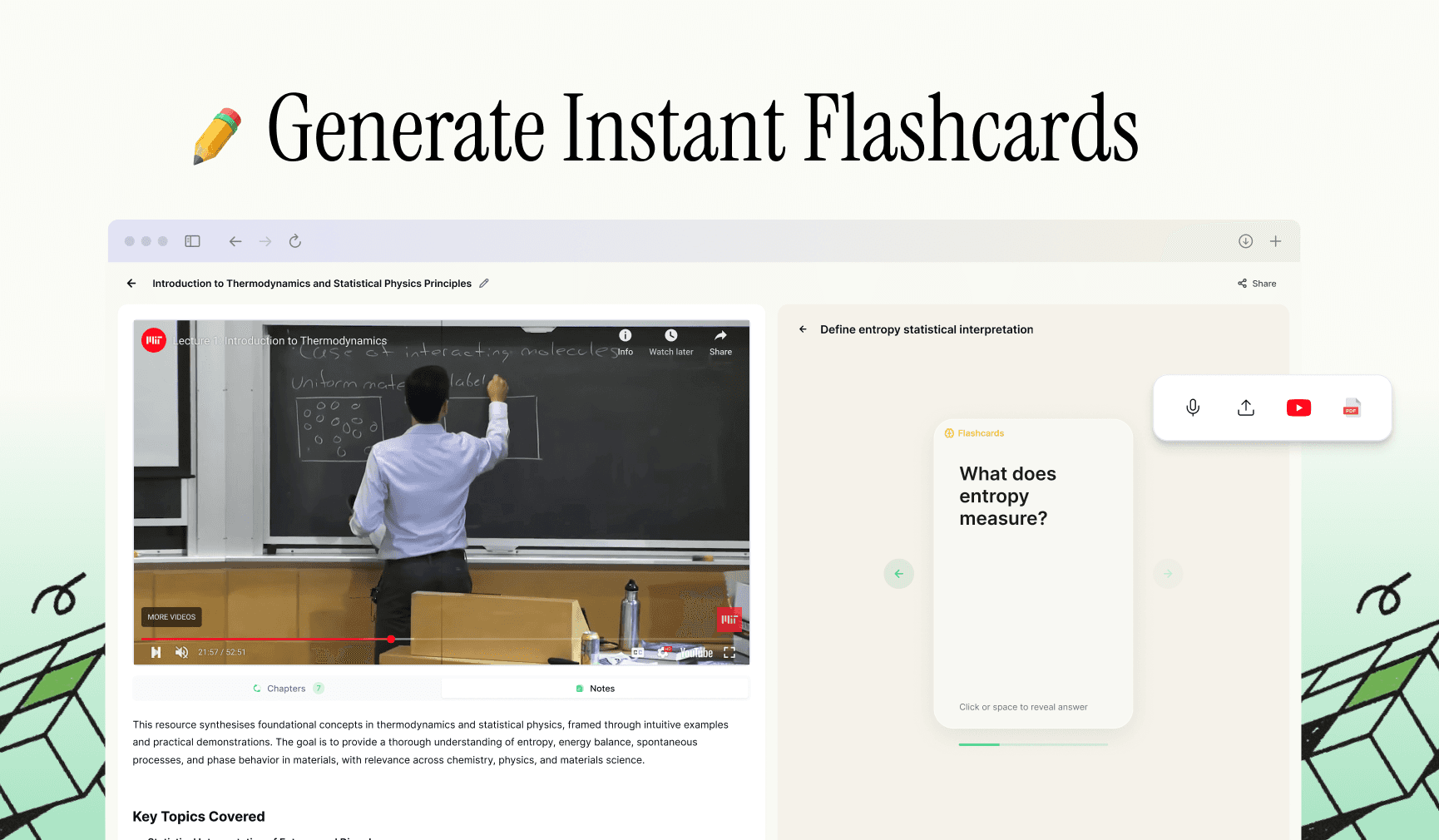
How to study Cryptography with flashcards
Mastering Cryptography requires a systematic approach. We recommend a two-pass workflow: first, use the AI to build your comprehensive deck, and then review it in targeted rounds to isolate what you don't know.
Focus your study sessions on the logic behind the math. Don't just memorize the name of an attack; try to visualize the vulnerability it exploits as you flip the card.
Make a deck from your PDF notes or textbook chapters in Duetoday.
Do one quick pass of the whole deck to identify high-difficulty cards.
Review these weak spots daily for at least three days.
Mix in foundational cards with implementation cards to keep your brain sharp.
Conduct a final randomized review before your exam or lab.
Generate Cryptography flashcards automatically in Duetoday
Creating flashcards manually is notoriously slow, especially for technical subjects like Cryptography where you have to type out formulas and draw diagrams. It often leads to messy notes and inconsistent study habits.
Duetoday solves this by automating the creation process. You provide the source material—whether it's a PDF on network security or a slide deck on blockchain—and our AI extracts the most important concepts for you.
Upload or paste your Cryptography material.
Click Generate Flashcards.
Review, edit for personal nuance, and start studying.
Generate Cryptography Flashcards in Duetoday
Start with your notes and get a deck you can actually use today.
Common Cryptography flashcard mistakes
Many students fail to get the most out of their cards because they make them too wordy or too simple. Avoid these common pitfalls to ensure your study time is effective:
Cards are too long: If a card takes 30 seconds to read, it's a note, not a flashcard. Split it up.
Relying on rote memorization: Don't just memorize the term; add How does this prevent X attack?
Ignoring the math: Ensure you have separate cards for the mathematical theories and the practical code.
No review schedule: Spaced repetition only works if you actually come back to the cards you missed.
Ready to generate your Cryptography flashcards?
Stop rereading and start recalling. Turn your complex security notes into a high-powered study deck in seconds. Upload your material, generate your first deck, and master Cryptography with ease.
Start Generating Flashcards
Works with notes, PDFs, slides, and transcripts.
FAQ
How many flashcards do I need for Cryptography? It depends on the scope, but usually 50-100 cards cover the core concepts of an introductory course, while 200+ may be needed for advanced protocol analysis.
What’s the best format for Cryptography flashcards? Question and answer format works best, specifically focusing on Why and How for algorithms rather than just What..
How often should I review Cryptography flashcards? Ideally every day for the first week, then every 3-4 days as you become more confident in the material.
Should I make cards from a textbook or lecture notes? Converting your lecture notes is often better because they highlight what your specific instructor finds most important for exams.
How do I stop forgetting encryption steps? Use step-by-step cards where one card asks for step 1, the next for step 2, and a third for the final outcome.
What if my flashcards feel too easy? Combine concepts. Instead of asking what RSA is, ask how RSA solves the key distribution problem mentioned on a previous card.
Can I generate Cryptography flashcards from a PDF? Yes, Duetoday is designed to parse PDFs and extract the most relevant cryptographic terms and logic automatically.
Are digital flashcards better than paper for Cryptography? Digital is usually better for technical subjects as you can easily edit formulas, add code snippets, and use automated spaced repetition algorithms.
How long does it take to make a full Cryptography deck? With Duetoday, you can generate a full deck in under one minute after uploading your materials.
Can Duetoday organize my flashcards for me? Yes, the AI categorizes cards by topic and difficulty, helping you stay organized as your knowledge base grows.

Duetoday is an AI-powered learning OS that turns your study materials into personalised, bite-sized study guides, cheat sheets, and active learning flows.