Generate Flashcards for Consumer Surplus and Producer Surplus
Generate Consumer and Producer Surplus flashcards in seconds. Try out our free AI tool today!
Generate Flashcards with AI Free

Turn your notes, PDFs, or slides into Consumer and Producer Surplus flashcards
Mastering market efficiency requires more than just looking at graphs; it requires active recall of formulas, definitions, and shifts in supply and demand. By turning your economics lectures into flashcards, you can review faster and ensure you never confuse consumer gain with producer profit during an exam.
Generate Consumer and Producer Surplus Flashcards
Upload notes / Paste text
In Duetoday, the process is simple: upload your economics materials, and our AI instantly identifies key concepts. You receive a structured deck ready for review, allowing you to edit or jump straight into active study mode.
What are Consumer and Producer Surplus flashcards?
Consumer and Producer Surplus flashcards cover the fundamental concepts of welfare economics. These cards break down the difference between what consumers are willing to pay versus the actual market price, and the price producers receive versus their minimum acceptable cost.
The outcome is a shift from passive reading to active testing. Instead of staring at a supply and demand curve, you test yourself on how shifts in price affect the shaded areas of the graph, building true recall of market efficiency and deadweight loss.
Why flashcards work for Consumer and Producer Surplus
Economics is a subject built on logical relationships and mathematical calculations. Flashcards are ideal for this because they force you to visualize the graph and calculate values without looking at your notes.
Memorize the exact formulas for calculating triangle areas (1/2 base x height).
Separate similar concepts like individual surplus vs. total market surplus.
Identify how price ceilings and floors create deadweight loss.
Practice applying the "willingness to pay" rule across different scenarios.
What to include in your Consumer and Producer Surplus flashcards
Effective economics flashcards follow the "one idea per card" rule. Use question-based prompts that force your brain to retrieve the logic behind the curves rather than just memorizing a definition.
Definitions: "What is the definition of Consumer Surplus?"
Formulas: "What is the formula for calculating total welfare?"
Comparisons: "How does Producer Surplus differ from total revenue?"
Application: "If the market price increases, what happens to Consumer Surplus?"
Example Prompts:
Define 'Willingness to Pay'.
Where is Producer Surplus located on a supply and demand graph?
What is the formula for Total Surplus?
How do you calculate the area of Deadweight Loss?
Define the 'Marginal Seller'.
What happens to Producer Surplus when the supply curve shifts left?
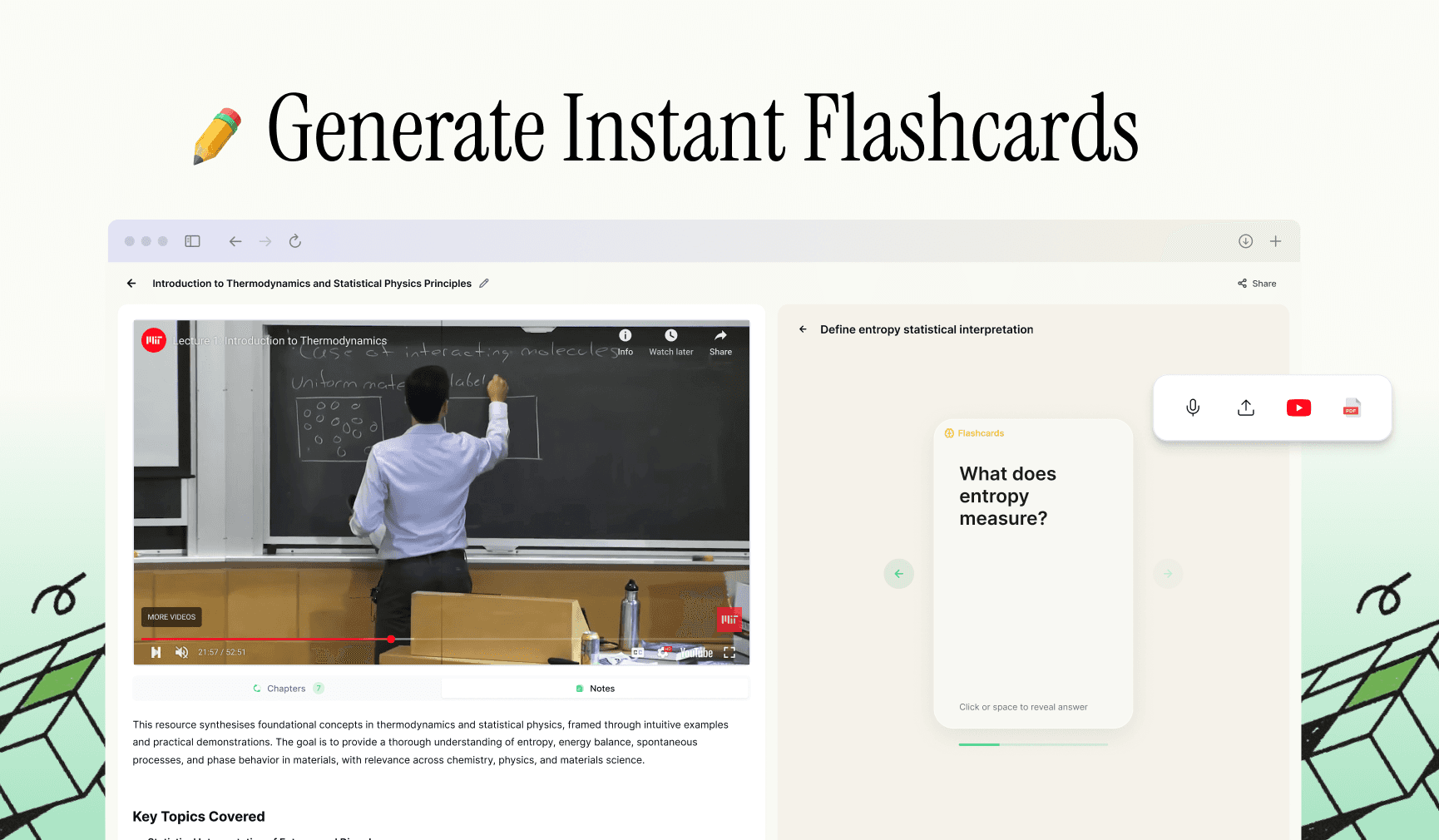
How to study Consumer and Producer Surplus with flashcards
The best way to master this topic is a two-pass approach. First, generate your deck to establish your baseline of knowledge, then use spaced repetition to hammer home the harder graphical interpretations.
Start with quick sessions focusing on definitions. Once those are locked in, move to the calculation cards. Review the cards you get wrong daily, and mix them with older topics like demand determinants to ensure you can distinguish between different economic shocks.
Generate a deck from your textbook or lecture slides.
Do a quick round to identify which formulas you keep forgetting.
Review the 'Deadweight Loss' cards daily until they become second nature.
Practice visualizing the graph shifts before flipping the card.
Do a final mixed review of all market efficiency topics before your midterm.
Generate Consumer and Producer Surplus flashcards automatically
Manually drawing graphs and writing out formulas on paper cards is incredibly slow. It takes time away from actual studying. Duetoday automates the tedious part so you can focus on the learning.
Simply upload your Microeconomics PDF or paste your lecture notes. Duetoday’s AI analyzes the text, finds the key definitions and formulas, and builds a professional deck in seconds.
Upload your Microeconomics notes or slides.
Click "Generate Flashcards."
Review, edit the AI’s work, and start your study session.
Generate Flashcards in Duetoday
Stop wasting hours on prep. Start with your notes and get a deck you can actually use today.
Common mistakes (and how to fix them)
Many students create poor economics flashcards that lead to "false mastery." Avoid these pitfalls to ensure you actually understand the material.
Cards are too wordy: Don't paste a whole paragraph. Use "Price - Cost = PS" format.
Ignoring the graph: Always include a prompt that asks where the area is located (e.g., "Above supply, below price").
Confusing Surplus with Profit: Add a specific card explaining why Producer Surplus is not the same as accounting profit.
No schedule: Don't just study the night before. Use spaced repetition for the calculation steps.
Ready to generate your flashcards?
Don't spend another hour rereading your textbook. Turn your notes into a powerful active recall tool and master the supply and demand curves today.
Start Generating Flashcards
Works with notes, PDFs, slides, and transcripts.

FAQ
How many flashcards do I need for this topic? Usually, a set of 20–30 cards is enough to cover the core definitions, formulas, and graph shifts for consumer and producer surplus.
What is the best format for these flashcards? A mix of 'Front/Back' for definitions and 'Image/Description' for identifying areas on a supply and demand graph.
How often should I review them? Review your surplus cards every other day until the formulas are muscle memory, then once a week to maintain recall.
Should I make cards from my textbook or slides? Both. Your textbook provides the formal definitions, while lecture slides often highlight the specific graph shifts your professor cares about.
How do I stop forgetting the formulas? Use flashcards that ask you to calculate surplus using specific numbers. The more you apply the formula, the more it sticks.
Are digital flashcards better than paper for Economics? Yes, because you can quickly regenerate decks for different chapters and use AI to create cards from complex digital PDFs.
Can I generate flashcards from a PDF automatically? Absolutely. Duetoday allows you to upload any Microeconomics PDF and converts the text into questions and answers instantly.
How long does it take to make a full deck? With Duetoday, it takes less than a minute. Manually, it could take an hour or more to write out 30 high-quality cards.

Duetoday is an AI-powered learning OS that turns your study materials into personalised, bite-sized study guides, cheat sheets, and active learning flows.