Generate Flashcards for Condensed Matter Physics
Make and generate Condensed Matter Physics flashcards to master crystal structures and thermodynamics using AI-powered study guides.
Generate Flashcards with AI Free
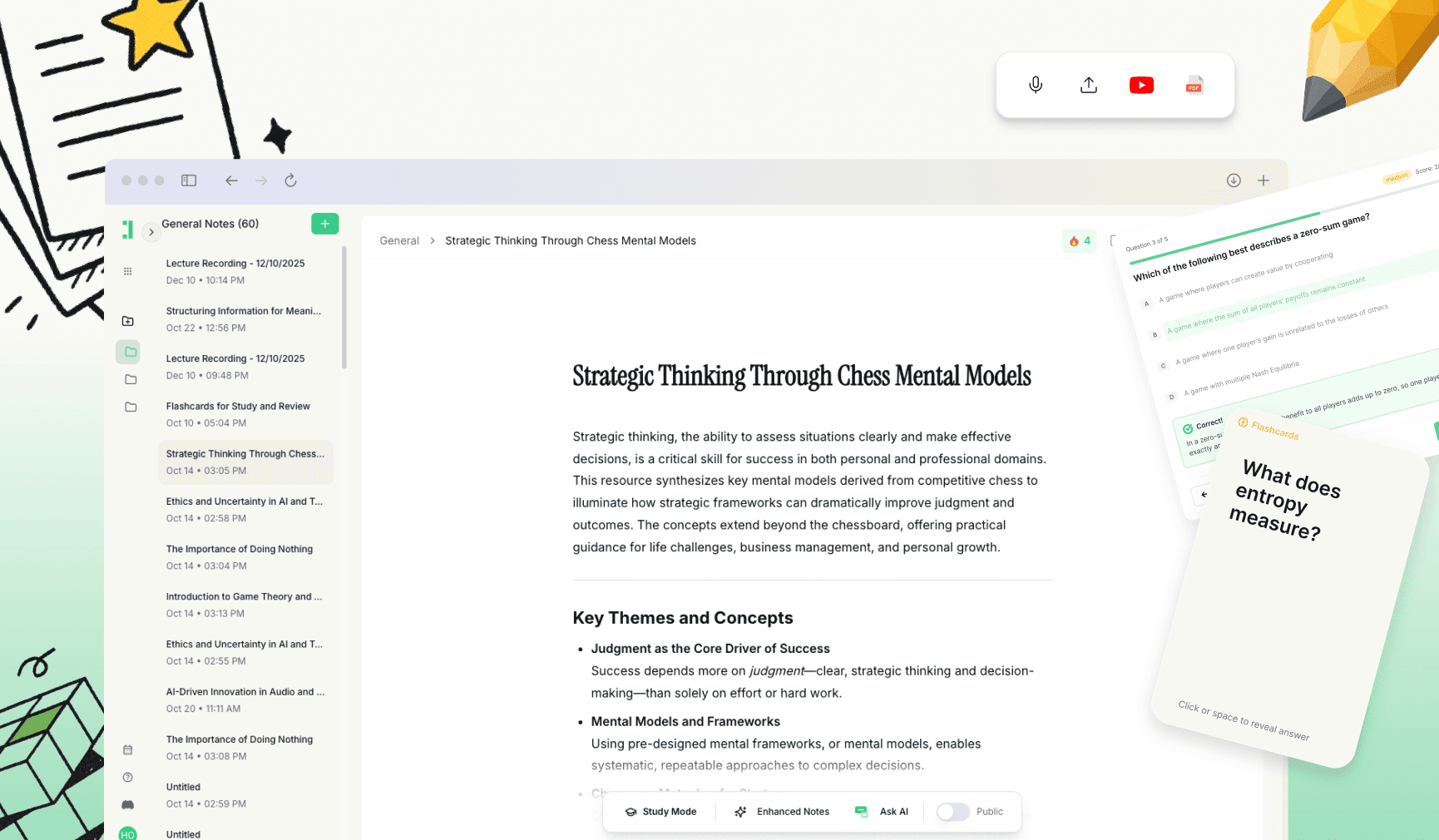
Turn your notes, PDFs, slides, or lectures into Condensed Matter Physics flashcards so you can review faster and remember more.
Mastering the complexities of solid-state physics requires more than just reading textbooks. With Duetoday, you can transform dense technical documents into interactive study sets that help you grasp the intricate behaviors of matter.
What are Condensed Matter Physics flashcards?
Condensed Matter Physics flashcards are specialized study tools that break down the physical properties of solid and liquid phases of matter. They cover essential concepts such as Bravais lattices, phonon dispersions, electronic band structures, and superconductivity. Instead of passively scanning a complex derivation, these cards force you to recall specific symmetry operations or transport equations.
By using these flashcards, you transition from recognizing a term to actually explaining the underlying mechanics. If you already have notes or research papers, Duetoday can generate a clean, structured deck in minutes, saving you hours of manual formatting.
Why flashcards work for Condensed Matter Physics
This subject relies heavily on connecting abstract mathematical models to physical properties. Flashcards are ideal for creating the mental shortcuts needed to navigate these relationships quickly during exams or research. Through active recall and spaced repetition, you reinforce the neural pathways associated with complex hardware and quantum phenomena.
Remember crystal symmetry groups and Miller indices without late-night cramming.
Separate similar concepts like Diamagnetism vs. Paramagnetism.
Learn the steps of the Tight-Binding model or Kronig-Penney derivation.
Practice applying the Fermi-Dirac distribution to different temperature regimes.
What to include in your Condensed Matter Physics flashcards
The most effective physics flashcards follow the "atomic" rule: one specific concept per card. This prevents cognitive overload and ensures you actually know the material rather than just recognizing the phrasing of a long paragraph.
Definitions & Key Terms: "What is the Meissner effect?" "Define the reciprocal lattice."
Processes & Steps: "What are the steps for calculating a Brillouin zone?"
Comparisons: "How does an insulator differ from a semiconductor in terms of energy gaps?"
Application: "Given a BCC structure, what is the packing fraction?"
Example prompts include: "What is the significance of the Debye temperature?", "State Bloch's Theorem for an electron in a periodic potential," or "How does the heat capacity of a solid behave at low temperatures according to the Einstein model?"
How to study Condensed Matter Physics with flashcards
We recommend a systematic approach to conquer this difficult subject. Start by building a comprehensive deck from your lecture slides or the Kittel/Ashcroft textbooks. Once generated, perform a 'diagnostic pass' to see which concepts like 'Topological Insulators' or 'Hall Effect' are tripping you up.
Make a deck from your notes or generate it automatically from your PDF syllabus.
Do one quick round to identify weak spots in your understanding of reciprocal space.
Review the most difficult quantum statistics cards daily.
Mix in easier cards (like lattice types) to maintain high confidence.
Perform a final mixed review of all materials before your midterm or final exam.
Generate Condensed Matter Physics flashcards automatically in Duetoday
Creating cards for physics is notoriously slow because of the symbols, diagrams, and equations involved. Manually typing out LaTeX formulas or drawing crystal structures on paper cards is a recipe for burnout. Duetoday eliminates this friction by using AI to parse your technical materials.
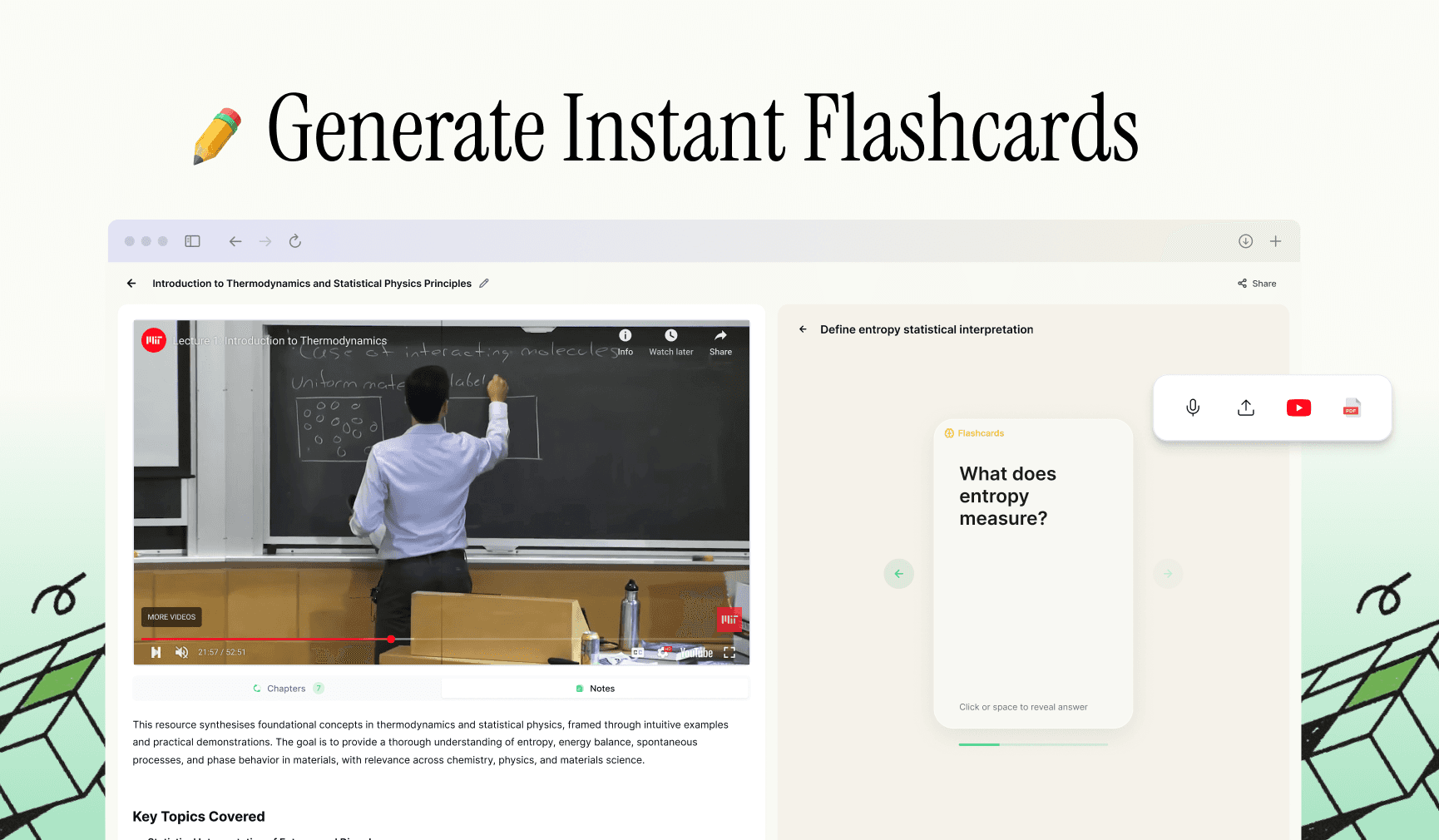
Upload your textbook PDFs, lecture transcripts, or handwritten notes.
Click 'Generate Flashcards' to see the AI create high-level conceptual questions.
Review, edit the formulas if needed, and start studying immediately.
Stop rereading. Start recalling. Upload your material and get a study-ready deck today.
Common Condensed Matter Physics flashcard mistakes
Avoid the 'wall of text' trap. Physics cards are often too detailed, leading to rote memorization of sentences rather than concepts. Ensure you are splitting complex derivations into three or four separate cards.
Cards are too long: Split a 5-step derivation into 5 individual cards.
Only memorizing definitions: Add cards that ask "Why does this happen?"
Ignoring the math: Include the core formula on the back of the card.
No review schedule: Ensure you revisit the 'Superconductivity' deck even after you think you've mastered it.
FAQ
How many flashcards do I need for Condensed Matter Physics? Usually, a standard semester course requires 150-300 cards to cover everything from crystal structure to transport properties efficiently.
What’s the best format for these flashcards? A question-on-front, answer-on-back format works best, especially when including specific formulas or conditions for physical laws.
How often should I review my physics cards? Use a spaced repetition schedule; review new cards daily and mastered cards once every few weeks to combat the forgetting curve.
Should I make cards from a textbook or slides? Both. Textbooks provide the 'why' while slides usually highlight the 'what' that will actually be on your exam.
How do I stop forgetting the Brillouin zones? Create cards that ask you to draw the zone for specific lattices, as visual recall is vital in condensed matter.
What if my flashcards feel too easy? Increase the difficulty by adding application-based questions, such as 'How does X change if the temperature is doubled?'
Can I generate flashcards from a PDF automatically? Yes, Duetoday is designed to read complex PDFs and extract the most important physical concepts for you.
Are digital flashcards better than paper? For physics, digital is often better because you can easily sync formulas across devices and use AI to generate cards with mathematical notation.
How long does it take to make a full deck? With Duetoday, you can generate a full deck in under two minutes once your notes are uploaded.
Can Duetoday organize my cards by topic? Yes, you can categorize your decks by chapter, such as 'Crystal Vibrations' or 'Fermi Surfaces,' to keep your study sessions focused.

Duetoday is an AI-powered learning OS that turns your study materials into personalised, bite-sized study guides, cheat sheets, and active learning flows.