Generate Flashcards for Computer Vision
Easily generate or make Computer Vision flashcards to study image processing, CNNs, and deep learning architectures with ease.
Generate Flashcards with AI Free
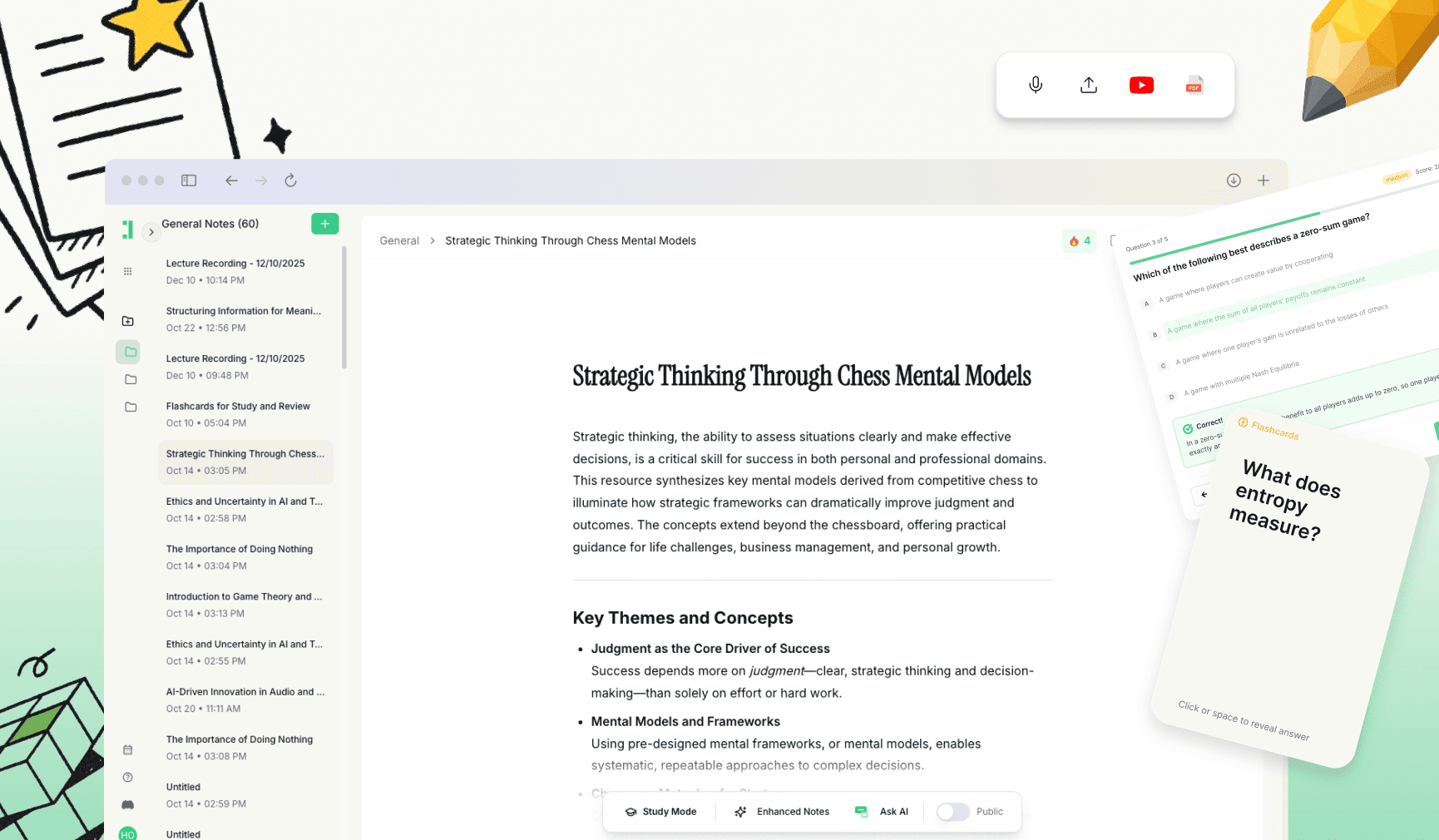
Generate Flashcards for Computer Vision
Turn your notes, PDFs, slides, or lecture transcripts into Computer Vision flashcards so you can review complex architectures faster and remember more for your exams or projects.
Generate Computer Vision FlashcardsUpload notes / paste text
In Duetoday, the process is simple: upload your materials, and our AI instantly identifies key concepts to generate a structured deck. You can then review, edit, and start your study session immediately.
What are Computer Vision flashcards?
Computer Vision flashcards cover the essential building blocks of how machines interpret visual data. This includes key terms like kernels and strides, mathematical formulas for convolutions, different hardware requirements, and the specific layers within neural network architectures.
Instead of passively rereading dense textbooks or watching long tutorials, these flashcards force you to test yourself on specific concepts like object detection, semantic segmentation, and feature extraction, building much stronger mental recall.
If you already have notes, Duetoday can generate a clean deck in minutes.
Why flashcards work for Computer Vision
Computer Vision requires a mix of theoretical understanding and mathematical application. Flashcards help bridge the gap between knowing a definition and understanding a process.
By using active recall and spaced repetition, you ensure that complex topics like backpropagation or loss functions move from your short-term memory into long-term mastery without the need for traditional cramming.
Remember architectures like CNNs, ResNets, and Transformers without confusion.
Separate similar concepts such as R-CNN vs. YOLO for object detection.
Learn mathematical processes step-by-step, including pooling and normalization.
Practice identifying the right filters and activation functions for specific tasks.

What to include in your Computer Vision flashcards
Effective Computer Vision flashcards follow the one idea per card rule. They should be question-based and prompt you to visualize or calculate specific outcomes rather than just memorizing long definitions.
Definitions & Key Terms: What is an image kernel? or Define Intersection over Union (IoU).
Processes & Steps: What are the four main steps in the Canny edge detection algorithm?
Comparisons: How does Max Pooling differ from Average Pooling?
Application: Which loss function is best for multi-class image classification?
Example prompts: What is the purpose of a stride in a convolution?, Define a bounding box., Explain the difference between supervised and self-supervised learning in CV., What does a 1x1 convolution accomplish?
How to study Computer Vision with flashcards
A simple system involves a two-pass approach. Start by generating your deck from your syllabus and doing an initial quick pass to identify which architectures or formulas are the hardest for you to recall.
Review those difficult cards daily for a few days while mixing in easier cards to maintain your overall knowledge. Before a quiz or technical interview, do a final mixed review of the entire deck to ensure you can switch between topics like GANs and traditional image filters seamlessly.
Make a deck from your lecture notes or papers.
Do a quick round to flag weak spots.
Review weak cards every morning.
Mix in harder application scenarios.
Perform a full deck review before your exam.
Generate Computer Vision flashcards automatically in Duetoday
Making cards manually is slow, and when dealing with complex CV diagrams and math, it’s easy to get disorganized. Duetoday automates this so you can focus on the actual learning.
Upload your CV slides or research PDFs.
Click Generate Flashcards.
Review the AI-generated questions and start studying.
Common Computer Vision flashcard mistakes
Avoid putting too much information on one card. If you try to explain an entire Transformer architecture on one card, you won't remember the details. Split it into smaller chunks like Self-attention mechanism and Positional encoding. Also, don't just memorize definitions; ensure you have cards that ask why specific parameters are chosen for specific image types.
FAQ
How many flashcards do I need for Computer Vision? Usually, 50-100 cards per major unit (like Image Preprocessing or Deep Learning) is sufficient to cover key details without being overwhelming.
What’s the best format for CV flashcards? A mix of conceptual questions and What happens if? scenarios works best for Computer Vision.
How often should I review? Aim for short 15-minute sessions daily rather than one long session once a week.
Should I make cards from a textbook or slides? Both. Slides usually have the high-level concepts, while textbooks provide the mathematical formulas you need to master.
How do I stop forgetting architectures? Use spaced repetition—a system that Duetoday helps manage by showing you difficult architectures more frequently.
What if my flashcards feel too easy? Add more application-based questions, like predicting the output dimensions of a specific convolutional layer.
Can I generate CV flashcards from a PDF? Yes, Duetoday is designed to parse PDFs and turn technical text into study-ready cards.
Are digital flashcards better than paper? For Computer Vision, digital is better because you can easily include images of graphs, layers, and code snippets.
How long does it take to make a full deck? With Duetoday, it takes seconds to generate a draft from your uploaded files.
Can Duetoday organize my cards? Yes, the tool automatically categorizes cards based on the context of your uploaded notes.

Duetoday is an AI-powered learning OS that turns your study materials into personalised, bite-sized study guides, cheat sheets, and active learning flows.