Generate Flashcards for Computer Architecture
Make flashcards for Computer Architecture to master CPU design, assembly, and memory hierarchy. Generate study decks fast.
Generate Flashcards with AI Free
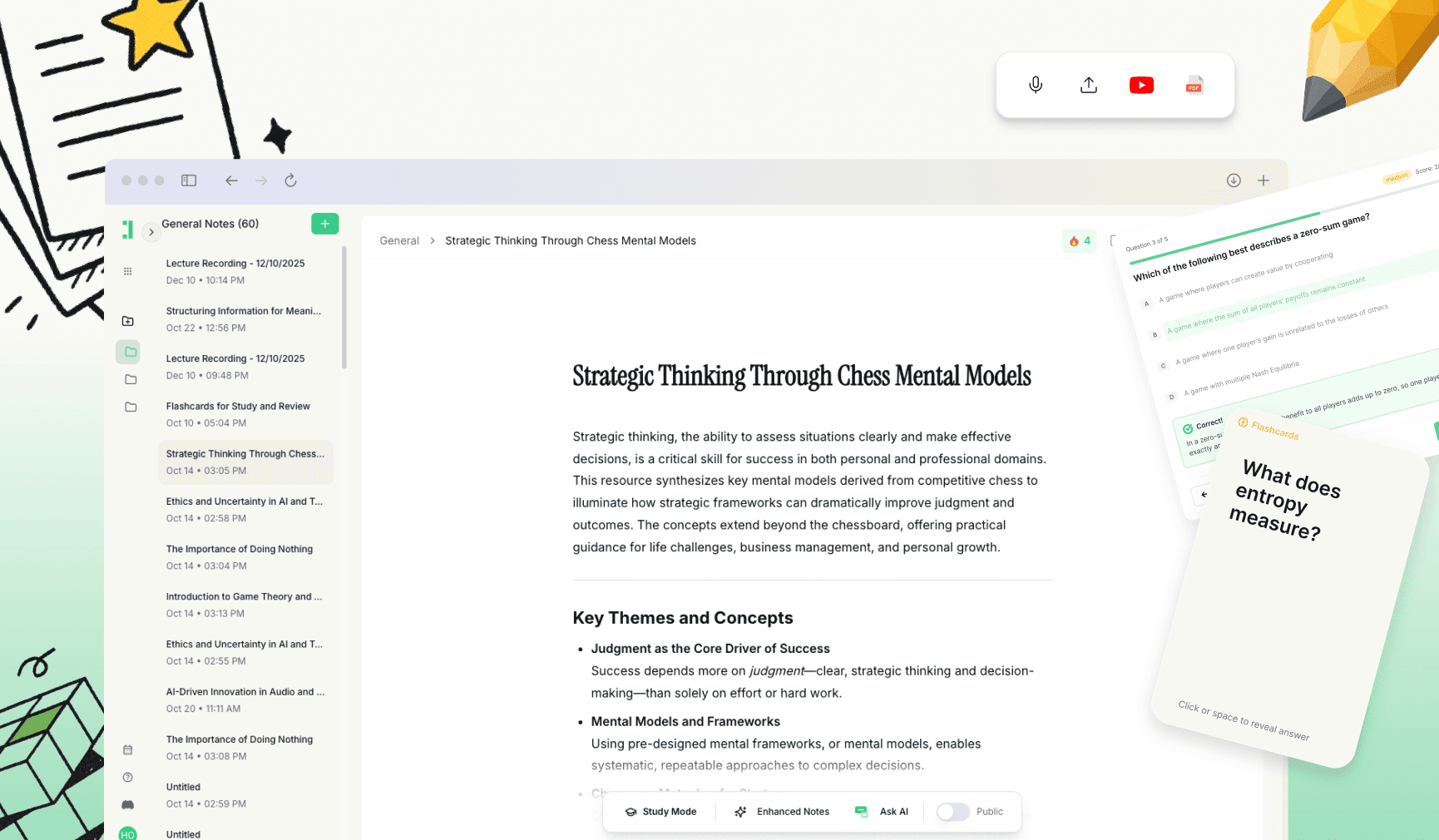
Generate Flashcards for Computer Architecture
Turn your notes, PDFs, slides, or lectures into Computer Architecture flashcards so you can review faster and remember more. Whether you are studying logic gates or complex pipelining, Duetoday helps you master the hardware-software interface without manual effort.
Generate Computer Architecture FlashcardsUpload notes / paste text
In Duetoday, the process is simple: upload your materials, generate your deck, review or edit the cards, and start studying with active recall immediately.
What are Computer Architecture flashcards?
Computer Architecture flashcards cover the fundamental principles of how computer systems are designed and organized. This includes key terms like ALU and control units, steps in the instruction cycle, cache mapping formulas, and the cause/effect relationships of hardware bottlenecks.
Instead of passively rereading dense textbooks on RISC vs. CISC, these flashcards force you to test yourself on specific components and logic. If you already have lecture notes, Duetoday can generate a clean, organized deck in minutes.
Why flashcards work for Computer Architecture
Computer Architecture requires a mix of rote memorization for terminology and deep understanding of sequences and data flow. Flashcards bridge the gap between knowing a definition and understanding how data moves through a processor.
By using active recall and spaced repetition, you ensure that complex concepts like branch prediction or virtual memory management stay fresh in your mind without the need for last-minute cramming.
Remember instruction formats (R-type, I-type, J-type) without confusion.
Separate similar concepts like Von Neumann vs. Harvard architectures.
Learn the stages of the instruction pipeline step-by-step.
Practice applying Amdahl's Law or calculating cache hit ratios quickly.
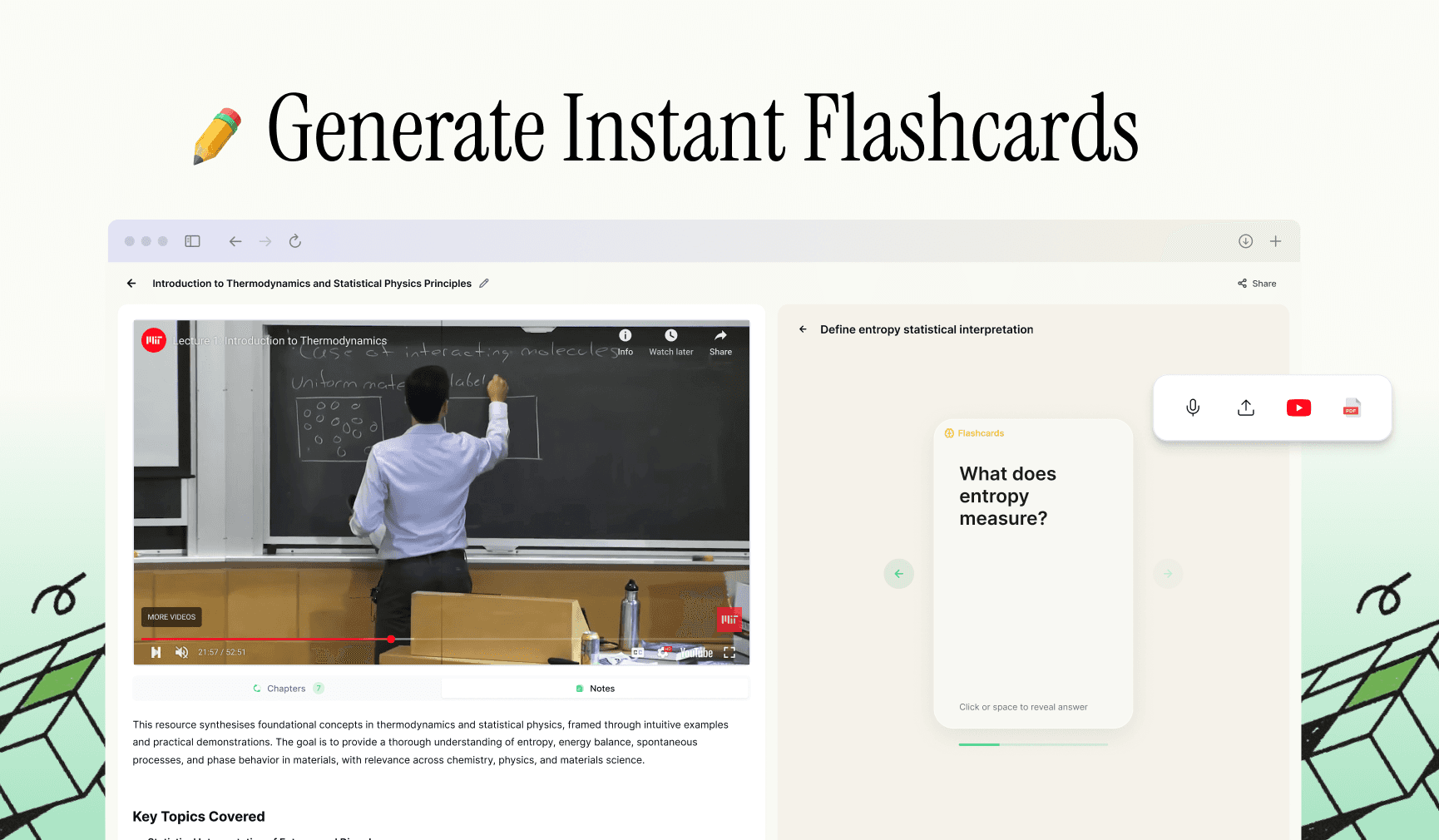
What to include in your Computer Architecture flashcards
Effective flashcards follow the principle of one idea per card. Keep your questions focused so you can quickly identify exactly which part of the architecture you've mastered and which needs more work.
Definitions & Key Terms: What is the role of the Program Counter? Define Instruction Set Architecture (ISA).
Processes & Steps: What are the five stages of a classic RISC pipeline?
Comparisons: How does SRAM differ from DRAM in terms of speed and density?
Application: If the clock cycle decreases, how does it affect the CPU execution time?
Example prompts: Explain the difference between Big-Endian and Little-Endian, What is the purpose of a Translation Lookaside Buffer (TLB)? or List the hazards that can occur in a pipeline.
How to study Computer Architecture with flashcards
Computer Architecture is hierarchical; you should study it that way too. Start with a two-pass approach: build your deck and then review in focused rounds to isolate the difficult hardware logic.
Make a deck from your notes or generate it from technical PDFs in Duetoday.
Do one quick round to identify weak spots like cache mapping or assembly syntax.
Review weak cards daily to strengthen your mental model of the CPU.
Mix in harder application problems, like calculating MIPS, into each session.
Perform a final mixed review across all chapters before your exam.
Generate Computer Architecture flashcards automatically
Making hardware diagrams and architecture cards manually is incredibly slow and often messy. Duetoday streamlines this by letting you upload your slides or transcripts and converting them into structured study material instantly.
Upload your Computer Architecture PDF or lecture slides.
Click Generate Flashcards.
Review, edit, and start studying your custom deck.
Generate Computer Architecture Flashcards in Duetoday
Start with your notes and get a deck you can actually use today to ace your hardware exams.
Common Computer Architecture flashcard mistakes
Many students create cards that are too broad, such as Explain how a CPU works, which is too complex for a single flashcard. Instead, break it down into the fetch, decode, and execute cycles.
Cards are too long: Split complex diagrams into individual component questions.
Only memorizing acronyms: Ensure you add why cards for things like RAID levels.
Ignoring the math: Include cards for performance equations and binary conversions.
No review schedule: Computer Architecture is dense; use spaced repetition to keep it in long-term memory.
FAQ
How many flashcards do I need for Computer Architecture? For a standard semester course, a deck of 150-250 cards usually covers the core ISA, arithmetic, and memory concepts.
What’s the best format for these flashcards? Question-and-answer format is best for definitions, while 'cloze deletion' (fill-in-the-blank) works well for assembly code snippets.
How often should I review? Review new concepts daily and older concepts every 3-5 days to maintain the complex logic required for hardware design.
Should I make cards from a textbook or slides? Textbooks are better for deep theory, while lecture slides usually contain the specific diagrams and formulas your professor will test.
How do I stop forgetting the different pipelining hazards? Create specific comparison cards for Data, Structural, and Control hazards to note their distinct differences.
What if my flashcards feel too easy? Add application cards that require you to calculate execution time or determine cache hits based on a sequence of addresses.
Can I generate flashcards from a PDF automatically? Yes, Duetoday can process your Computer Architecture PDFs and extract the most relevant technical terms for cards.
Are digital flashcards better than paper? Yes, digital cards allow for easier insertion of architecture diagrams and support spaced repetition algorithms.
How long does it take to make a full deck? Manually it can take hours; with Duetoday's AI, it takes less than a minute after uploading your notes.
Can Duetoday organize my flashcards by topic? Yes, you can generate and categorize decks by chapters like 'Memory Hierarchy' or 'Arithmetic Logic Units.'

Duetoday is an AI-powered learning OS that turns your study materials into personalised, bite-sized study guides, cheat sheets, and active learning flows.