Generate Flashcards for Computational Physics
Make Computational Physics flashcards from your notes. Learn how to generate study guides for physics simulations and algorithms.
Generate Flashcards with AI Free
Generate Flashcards for Computational Physics
Turn your complex notes, PDFs, Python scripts, or lecture slides into Computational Physics flashcards so you can review numerical methods faster and master simulation logic. Instead of struggling with dry theory, you can convert dense technical documentation into bite-sized study units designed for memory retention.
Generate Computational Physics Flashcards
Upload code / paste theory
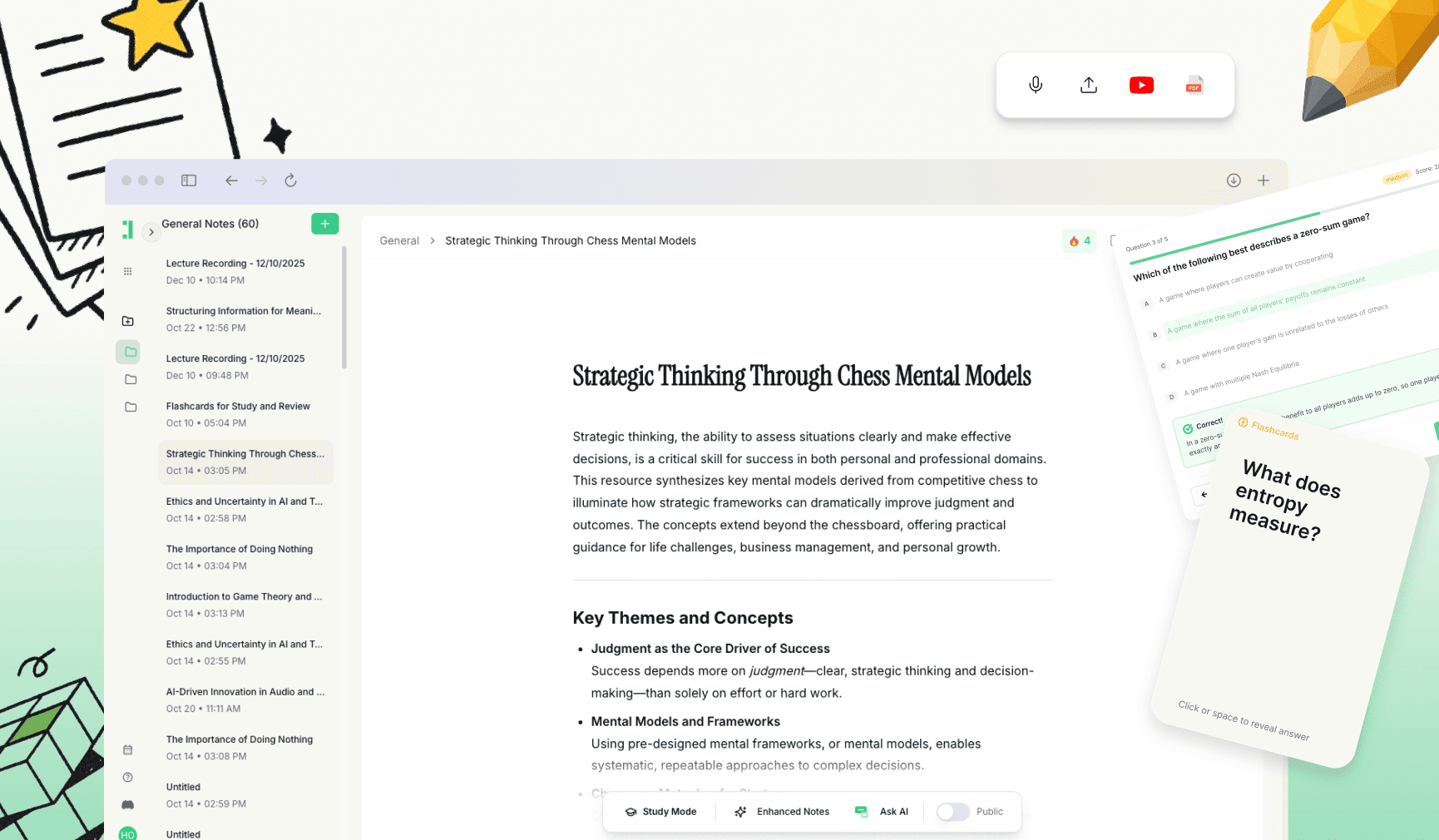
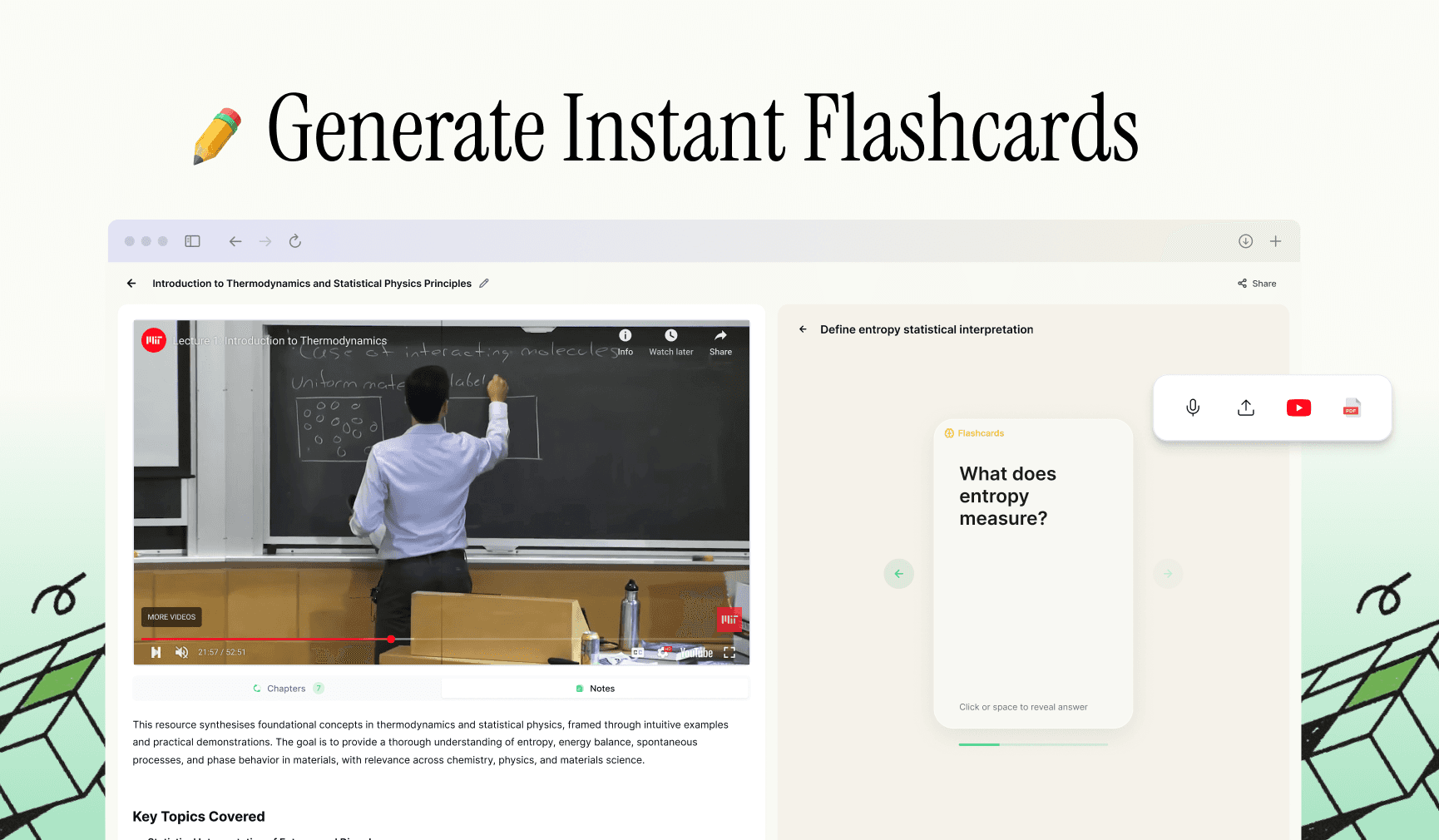
In Duetoday, the process is simple: upload your materials, and our AI identifies key algorithms and mathematical proofs to generate a custom deck. You can then review, edit, and study your flashcards anywhere.
What are Computational Physics flashcards?
Computational Physics flashcards cover the intersection of physical theory and numerical implementation. They break down complex topics like root-finding algorithms, differential equation solvers (like Runge-Kutta), Monte Carlo simulations, and error analysis into manageable questions.
Instead of just staring at lines of code or long derivations, these flashcards force you to explain the 'why' behind the algorithm. This builds active recall, ensuring you understand the physics before you even hit 'run' on your compiler. If you already have lecture notes, Duetoday can generate a clean deck in minutes.
Why flashcards work for Computational Physics
Computational Physics requires a mix of theoretical understanding and procedural knowledge. You need to remember both the physical laws and the constraints of the numerical methods used to solve them. Flashcards bridge this gap by enforcing active recall and spaced repetition.
Memorize stability conditions for numerical schemes without cramming.
Distinguish between truncation errors and round-off errors.
Learn iterative processes step-by-step (e.g., the steps of the Metropolis algorithm).
Practice identifying which numerical method fits a specific physical system.
What to include in your Computational Physics flashcards
The best flashcards for this subject are concise and question-based. Avoid putting entire blocks of code on one card; instead, focus on the logic and the outcomes of specific methods.
Definitions & terms: Define 'Floating Point Precision' or 'Von Neumann Stability Analysis.'
Processes: 'What are the four stages of the RK4 method?'
Comparisons: 'How does the Euler method differ from the Verlet integration?'
Application: 'Which algorithm is best for a many-body gravitational simulation?'
Example prompts: "What is the convergence rate of the Newton-Raphson method?" or "Define the objective of a relaxation method in electrostatics."
How to study Computational Physics with flashcards
Mastering this subject requires a two-pass approach. First, use your cards to nail down the definitions and algorithm steps. Second, use them to troubleshoot conceptual hurdles in your coding projects.
Generate a deck from your syllabus or textbook chapters.
Run a quick review session to identify which algorithms you struggle to explain.
Review high-difficulty cards (like those on Fast Fourier Transforms) daily.
Mix theoretical physics cards with numerical implementation cards.
Perform a final review before your lab exams or project deadlines.
Generate Computational Physics flashcards automatically in Duetoday
Manually writing flashcards for technical subjects is exhausting and often leads to overly wordy cards. Duetoday automates this by extracting the most important formulas and logic from your files instantly.
Upload your Computational Physics PDFs or code snippets.
Click Generate Flashcards.
Edit your deck and start studying with our interactive player.
Generate Computational Physics Flashcards in Duetoday
Start with your notes and get a deck you can actually use today.
Common Computational Physics flashcard mistakes
Avoid these traps to ensure your study sessions are effective:
Cards are too long: Don't paste the whole script; ask about a specific function's purpose.
Ignoring constraints: Always include cards about the limitations of a method (e.g., when a method diverges).
Forgetting units: Include cards about non-dimensionalization, a key part of computational modeling.
No schedule: Computational concepts fade fast; use spaced repetition to keep them fresh.
FAQ
How many flashcards do I need for Computational Physics? Aim for 50-100 cards per major unit, such as Linear Algebra or Stochastic Processes, to cover both theory and methods.
What’s the best format for these cards? Use a 'Question and Answer' format that focuses on the 'why' and 'how' of numerical algorithms.
How often should I review? Daily review is best for algorithms you are currently coding, while weekly reviews work for broader physical theories.
Should I make cards from code or textbooks? Both. Use textbooks for the mathematical logic and your own code comments for the implementation details.
How do I stop forgetting the algorithms? Use spaced repetition to trigger recall just as you are about to forget the steps of the solver.
What if the flashcards feel too easy? Increase the difficulty by adding 'Scenario' cards, such as 'How would this algorithm fail if the step size is too large?'
Can I generate flashcards from a coding PDF? Yes, Duetoday can parse technical PDFs to create structured questions from the text and equations.
Are digital flashcards better than paper? Yes, digital cards allow you to easily include code snippets and use automated spaced repetition algorithms.
How long does it take to make a full deck? With Duetoday AI, you can generate a comprehensive deck from a lecture file in under a minute.
Can Duetoday organize my cards by topic? Yes, you can categorize your decks by sub-topics like 'Integration' or 'Matrix Inversion' for focused study.

Duetoday is an AI-powered learning OS that turns your study materials into personalised, bite-sized study guides, cheat sheets, and active learning flows.