Generate Flashcards for Computational Chemistry
Make and generate Computational Chemistry flashcards to master molecular modeling, DFT, and quantum mechanics with this expert guide.
Generate Flashcards with AI Free

Generate Flashcards for Computational Chemistry
Turn your complex notes, PDFs, molecular modeling slides, or quantum mechanics lectures into Computational Chemistry flashcards so you can review faster and remember intricate algorithms and theories more effectively.
Generate Computational Chemistry FlashcardsUpload notes / paste text
In Duetoday, the process is seamless: simply upload your specific study material, let the AI generate high-quality cards, review or edit the content, and start your study session immediately.
What are Computational Chemistry flashcards?
Computational Chemistry flashcards focus on the intersection of chemistry, physics, and computer science. They cover key terms such as Schrödinger equations, density functional theory (DFT), molecular mechanics (MM), and force fields, as well as the mathematical steps required for simulations.
Instead of passively rereading dense textbooks or code documentation, these flashcards force you to test yourself on specific concepts, building the strong mental recall needed for both exams and lab research. If you already have notes, Duetoday can generate a clean deck in minutes.
Why flashcards work for Computational Chemistry
Computational Chemistry requires a deep understanding of abstract mathematical models and their practical application to molecular systems. Flashcards help bridge the gap between theory and calculation.
By utilizing active recall and spaced repetition, you ensure that complex formulas and software-specific parameters move from short-term memory to long-term mastery without the stress of cramming.
Remember key terminology like Basis Sets and Pseudopotentials without cramming.
Separate similar concepts, such as Hartree-Fock vs. Density Functional Theory.
Learn multi-step simulation workflows and optimization cycles.
Practice applying physical constants and periodic properties quickly.
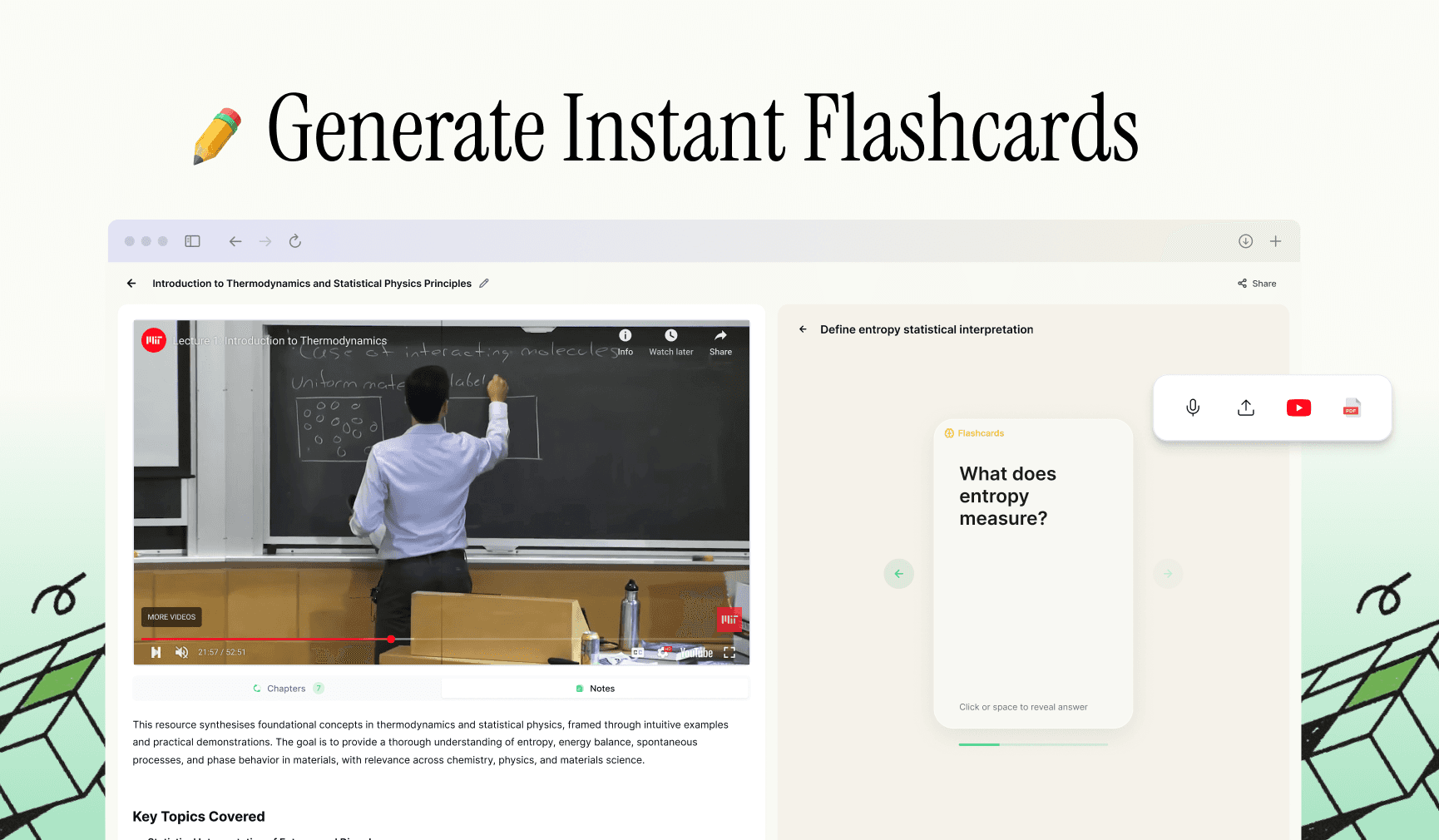
What to include in your Computational Chemistry flashcards
Effective flashcards follow the principle of one idea per card. Keep them question-based to trigger your brain's search for the answer. Using a mix of theory and practical application ensures a well-rounded understanding.
Definitions & key terms: Focus on concepts like Born-Oppenheimer Approximation or Stochastic Dynamics.
Processes & steps: Break down the stages of a geometry optimization or a Monte Carlo simulation.
Comparisons: Contrast different methods, such as Ab Initio vs. Semi-empirical approaches.
Application: Ask questions about which algorithm is best for a specific molecular size or state.
Example prompts include: What is the main limitation of the Hartree-Fock method? or Define the role of a Jacobian matrix in transition state searching.
How to study Computational Chemistry with flashcards
Try a two-pass approach: first, use Duetoday to build a comprehensive deck from your course materials. Then, review the entire deck once to identify which algorithms or theories are the most difficult to remember.
Focus your energy on those difficult cards by reviewing them daily, while spacing out the cards you already know. This targeted approach prevents you from wasting time on concepts you've already mastered.
Make a deck from your lecture notes or software manuals.
Do one quick round to find weak spots in theory or math.
Review weak cards daily for consistent reinforcement.
Mix in harder application cards as you gain confidence.
Perform a final mixed review before your midterm or lab project deadline.
Generate Computational Chemistry flashcards automatically in Duetoday
Manually creating flashcards for a subject as technical as Computational Chemistry is slow and prone to errors in complex formulas. Duetoday automates this so you can focus on the actual science.
Simply upload your PDFs, slides, or transcripts, and our AI will extract the most critical data points to create an organized, professional study deck in seconds.
Upload your Computational Chemistry material
Click Generate Flashcards
Review, edit, and start studying immediately
Generate Computational Chemistry Flashcards in Duetoday
Start with your notes and get a deck you can actually use today.
Common Computational Chemistry flashcard mistakes
Many students make the mistake of putting an entire paragraph on one card. This makes it impossible to test a single concept. Another common pitfall is ignoring the why behind a formula—ensure your cards ask for the reasoning behind choosing specific functionals or basis sets.
Ready to generate your Computational Chemistry flashcards?
Stop rereading and start recalling. Upload your notes today and let Duetoday build your perfect study companion.
Start Generating Flashcards
[object Object]

Duetoday is an AI-powered learning OS that turns your study materials into personalised, bite-sized study guides, cheat sheets, and active learning flows.