Generate Flashcards for Collisions
Turn physics notes into Collisions flashcards. Fast AI generation for momentum & impulse. Try for free!
Generate Flashcards with AI Free
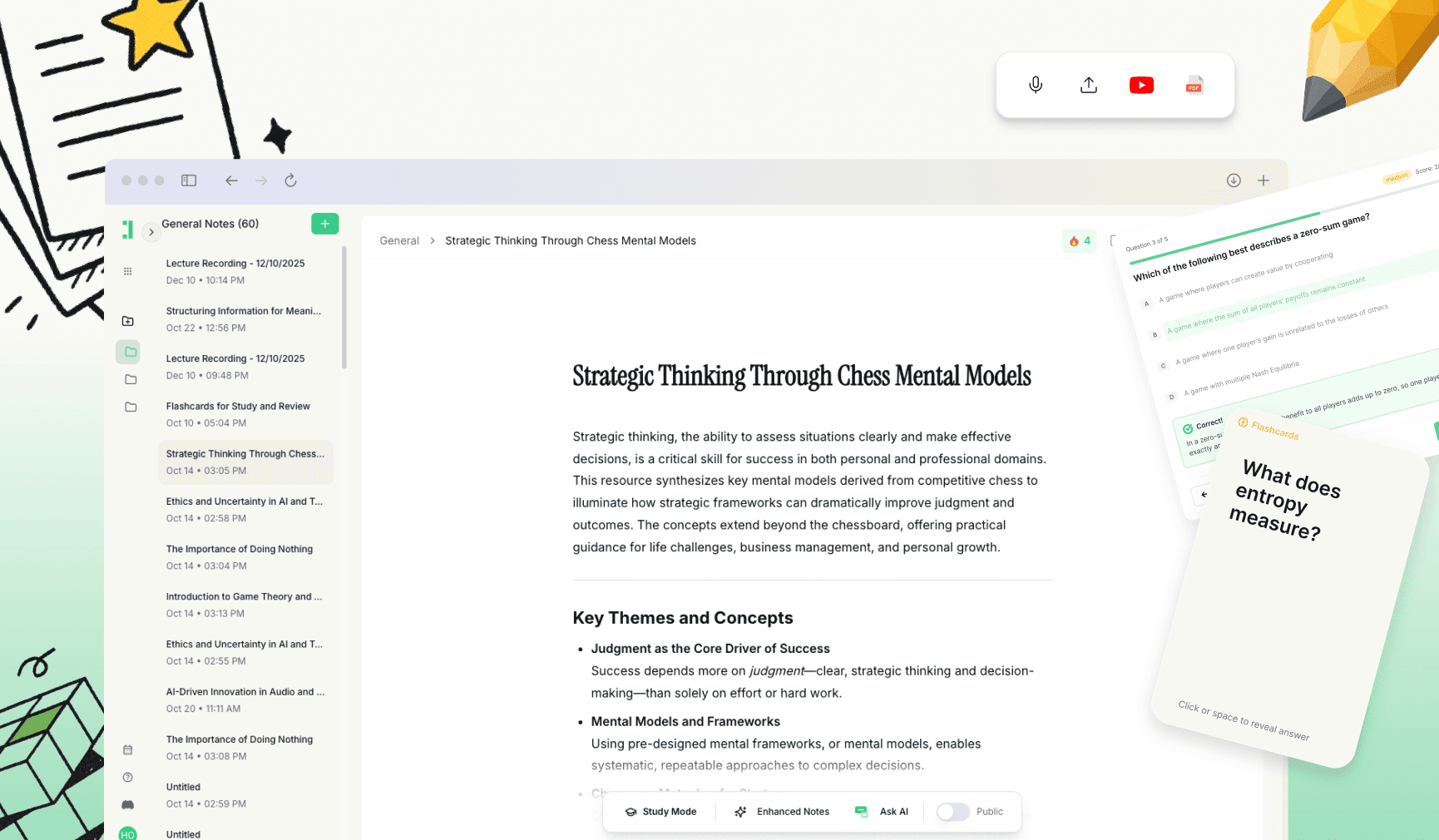
Generate Flashcards for Collisions
Turn your notes, PDFs, slides, or physics lectures into Collisions flashcards so you can review faster and remember more. Whether you are studying elastic impacts or perfectly inelastic collisions, Duetoday helps you master the math and theory behind every interaction.
Generate Collisions FlashcardsUpload physics notes
In Duetoday, the process is simple: upload your materials, and our AI identifies key principles like conservation of momentum. You get a ready-to-use deck that you can review, edit, and use for active recall immediately.
What are Collisions flashcards?
Collisions flashcards cover the mechanics of two or more bodies exerting forces on each other in a relatively short time. These cards break down complex physics problems into bite-sized questions focusing on momentum, kinetic energy, impulse, and the coefficient of restitution.
The outcome is a shift from passive reading to active testing. Instead of staring at a textbook diagram, you challenge yourself to recall which variables stay constant and which change, building the mental muscle needed for high-stakes exams.
If you already have notes, Duetoday can generate a clean deck in minutes.
Why flashcards work for Collisions
Collisions require a mix of conceptual understanding and rapid formula application. Flashcards bridge the gap between knowing a definition and knowing which equation to solve for in a split second. They leverage active recall to ensure you aren't just recognizing a problem, but actually solving it.
Remember momentum conservation rules without cramming
Separate similar concepts (e.g., Elastic vs. Inelastic collisions)
Learn multi-step problem solving pathways for 2D collisions
Practice applying the Impulse-Momentum theorem quickly
Master vector addition for off-center impacts
What to include in your Collisions flashcards
Effective physics flashcards follow the "one idea per card" rule. Instead of putting an entire multi-part problem on one card, break it down into the specific trigger points that lead to the solution.
Definitions & key terms: "What is an isolated system?" "Define impulse in terms of force and time."
Processes & steps: "What is the first step in solving a 2D collision problem?"
Comparisons: "How does kinetic energy behave in an elastic vs. an inelastic collision?"
Application: "If the velocity of object A doubles, what happens to its momentum?"
Example Prompts:
- "State the Law of Conservation of Momentum."
- "What is the formula for the Coefficient of Restitution?"
- "Does total energy change in a perfectly inelastic collision?"
- "What is the unit for Impulse?"
- "How do you calculate final velocity for sticking objects?"
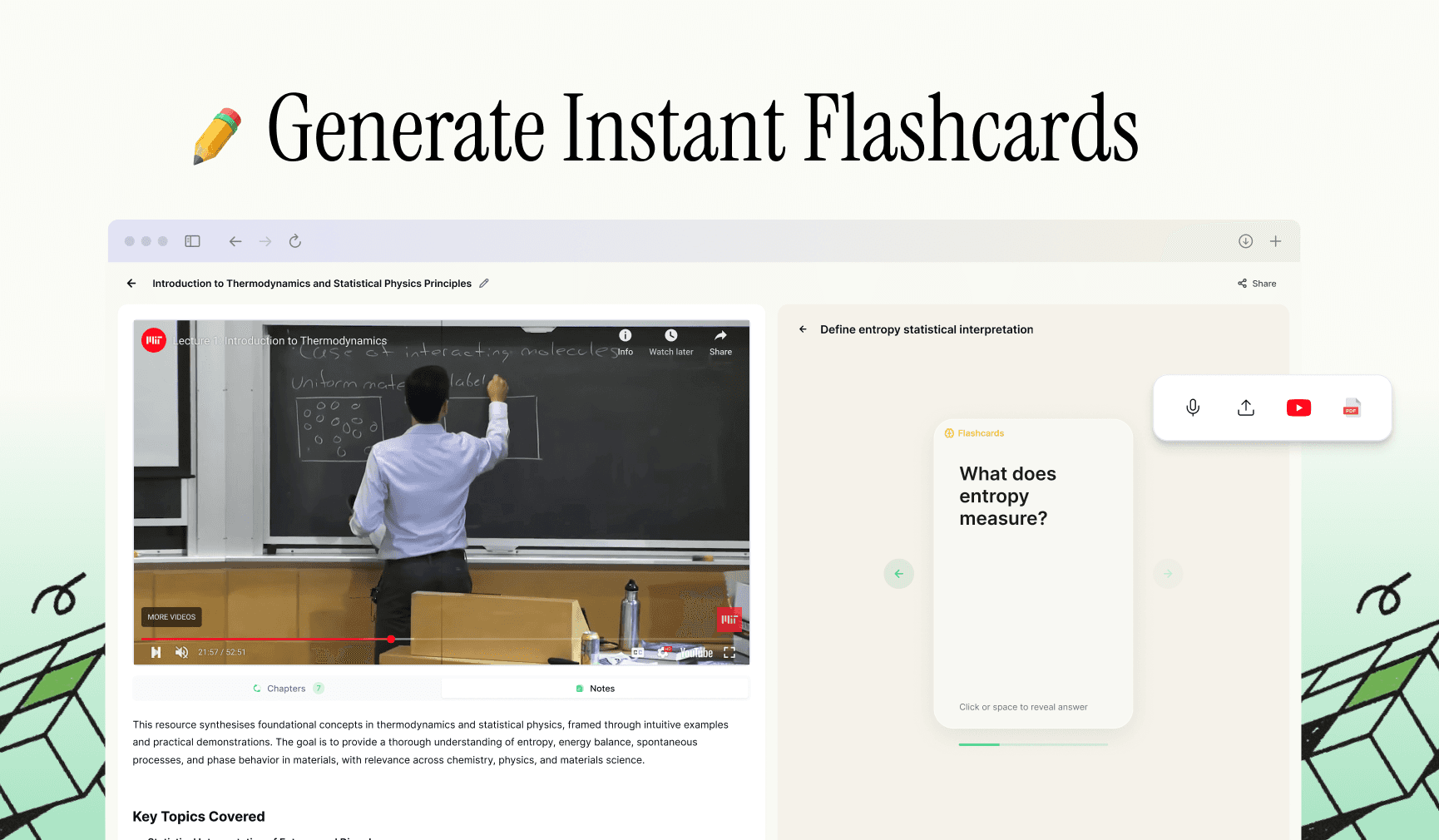
How to study Collisions with flashcards (a simple system)
Studying physics requires a systematic approach. You can't just memorize; you have to apply. Use the "two-pass" method: first, use flashcards to lock in the formulas and definitions, then use them to trigger the procedural steps of a physics problem.
Make a deck from your lecture slides or textbook chapters.
Do one quick round to identify which collision types (elastic, inelastic) confuse you.
Review high-difficulty cards daily to build fluency with vector math.
Mix in scenario-based cards to practice choosing the right formula.
Do a final mixed review of all mechanics topics before your exam.
Generate Collisions flashcards automatically in Duetoday
Making cards manually is slow and often results in cards that are too wordy to be useful. When you have an exam on Friday, you don't have time to copy-paste formulas into a deck manually. Duetoday streamlines this by extracting the core physics logic from your documents.
Upload your textbook PDF or paste your collision lab notes.
Click Generate Flashcards.
Review the AI-generated deck and start your study session.
Generate Collisions Flashcards in Duetoday
Start with your notes and get a deck you can actually use today.
Common Collisions flashcard mistakes
Physics students often create ineffective cards. Avoid these pitfalls to ensure your study time actually yields results:
Cards are too long: Don't put a 10-step problem on one card; split it into separate logic steps.
Ignoring vectors: Ensure cards remind you that momentum is a vector quantity (magnitude AND direction).
Only memorizing formulas: Add "why" cards to understand when a formula is applicable.
Neglecting units: Always include unit checks (kg·m/s) on your cards.
FAQ
How many flashcards do I need for Collisions? Usually 30-50 cards are enough to cover the core concepts of momentum, impulse, and different collision types for a standard unit.
What’s the best format for Collisions flashcards? Question-and-answer format is best for formulas, while "Compare/Contrast" is perfect for elastic vs. inelastic scenarios.
How often should I review Collisions flashcards? Review daily for the first three days, then every other day until the concepts feel like second nature.
Should I make cards from a textbook or lecture notes? Use both. Textbooks provide the rigorous definitions, while lecture notes often contain the specific problem-solving shortcuts your teacher prefers.
How do I stop forgetting the formulas after a few days? Spaced repetition is the key. Duetoday's system ensures you see the hardest formulas just before you’re about to forget them.
What if my flashcards feel too easy? Add application cards where you have to predict the outcome of a specific physical scenario rather than just defining a term.
Can I generate Collisions flashcards from a PDF automatically? Yes, Duetoday can read your physics PDFs and summarize them into a structured flashcard deck instantly.
Are digital flashcards better than paper for physics? Digital is often better because you can easily include diagrams of vector collisions and use automated spaced repetition algorithms.
How long does it take to make a full Collisions deck? With Duetoday, it takes less than a minute. Manually, it can take over an hour of writing and drawing.
Can Duetoday handle the math symbols in my notes? Yes, the AI is designed to recognize and format physics equations and scientific notation accurately.

Duetoday is an AI-powered learning OS that turns your study materials into personalised, bite-sized study guides, cheat sheets, and active learning flows.