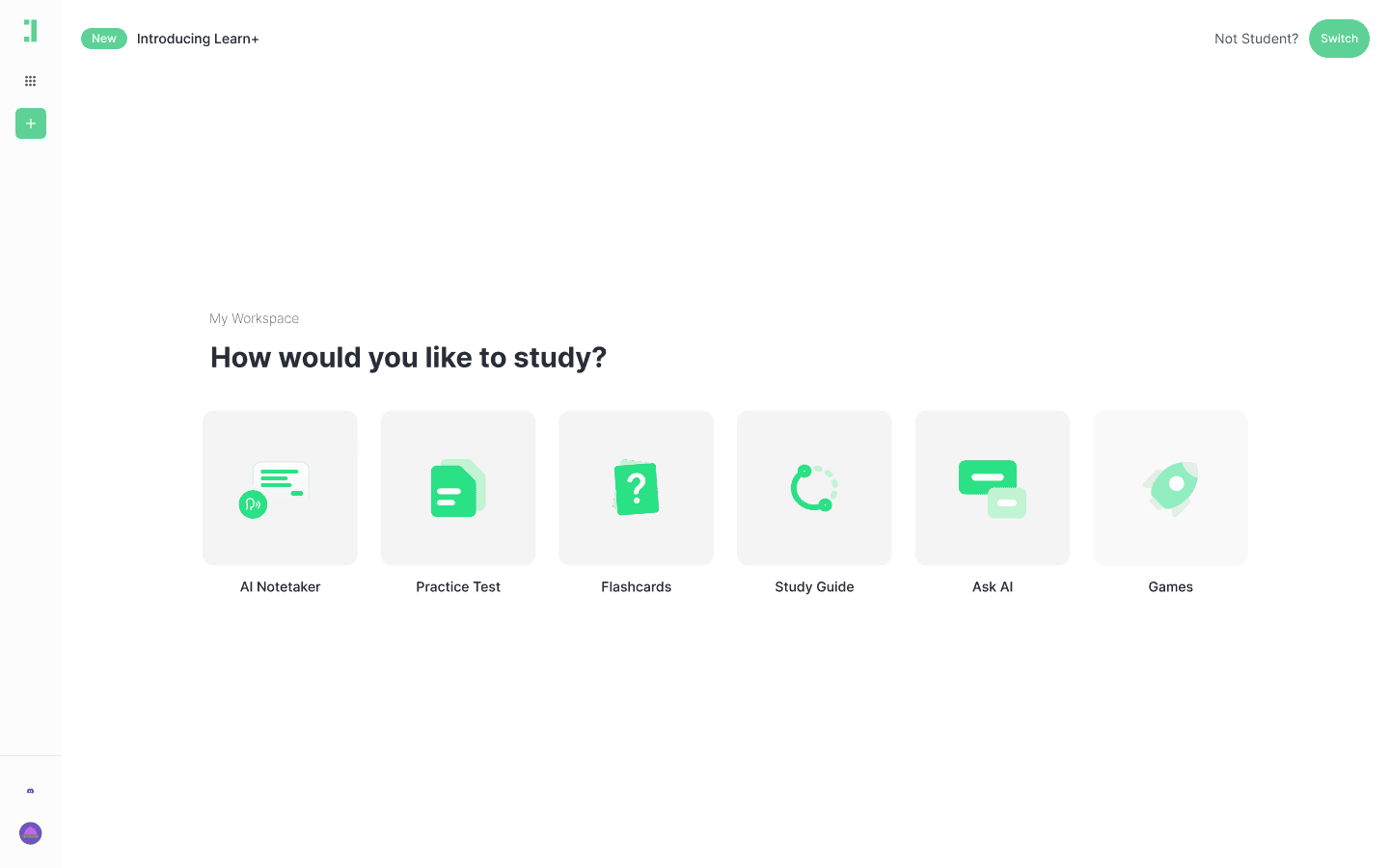
Generate Flashcards for Cognitive Psychology
Easily generate or make flashcards for Cognitive Psychology to master complex theories and memory models.
Generate Flashcards with AI Free
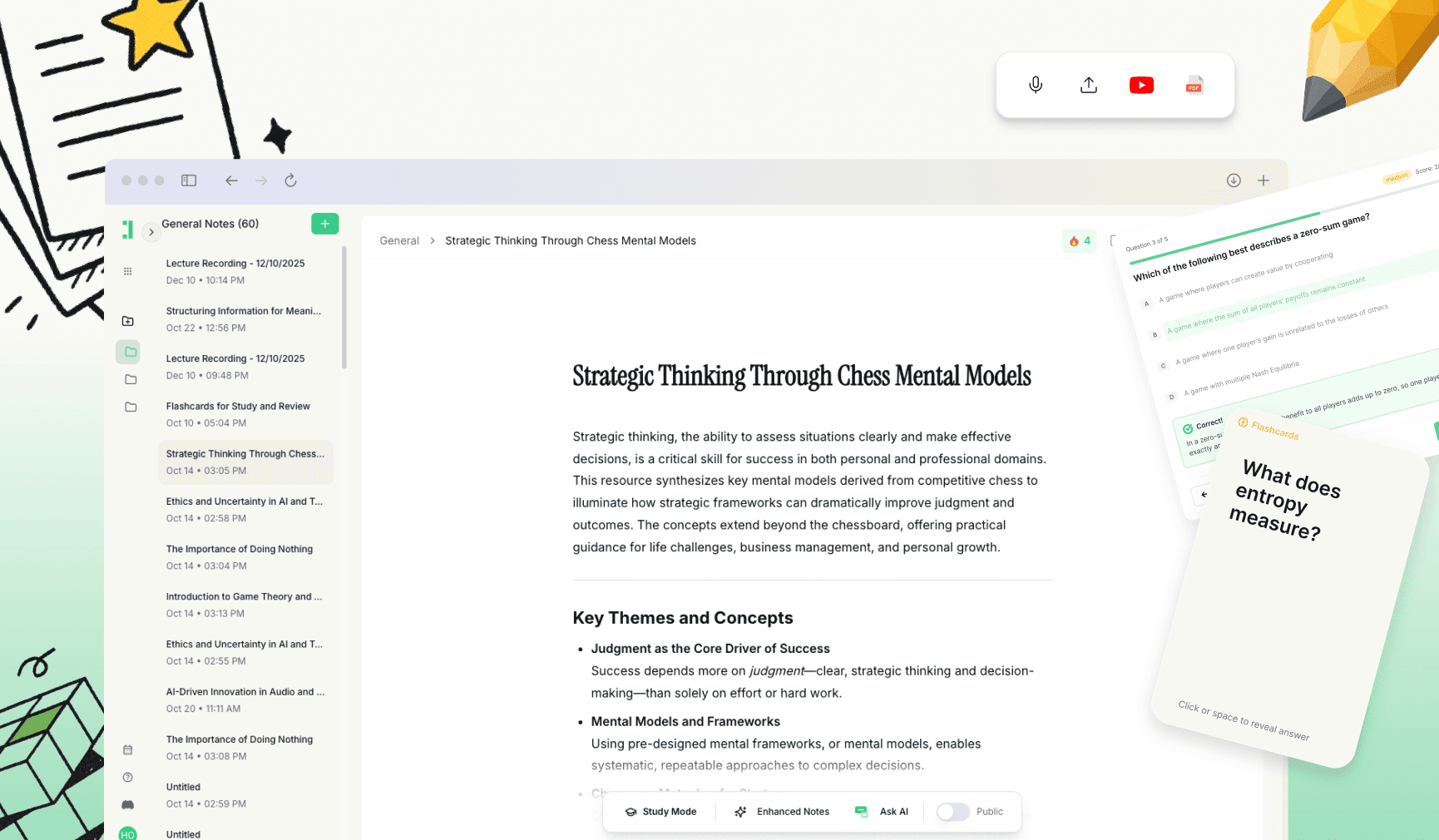
Generate Flashcards for Cognitive Psychology
Turn your notes, PDFs, slides, or lectures into Cognitive Psychology flashcards so you can review faster and remember more. Whether you are studying the Multi-Store Model of memory or the intricacies of gestalt principles, Duetoday helps you transform passive reading into active testing.
Generate Cognitive Psychology Flashcards | Upload notes / paste text
Simply upload your study material to Duetoday, and our AI identifies key theories and researchers to create a custom deck. You can then review, edit, and export your cards to start studying immediately.
What are Cognitive Psychology flashcards?
Cognitive Psychology flashcards cover the mental processes involved in gaining knowledge and comprehension. These flashcards break down complex topics like sensory memory, language acquisition, problem-solving heuristics, and neural pathways into bite-sized, testable questions.
The outcome is a shift from passive re-reading to active retrieval. Instead of hoping you remember the difference between retroactive and proactive interference, you test yourself repeatedly until the connection is permanent.
If you already have notes, Duetoday can generate a clean deck in minutes.
Why flashcards work for Cognitive Psychology
Cognitive Psychology involves a high volume of specific terminology and interconnected models. Flashcards are ideal because they isolate these variables, forcing your brain to retrieve the information without context clues.
By using active recall and spaced repetition, you reinforce the neural pathways associated with these concepts, making them easier to access during exams.
Remember key terms like 'schema' or 'priming' without cramming
Separate similar concepts (e.g., Bottom-up vs. Top-down processing)
Learn processes step-by-step (encoding, storage, and retrieval cycles)
Practice applying psychological rules to real-world scenarios
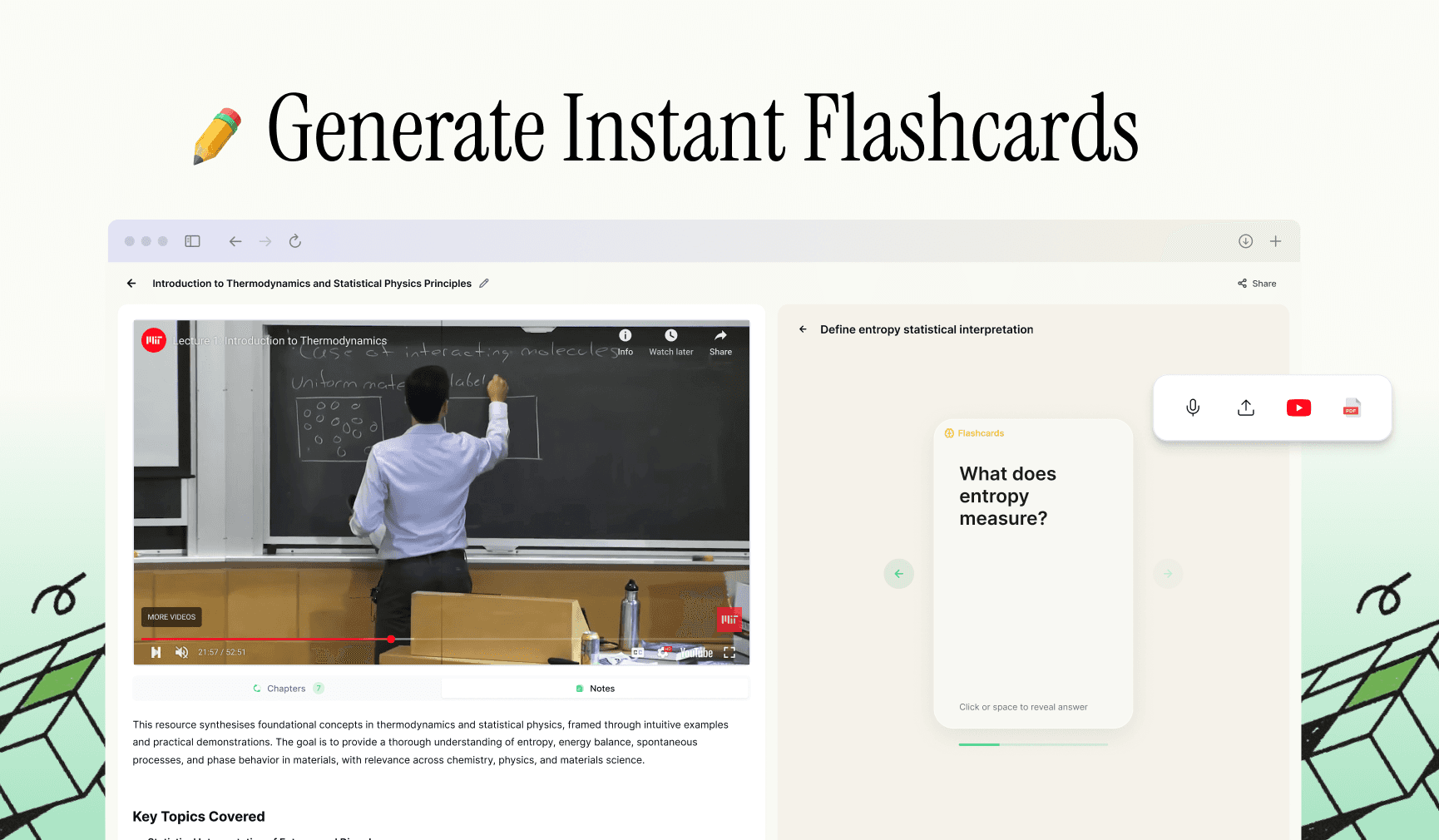
What to include in your Cognitive Psychology flashcards
Effective flashcards follow the 'one idea per card' rule. Avoid cluttering a single card with an entire theory; instead, break the theory down into its component parts and creators.
Definitions & key terms: What is the phonological loop?
Processes & steps: What are the three stages of the Atkinson-Shiffrin model?
Comparisons: How does short-term memory differ from working memory?
Application: Give an example of a mnemonic device for list learning.
Example prompts include: Who proposed the Filter Theory of Attention?, Define Change Blindness, and What is the capacity of Magic Number 7 plus or minus 2?
How to study Cognitive Psychology with flashcards
Start with a 'two-pass' approach. First, generate your deck and go through it once to identify which models or experiments are confusing. Then, focus your energy on those specific gaps.
Make a deck from your lecture slides or textbook chapters.
Do one quick round to find weak spots in your understanding.
Review weak cards daily to leverage the spacing effect.
Mix in older cards to ensure long-term retention.
Do a final mixed review before your midterm or final exam.
Generate Cognitive Psychology flashcards automatically in Duetoday
Making cards manually is slow and often leads to over-complicated cards that are hard to study. Duetoday automates the tedious part so you can focus on the actual learning.
Upload or paste your Cognitive Psychology material.
Click 'Generate Flashcards'.
Review, edit, and start studying.
Generate Cognitive Psychology Flashcards in Duetoday
Start with your notes and get a deck you can actually use today.
Common Cognitive Psychology flashcard mistakes
Many students make cards that are essentially paragraphs. If a card takes more than 10 seconds to read, it's too long.
Cards are too long: Split complex experiments into hypothesis, method, and result cards.
Only memorizing names: Ensure you include 'why' a specific study changed the field.
Confusing similar models: Create specific contrast cards for Broadbent vs. Treisman.
No review schedule: Spaced repetition is the core of cognitive science—use it!
Ready to generate your Cognitive Psychology flashcards?
Stop rereading your textbook and start testing your knowledge. Upload your notes, generate your deck, and master the mind.
Start Generating Flashcards
Works with notes, PDFs, slides, and transcripts.
FAQ
How many flashcards do I need for Cognitive Psychology? It depends on the depth of the unit, but typically 50-100 cards per major topic (like Memory or Perception) ensures full coverage without overwhelm.
What’s the best format for Cognitive Psychology flashcards? Question-and-answer format is best. Use the front for a specific prompt like 'What is the Stroop Effect?' and the back for a concise explanation of the interference in reaction time.
How often should I review my flashcards? Aim for daily reviews of new cards and every 3-5 days for cards you already know well to maximize the spacing effect.
Should I make cards from a textbook or slides? Both. Textbooks provide depth for definitions, while slides often highlight the specific experiments your professor wants you to know.
How do I stop forgetting theories after a few days? This is common in psychology. Use 'Interleaving'—mix cards from different chapters (e.g., Attention and Language) so your brain learns to distinguish them.
What if my flashcards feel too easy? Try changing the prompt from 'Define X' to 'Give a real-world example of X' to increase the cognitive load.
Can I generate flashcards from a PDF automatically? Yes, Duetoday allows you to upload any Cognitive Psychology PDF and converts the text into structured flashcards instantly.
Are digital flashcards better than paper for this subject? Digital cards are often superior because they allow for easier organization of the hundreds of theories involved in Cognitive Psychology.
How long does it take to make a full deck? With Duetoday, you can generate a comprehensive deck from an entire lecture in under a minute.
Can Duetoday organize my cards by topic? Yes, the AI categorizes the information based on your source material so your study sessions remain structured.

Duetoday is an AI-powered learning OS that turns your study materials into personalised, bite-sized study guides, cheat sheets, and active learning flows.