Generate Flashcards for Circuits I
Easily generate or make Circuits I flashcards to study electrical engineering concepts like KVL, KCL, and circuit theorems.
Generate Flashcards with AI Free

Generate Flashcards for Circuits I
Turn your notes, PDFs, slides, or lectures into Circuits I flashcards so you can review faster and remember more. Whether you are struggling with nodal analysis or mastering Thevenin equivalents, Duetoday helps you transform complex diagrams and equations into study-ready cards.
Generate Circuits I Flashcards
Upload notes / paste text
In Duetoday, the process is simple: upload your course material, generate a structured deck, review or edit the AI-suggested cards, and start your study session immediately.
What are Circuits I flashcards?
Circuits I flashcards cover the fundamental building blocks of electrical engineering, including Ohm’s Law, Kirchhoff’s Laws (KVL/KCL), power calculations, and passive components like resistors, capacitors, and inductors. They translate abstract circuit theorems into digestible questions that test your ability to identify configurations and apply formulas.
The outcome is simple: instead of passively rereading a textbook, you test yourself on component behaviors and circuit laws to build permanent recall. If you already have lecture notes, Duetoday can generate a clean deck in minutes.
Why flashcards work for Circuits I
Circuits I requires a mix of rote memorization for symbols and units, and deep procedural knowledge for solving networks. Flashcards bridge this gap by forcing you to recall reactive properties and step-by-step analysis methods without looking at the solution.
Remember SI units and component symbols without cramming
Separate similar concepts (e.g., Series vs Parallel characteristics)
Learn analysis processes step-by-step (Nodal vs Mesh pathways)
Practice applying Ohm’s Law and voltage divider rules quickly
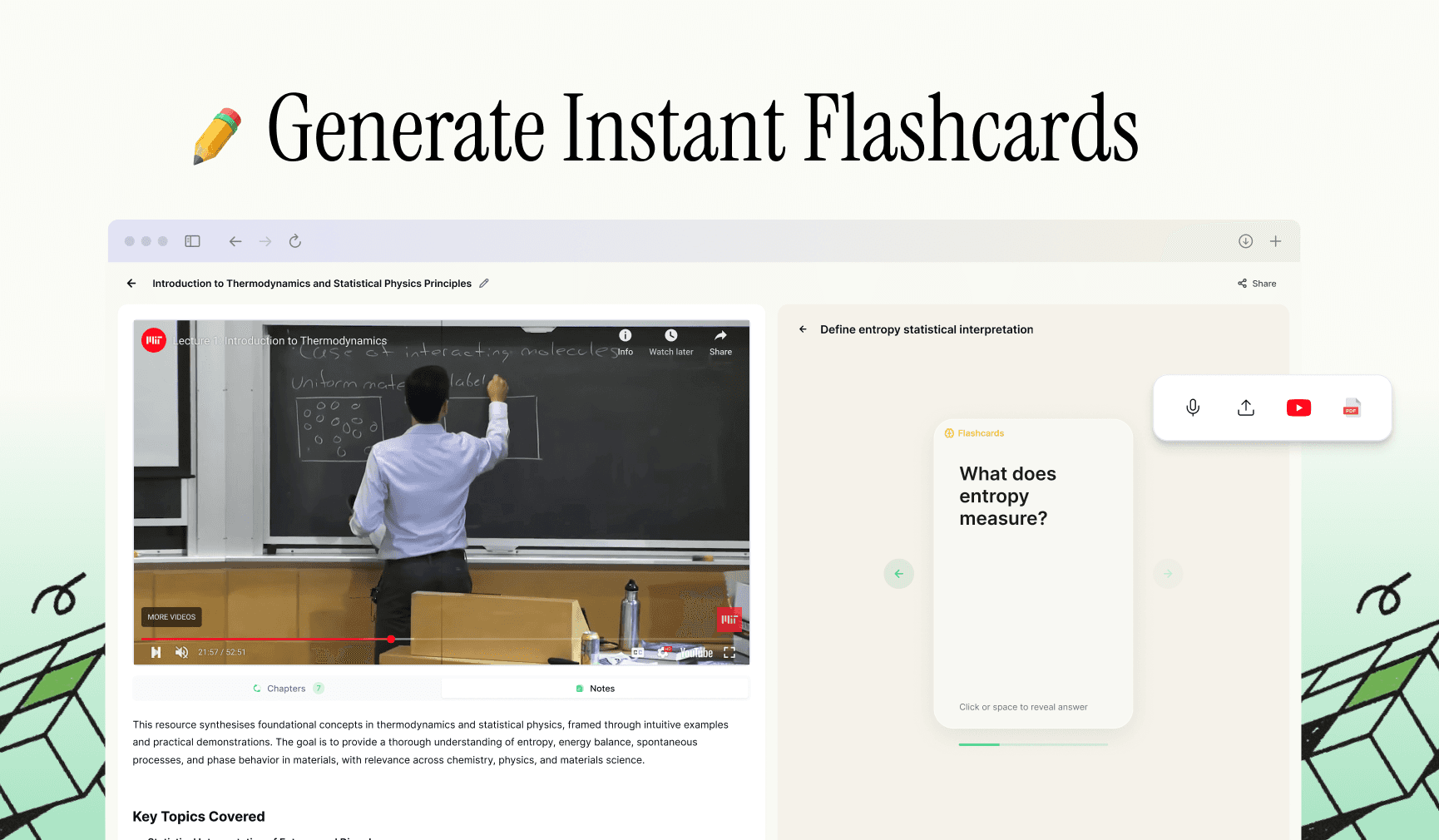
What to include in your Circuits I flashcards
Effective Circuits I flashcards follow the "one idea per card" rule. Don't try to solve an entire multiloop circuit on one card; instead, focus on the individual steps and theorems that lead to the solution.
Definitions & key terms: "What is an ideal voltage source?" "Define impedance in DC circuits."
Processes & steps: "What is the first step in performing Nodal Analysis?"
Comparisons: "How does current behave in series vs parallel branches?"
Application: "What is the Thevenin resistance formula?" "Calculate power given V and I."
Example prompts: "State Kirchhoff's Current Law," "Formula for equivalent resistance in parallel," "What is the unit of Conductance?", and "Relationship between energy and power."
How to study Circuits I with flashcards (a simple system)
Engineering subjects require a two-pass approach. First, you build a deck to master the definitions and laws, then you use cards to prompt the setup of problem-solving equations. Review in quick, high-frequency sessions to keep the formulas fresh.
Make a deck from your problem sets or textbook chapters.
Do one quick round to identify which laws (like KVL) you keep mixing up.
Review weak cards daily to solidify your formula recall.
Mix in harder application cards involving dependent sources.
Do a final mixed review before your midterm or final exam.
Generate Circuits I flashcards automatically in Duetoday
Making cards manually for engineering is slow, especially when you have to copy complex formulas and definitions. Duetoday automates the tedious part of studying so you can get straight to the practice.
Simply upload your PDFs, slides, or manual notes, and our AI identifies the core engineering principles to create a comprehensive study deck instantly.
Upload or paste your Circuits I material
Click Generate Flashcards
Review, edit, and start studying
Generate Circuits I Flashcards in Duetoday
Start with your notes and get a deck you can actually use today.
Common Circuits I flashcard mistakes
Avoid making cards that are too wordy; instead, focus on the "if-then" logic of circuit behavior. Don't just memorize the final answer to a specific homework problem; memorize the theorem used to get there. Ensure you aren't ignoring passive sign convention, as that is where most errors occur in analysis.
FAQ
How many flashcards do I need for Circuits I? Aim for 40-60 cards per chapter to cover definitions, laws, and basic component behaviors without becoming overwhelmed.
What’s the best format for Circuits I flashcards? Question-and-answer format works best for laws, while "Step 1, Step 2" cards are ideal for analysis methods like Mesh or Nodal.
How often should I review Circuits I flashcards? Review daily for 15 minutes to keep formulas in your long-term memory, especially leading up to a lab or exam.
Should I make cards from a textbook or slides? Use lecture slides for the core laws emphasized by your professor, and textbooks for more detailed component definitions.
How do I stop forgetting formulas after a few days? Spaced repetition is key; Duetoday repeats the cards you get wrong more frequently to ensure they stick.
Can I generate Circuits I flashcards from a PDF? Yes, Duetoday can digest textbook chapters or lecture PDFs and extract the most important formulas and concepts into cards.
Are digital flashcards better than paper for Circuits I? Digital cards are superior because they allow for easy editing of formulas and utilize AI to automate the creation process.
Can Duetoday handle circuit diagrams? Duetoday excels at turning the text and descriptions surrounding diagrams into conceptual questions that test your understanding of the circuit's logic.

Duetoday is an AI-powered learning OS that turns your study materials into personalised, bite-sized study guides, cheat sheets, and active learning flows.