Generate Flashcards for Circuits
Turn circuit notes into flashcards instantly. Try Duetoday for free and master Ohm's Law!
Generate Flashcards with AI Free

Generate Flashcards for Circuits
Turn your notes, PDFs, slides, or lectures into Circuits flashcards so you can review faster and remember more.
Making manual flashcards for complex engineering subjects is time-consuming. With Duetoday, you can simply upload your course materials and let AI extract the most important components, formulas, and laws into a ready-to-study deck.
Generate Circuits FlashcardsUpload notes / paste text
In Duetoday, you simply upload your files, generate your cards, review or edit the content, and start your study session immediately.
What are Circuits flashcards?
Circuits flashcards cover the fundamental principles of electrical engineering, including component symbols, circuit laws, analysis techniques (like Mesh and Nodal), and theorems like Thévenin and Norton. They break down complex schematic interactions into digestible questions.
Instead of staring at a complicated diagram and hoping it clicks, these flashcards force you to test your knowledge of how current, voltage, and resistance interact. This builds the mental muscle memory needed for exams and lab environments.
If you already have notes, Duetoday can generate a clean deck in minutes.
Why flashcards are one of the best ways to study Circuits
Circuits require a mix of rote memorization for symbols and deep conceptual understanding for problem-solving. Flashcards bridge this gap by enforcing active recall and spaced repetition.
Remember component symbols and units without cramming
Separate similar concepts (e.g., Series vs. Parallel behavior)
Learn analysis processes step-by-step (KCL, KVL, and Nodal analysis)
Practice applying rules and formulas (V=IR, P=IV) quickly
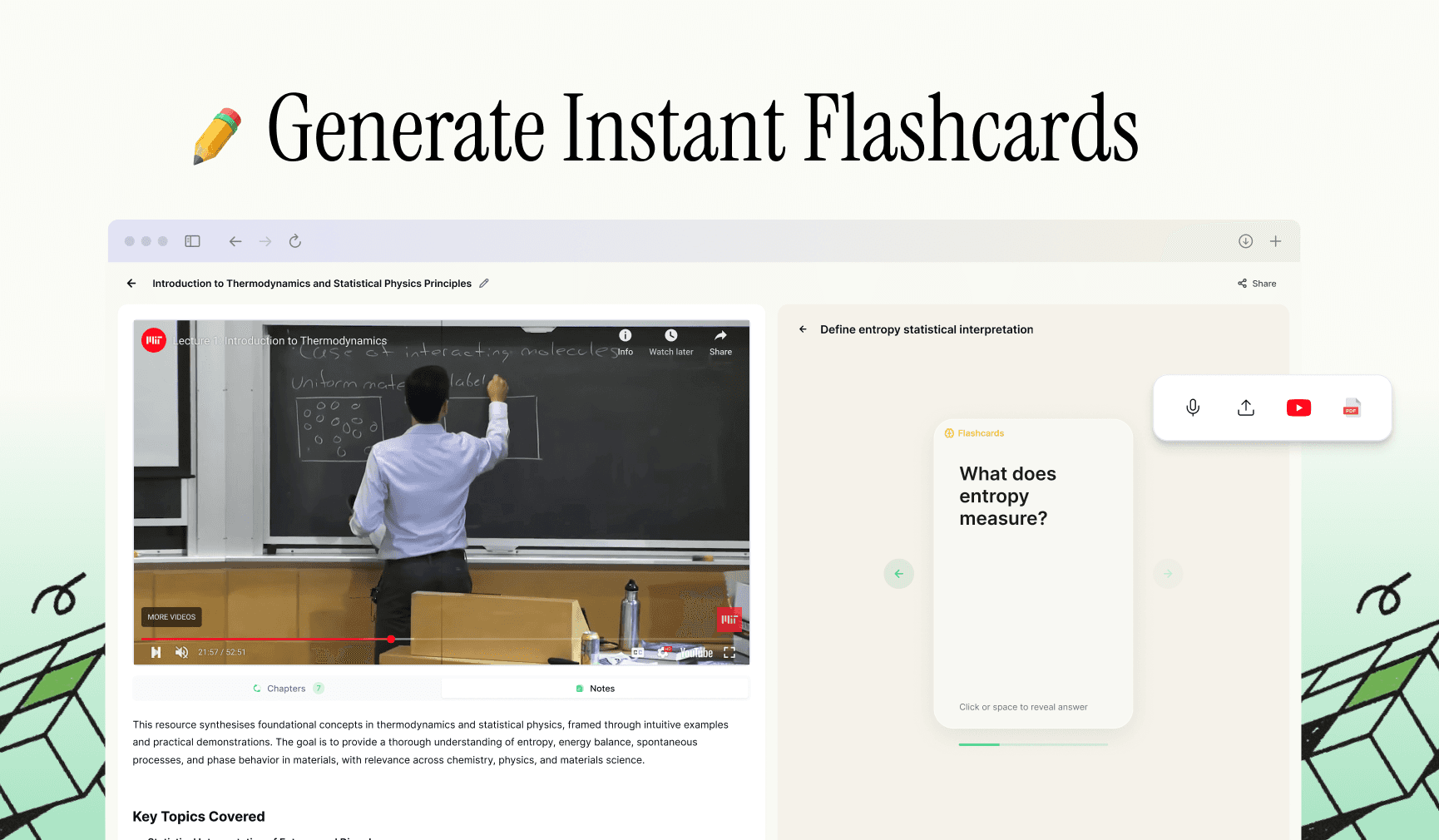
What to include in your Circuits flashcards
The best Circuits flashcards follow the "one idea per card" rule. Instead of trying to explain an entire circuit on one card, focus on specific relationships and rules.
Definitions & key terms: "What is Impedance?" "Define Capacitance in one sentence."
Processes & steps: "What is the first step in Thévenin Theorem?"
Comparisons: "How does an Inductor behave in DC vs. AC?"
Application: "What happens to total resistance if a resistor is added in parallel?"
Example prompts: "State Kirchhoff's Voltage Law," "Formula for Time Constant (RC)," or "Identify this symbol: —[ ]—."
How to study Circuits with flashcards (a simple system)
Don't just flip through cards; use a two-pass approach. Start by building your deck from your syllabus or lecture slides, then review in focused rounds.
Make a deck from your circuit notes or generate it from your textbook PDF.
Do one quick round to find weak spots (e.g., failing to calculate equivalent resistance).
Review weak cards daily to cement the formulas.
Mix in harder analysis cards each session.
Do a final mixed review before your midterm or final exam.
Generate Circuits flashcards automatically in Duetoday
Drawing circuits and writing out long formulas on paper cards is incredibly slow. Duetoday simplifies this by digitizing the process. Upload your lecture recordings, PDFs, or slides, and our AI identifies the core engineering principles for you.
Upload or paste your Circuits material
Click Generate Flashcards
Review, edit, and start studying
Generate Circuits Flashcards in Duetoday
Start with your notes and get a deck you can actually use today.
Common Circuits flashcard mistakes
Most students make their cards too dense or too simple. Avoid these pitfalls:
Cards are too long: Don't put a whole problem on one card; split it into steps.
Only memorizing words: You must flashcard the *reasoning* behind the math.
Confusing units: Always include the units (Farads, Henries, Ohms) on your cards.
No review schedule: Circuits concepts build on each other; review old cards weekly.
FAQ
How many flashcards do I need for Circuits? Usually, 50-100 cards per chapter are sufficient to cover symbols, formulas, and fundamental laws.
What’s the best format for Circuits flashcards? Question-answer format works best. For example: 'Question: KCL is based on which law? Answer: Conservation of charge.'
How often should I review Circuits flashcards? Daily for the first week after learning a new topic, then every 3-5 days using spaced repetition.
Should I make cards from a textbook or slides? Use lecture slides for the core exam material and textbooks for clarifying complex components like transistors.
How do I stop forgetting formulas? Use flashcards that ask you to derive a simple formula or state it based on a given circuit diagram.
What if my flashcards feel too easy? Add 'Why' questions to your cards to force a deeper conceptual understanding of the electrical physics.
Can I generate Circuits flashcards from a PDF? Yes, Duetoday can scan your engineering PDFs and extract relevant definitions and laws into cards.
Are digital flashcards better than paper? Yes, because you can easily include complex schematic images and use AI to shuffle based on difficulty.
How long does it take to make a full deck? Manually it takes hours; with Duetoday's AI, it takes less than a minute.
Can Duetoday organize my cards? Specifically, yes. Duetoday categorizes your cards by topic so you can focus on specific areas like AC or DC analysis.

Duetoday is an AI-powered learning OS that turns your study materials into personalised, bite-sized study guides, cheat sheets, and active learning flows.