Generate Flashcards for Chemical Engineering Fundamentals
Make flashcards for Chemical Engineering Fundamentals to master thermodynamics and mass balance concepts using AI.
Generate Flashcards with AI Free
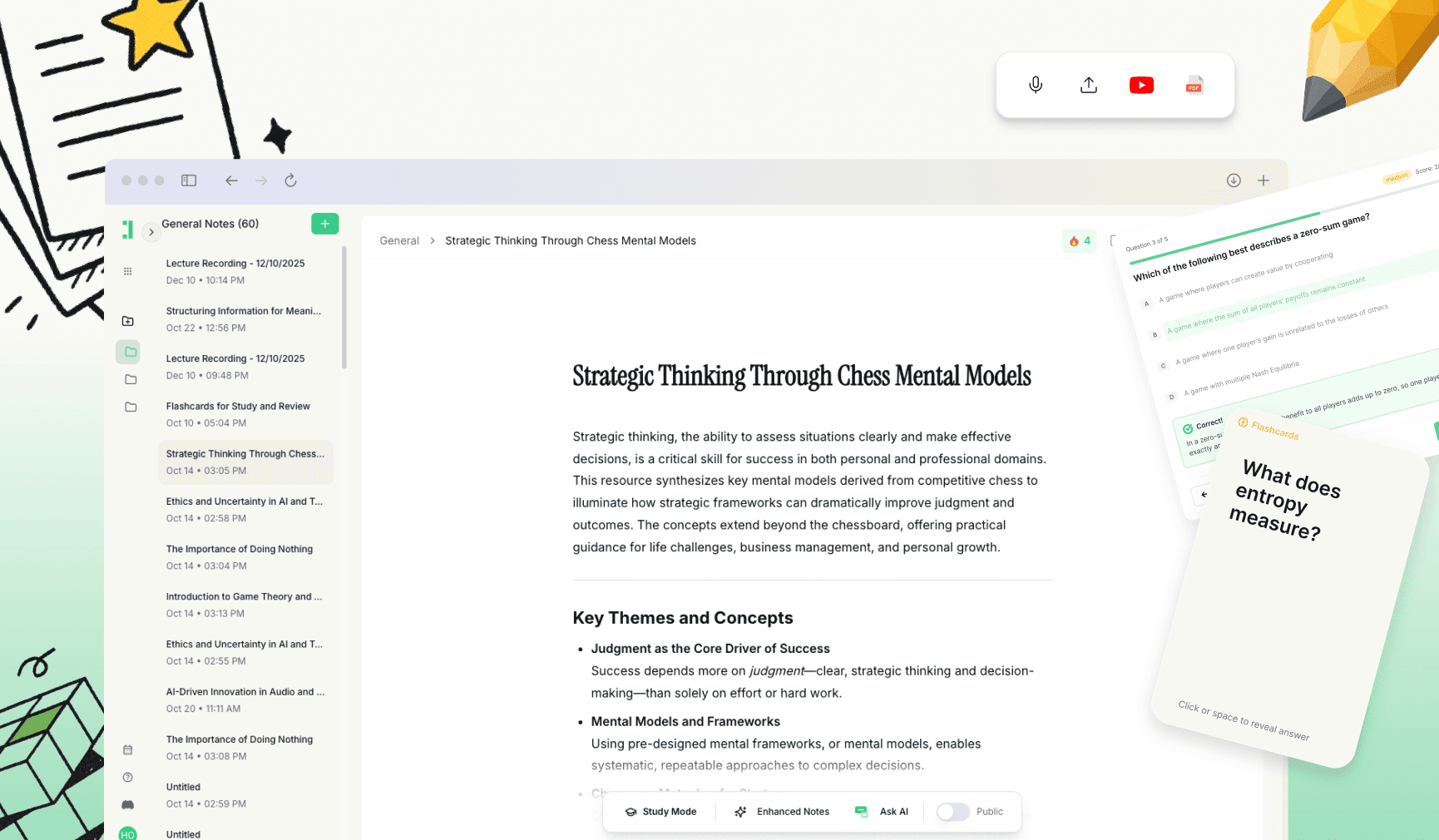
Generate Flashcards for Chemical Engineering Fundamentals
Turn your complex notes, textbook PDFs, lecture slides, or technical transcripts into high-quality Chemical Engineering Fundamentals flashcards so you can review faster and master difficult concepts with ease.
Generate Chemical Engineering Flashcards | Upload Study Materials
In Duetoday, the process is simple: upload your technical material, let the AI generate precise engineering cards, review the technical accuracy, and start your study session immediately.
What are Chemical Engineering Fundamentals flashcards?
Chemical Engineering Fundamentals flashcards cover the foundational pillars of the discipline, including material and energy balances, thermodynamics, fluid flow, heat transfer, and basic kinetics. These cards translate dense mathematical equations and theoretical laws into manageable questions that test your understanding of how systems behave.
The outcome is a shift from passive reading to active problem-solving. Instead of staring at a 50-page chapter on enthalpy, you test yourself on specific state functions and boundary conditions, building the technical recall necessary for exams and laboratory applications.
Soft CTA: If you already have lecture notes, Duetoday can generate a clean deck of engineering cards in minutes.
Why flashcards work for Chemical Engineering Fundamentals
Chemical Engineering requires a mix of rote memorization for constants/conventions and deep conceptual understanding for process application. Flashcards bridge this gap by forcing you to explain the 'why' behind the 'how' without looking at the solution manual.
Through active recall and spaced repetition, you move these complex concepts into long-term memory, ensuring you don't struggle with basic unit conversions or laws during high-stakes exams.
Remember unit conversions and dimensionless numbers (Re, Pr, Nu) without physical constants sheets.
Separate similar concepts like isothermal vs. adiabatic processes.
Learn multi-step processes like distillation reflux cycles and reactor mass balances step-by-step.
Practice applying conservative laws and governing equations rapidly.
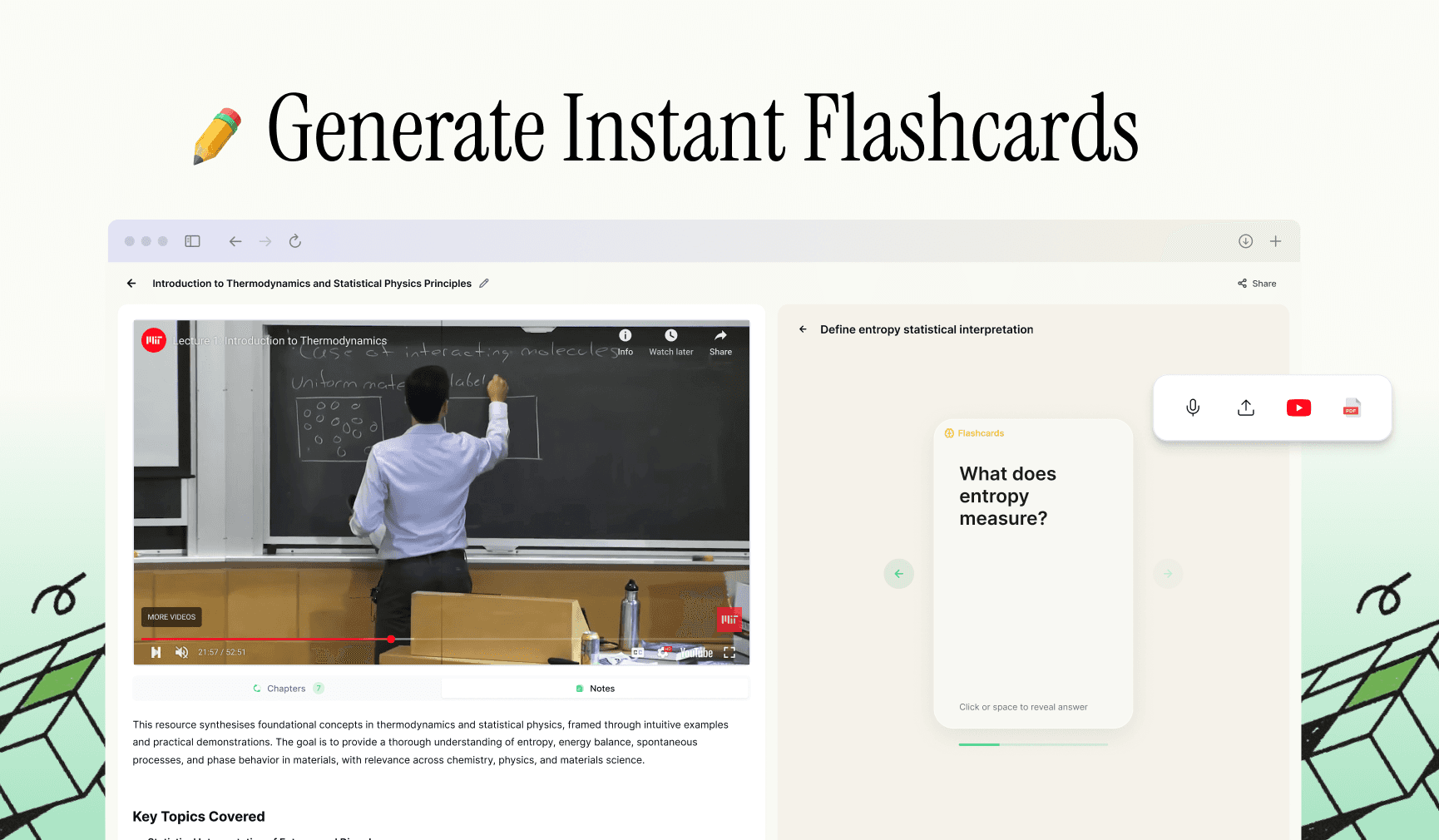
What to include in your Chemical Engineering flashcards
Effective engineering flashcards follow the 'atomic' rule: one specific concept per card. This prevents you from glazing over complex multi-part derivations and ensures you actually understand each variable in an equation.
Focus on four main categories to ensure your deck provides comprehensive coverage of the fundamentals.
Definitions & Key Terms: What is an intensive property? Define the Joule-Thomson effect.
Processes & Steps: What are the four steps of the Carnot cycle? What follows the flash drum in this separation sequence?
Comparisons: How does laminar flow differ from turbulent flow in terms of Reynolds number?
Application: When would you use the Peng-Robinson equation of state? What happens to pressure if temperature increases in an isochoric system?
Example prompts: State the First Law of Thermodynamics for an open system, What is the physical significance of the Nusselt number? Define steady-state vs. unsteady-state.
How to study Chemical Engineering with flashcards
Engineering subjects are cumulative. Use a 'layering' approach: start with the basic laws and definitions, then move into application-based cards as you progress through the semester.
Don't just look at the card; write down the formula or draw the control volume before flipping it. Physical engagement with these cards improves your ability to replicate them during midterms.
Generate a deck from your problem sets or lecture slides.
Do a quick pass to identify which dimensionless numbers or formulas you keep forgetting.
Review these 'weak' cards daily until the relationship becomes intuitive.
Mix conceptual cards with calculation-based prompts to keep your brain agile.
Perform a final mixed review of all units (Fluids, Thermo, Mass Balance) before the final exam.
Generate Chemical Engineering flashcards automatically in Duetoday
Making engineering cards by hand is a bottleneck. Drawing diagrams and formatting complex LaTeX equations manually takes hours that should be spent studying the concepts themselves.
Duetoday automates this: upload your PDFs or paste your lecture transcripts, and get a structured, accurate deck of Chemical Engineering flashcards instantly. You get the quality of a textbook-curated deck with the customization of your own notes.
Upload your engineering PDFs or lecture slides.
Click Generate Flashcards.
Check the formulas, edit if needed, and start reviewing.
Generate Chemical Engineering Flashcards in Duetoday
Start with your notes and get a deck you can actually use today.
Common Chemical Engineering flashcard mistakes
Many students create cards that are essentially entire textbook paragraphs. These are impossible to memorize and lead to 'recognition' rather than 'recall.'
Cards are too long: Don't put the entire Bernoulli equation and its derivation on one card; split it.
Only memorizing the formula: Add cards that ask for the assumptions behind the formula (e.g., When is Bernoulli’s equation valid?).
Ignoring units: Always include a card for the standard SI units of specific constants.
Neglecting diagrams: Use cards to identify symbols in a Process Flow Diagram (PFD).
Ready to generate your Chemical Engineering flashcards?
Stop rereading your engineering manuals. Turn your notes into an active study tool by generating a custom flashcard deck today. Upload your materials, generate your deck, and master the fundamentals of Chemical Engineering.
Start Generating Flashcards
Works with notes, PDFs, slides, and transcripts.
FAQ
How many flashcards do I need for Chemical Engineering Fundamentals? Usually, 150-200 high-quality cards cover the core concepts of an introductory course, focusing on laws, units, and basic processes.
What’s the best format for engineering flashcards? A mix of 'Prompt-Answer' for definitions and 'Scenario-Constraint' for application works best to simulate real exam questions.
How often should I review my cards? Review technical formulas daily for the first week, then shift to every 3-4 days once the recall becomes automatic for those specific terms.
Should I make cards from a textbook or slides? Use slides for specific exam focus and textbooks for deep conceptual drilling and definitions.
How do I stop forgetting complex formulas? Breakdown the formula into parts. Have one card for the formula name, one for its variables, and one for its physical application.
What if my flashcards feel too easy? Increase the difficulty by adding 'What if' scenarios. For example: 'What happens to the heat transfer coefficient if velocity doubles?'
Can I generate flashcards from a PDF automatically? Yes, Duetoday is designed to parse complex engineering PDFs and convert the text and concepts into flashcards instantly.
Are digital flashcards better than paper for engineering? Digital is superior for the ability to quickly edit formulas and reorganize decks as you move through different units like Thermodynamics or Fluids.
How long does it take to make a full deck? With Duetoday, you can generate a full deck from a chapter in less than a minute, compared to hours manually.
Can Duetoday organize my cards by topic? Yes, Duetoday allows you to categorize your generated cards into specific decks like 'Mass Balance' or 'Fluid Mechanics' for organized study.

Duetoday is an AI-powered learning OS that turns your study materials into personalised, bite-sized study guides, cheat sheets, and active learning flows.