Generate Flashcards for Calculus I
Make Calculus I flashcards from your notes. Generate study sets on limits, derivatives, and integrals to master your subject with AI.
Generate Flashcards with AI Free
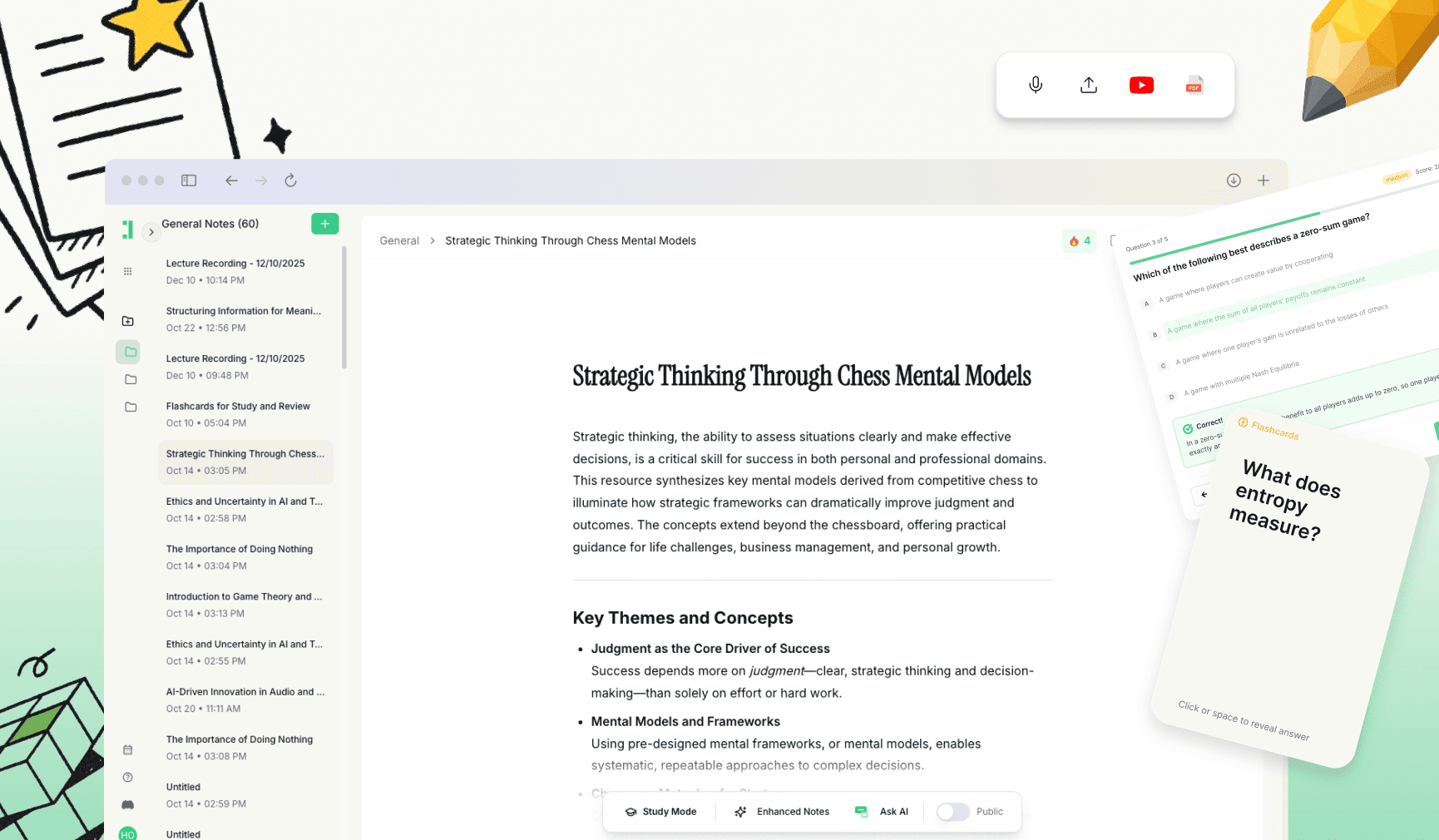
Maximize Your Calculus I Study Sessions
Turn your notes, PDFs, slides, or lectures into Calculus I flashcards so you can review faster and remember more. Mastering complex mathematical concepts requires moving beyond passive reading and into active testing.
Generate Calculus I FlashcardsUpload notes / paste text
In Duetoday, the process is seamless: simply upload your study material, and our AI identifies key theorems and formulas to generate a custom deck you can review, edit, and study immediately.
What are Calculus I flashcards?
Calculus I flashcards cover the foundational pillars of differential and integral calculus. This includes precise definitions of limits, derivative rules (like product and chain rules), optimization steps, and basic integration techniques. They transform dense textbook chapters into bite-sized, testable questions.
The outcome is simple: instead of rereading your textbook and hoping the formulas stick, you test yourself quickly to build permanent mental pathways and stronger recall. If you already have notes, Duetoday can generate a clean deck in minutes.
Why flashcards work for Calculus I
Calculus I relies heavily on a mix of conceptual understanding and procedural fluency. You need to know both *what* a concept is and *how* to apply the rule correctly every time. Flashcards bridge this gap by forcing your brain to retrieve the information without prompts.
Remember key derivative and integral formulas without cramming
Separate similar concepts (e.g., Mean Value Theorem vs. Intermediate Value Theorem)
Learn multi-step processes like Implicit Differentiation or Related Rates
Practice identifying which rule to apply based on the function’s structure
What to include in your Calculus I flashcards
Effective Calculus flashcards follow the "one idea per card" rule. They should be question-based and focused on either a definition, a theorem, or a specific step in a calculation process. Using variety in your card types ensures you aren't just memorizing symbols, but understanding logic.
Definitions & Key Terms: "What is the formal definition of a limit?" or "Define continuity at a point."
Processes & Steps: "What is the first step when performing the Quotient Rule?"
Comparisons: "How does a local maximum differ from an absolute maximum?"
Application: "What happens to the derivative if the function is a constant?"
Example prompts include: "State the Power Rule for derivatives," "What are the conditions for the Squeeze Theorem?", and "What is the derivative of ln(x)?"

How to study Calculus I with flashcards
For a subject like Calculus, a "two-pass" approach works best. Start by building your deck using your class notes or homework problems, then review in focused rounds to build speed and accuracy.
Review in short, frequent sessions. Science shows that repeating tough cards more often—rather than reviewing what you already know—leads to faster mastery of the material.
Make a deck from your notes (or generate it automatically from a PDF).
Do one quick round to find weak spots (like forgetting the +C in integrals).
Review weak cards daily for at least three days.
Mix in harder application cards once you've mastered basic formulas.
Do a final mixed-topic review before your midterm or final exam.
Generate Calculus I flashcards automatically in Duetoday
Making math cards manually is slow, messy, and prone to errors. Writing out complex LaTeX formulas or drawing graphs by hand takes time away from actual studying. Duetoday automates this hurdle.
Position yourself for success by uploading your lecture slides or textbook chapters. Our AI analyzes the mathematical context to generate high-quality study aids instantly.
Upload or paste your Calculus I material.
Click "Generate Flashcards."
Review, edit, and start studying with active recall.
Generate Calculus I Flashcards in Duetoday
Start with your notes and get a deck you can actually use today. Stop rereading and start recalling.
Common Calculus I flashcard mistakes
Most students make the mistake of creating "cluttered" cards that try to explain an entire chapter on one side. This prevents the quick mental "snap" needed for active recall.
Cards are too long: Split complex proofs into multiple single-step cards.
Only memorizing formulas: Add "when to use" prompts to understand the context.
Ignoring the 'why': Include cards that ask for the conceptual meaning of a derivative.
No review schedule: Ensure you are revisiting the cards you got wrong at least once every 24 hours.
Ready to generate your Calculus I flashcards?
Stop wasting hours on manual data entry. Upload your Calculus I notes today, generate a custom deck, and start mastering your exam material with the power of AI-driven active recall.
FAQ
How many flashcards do I need for Calculus I? Most students find that 100-150 cards cover the essential formulas, theorems, and common pitfalls for the entire semester. Focus on quality over quantity.
What’s the best format for Calculus I flashcards? A question on the front (e.g., 'What is the derivative of sin(x)?') and a clear, concise answer on the back is most effective for speed.
How often should I review Calculus I flashcards? Aim for 15-20 minutes every day. Consistency is more important than long, infrequent study marathons.
Should I make cards from a textbook or lecture notes? Use lecture notes for exam-specific tips and textbooks for rigorous definitions and more varied practice problems.
How do I stop forgetting formulas after a few days? Use spaced repetition. Duetoday helps you track which cards you struggle with so you see them more frequently until they stick.
What if my flashcards feel too easy? Add application-based questions, such as 'When is the Chain Rule required?' instead of just asking for the formula.
Can I generate Calculus I flashcards from a PDF? Yes, Duetoday is designed to parse PDFs and extract the most important mathematical concepts into study cards automatically.
Are digital flashcards better than paper for Calculus I? Digital cards are superior for math because they are easier to organize, allow for AI generation, and use algorithms to schedule your reviews.
How long does it take to make a full Calculus I deck? With Duetoday's AI, you can turn a full set of lecture notes into a deck in under 60 seconds.
Can Duetoday organize my flashcards for me? Yes, Duetoday categorizes your generated cards by topic, such as limits, derivatives, or integrals, to keep your study sessions focused.

Duetoday is an AI-powered learning OS that turns your study materials into personalised, bite-sized study guides, cheat sheets, and active learning flows.