Generate Flashcards for Business Cycles
Generate Business Cycles flashcards instantly with AI. Turn notes into study decks. Try out free!
Generate Flashcards with AI Free
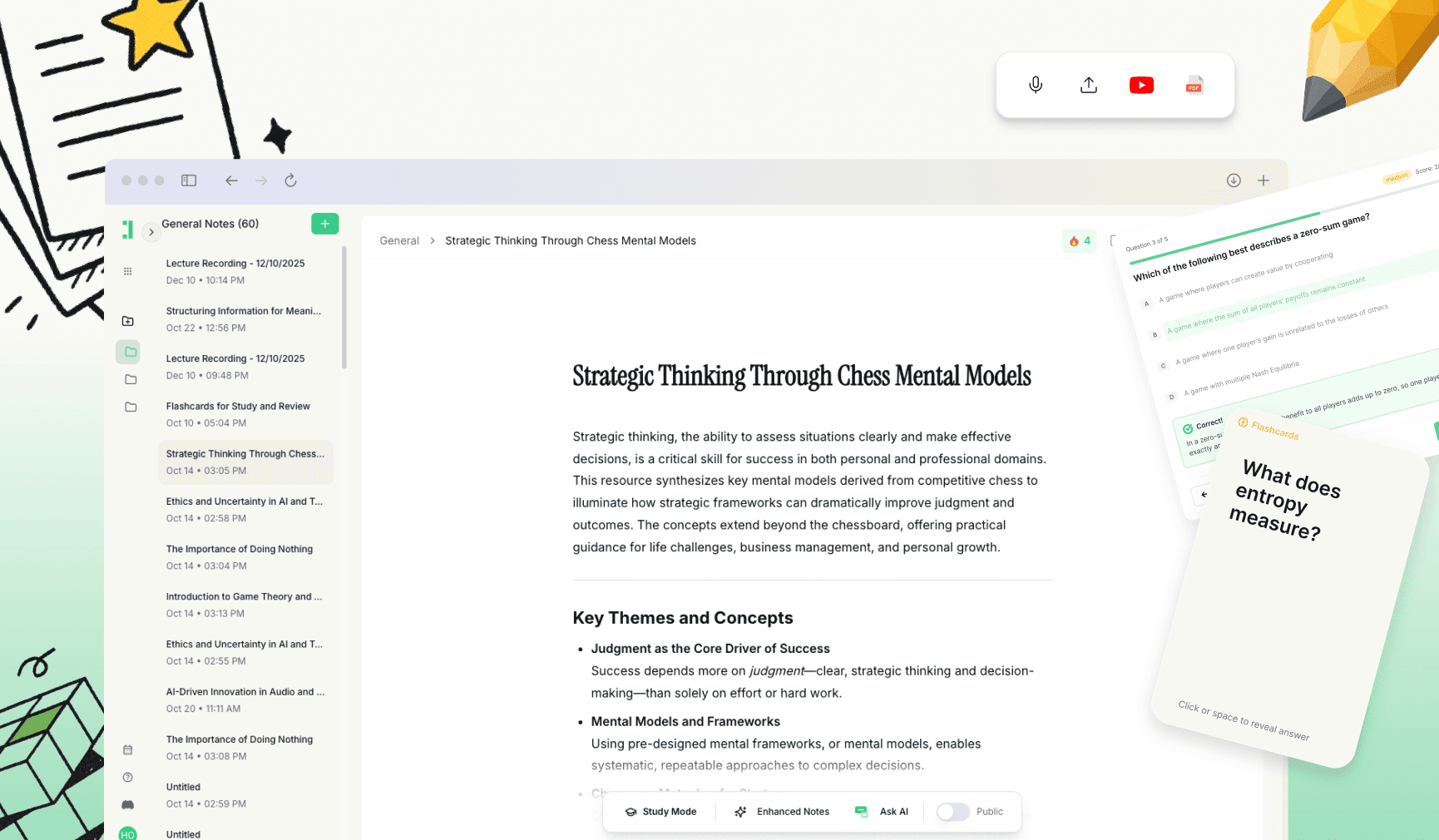
Turn your notes into Business Cycles flashcards instantly
Turn your economics notes, PDFs, slides, or lectures into Business Cycles flashcards so you can review faster and remember more. Whether you are studying macroeconomics or financial markets, mastering economic fluctuations requires active engagement with the material.
Generate Business Cycles FlashcardsUpload notes / paste text
In Duetoday, the process is simple: upload your materials, our AI generates a structured deck, you review or edit the cards, and start studying immediately to build long-term retention.
What are Business Cycles flashcards?
Business Cycles flashcards cover the systematic fluctuations in economic activity, including key terms like GDP, inflation rates, employment levels, and the four distinct phases of the cycle: expansion, peak, contraction, and trough. They help you break down complex theories into bite-sized, testable concepts.
Instead of passively rereading your textbook, these flashcards force you to test your knowledge quickly. By focusing on the relationships between economic indicators and cycle phases, you build the recall necessary for exams and real-world analysis. If you already have notes, Duetoday can generate a clean deck in minutes.
Why flashcards work for Business Cycles
Flashcards are one of the best ways to study Business Cycles because economics relies heavily on understanding sequences and cause-and-effect relationships. You need to know not just what a phase is, but what happens to interest rates or consumer spending during that specific time.
Using active recall and spaced repetition helps you move beyond memorization into true understanding. You learn to recognize the signals of an impending recession or the characteristics of a recovery without having to flip through hundreds of pages of notes.
Remember key economic indicators without cramming
Separate similar concepts (e.g., Recession vs. Depression)
Learn the sequence of phases and their turning points
Practice applying economic rules to different market scenarios

What to include in your Business Cycles flashcards
Good flashcards follow the "atomic" rule: one idea per card. Your Business Cycles deck should be question-based to stimulate your brain's retrieval process rather than just displaying static information.
Definitions & key terms: Focus on terms like "Aggregate Demand," "Trough," and "Stagflation."
Processes & steps: Identify what happens during the transition from peak to contraction.
Comparisons: Contrast leading vs. lagging economic indicators.
Application: Predict policy responses (fiscal/monetary) to different cycle stages.
Example prompts: "What is the primary characteristic of an expansion?", "How does unemployment behave during a trough?", and "List three leading economic indicators."
How to study Business Cycles with flashcards
Use a two-pass approach: first, build or generate your deck from your lecture slides or textbook. Then, go through the deck in rounds to identify which phases or indicators are most confusing to you.
Make a deck from your notes or generate it automatically.
Do one quick round to find weak spots.
Review weak cards daily for a few days until the concepts stick.
Mix in harder cards, like those involving complex formulas or graphs.
Do a final mixed review before your midterm or final exam.
Generate Business Cycles flashcards automatically in Duetoday
Making cards manually is slow and messy. You spend more time writing the cards than actually studying them. Duetoday fixes this by automating the creation process so you can focus on learning.
Upload or paste your Business Cycles material
Click Generate Flashcards
Review, edit, and start studying
Generate Business Cycles Flashcards in Duetoday
Start with your notes and get a deck you can actually use today. Stop rereading and start recalling.
Common Business Cycles flashcard mistakes
Many students create cards that are too long, containing entire paragraphs about Keynesian theory. This makes it impossible to test yourself quickly. Instead, split these into specific prompts about specific aspects of the theory.
Cards are too long: split into one core idea per card.
Only memorizing words: add "why" and "how" prompts to understand mechanics.
Confusing indicators: create dedicated comparison cards for leading, lagging, and coincident indicators.
No review schedule: use spaced repetition to repeat the hardest cards more often.
Ready to generate your Business Cycles flashcards?
Upload your notes, generate your deck, and master the cycles of the economy with active recall. Works with notes, PDFs, slides, and transcripts.
Start Generating Flashcards
FAQ
How many flashcards do I need for Business Cycles? Usually, 30-50 cards are enough to cover the core phases, indicators, and basic theories.
What’s the best format for Business Cycles flashcards? Question-and-answer format is best, focusing on identifying phases based on economic data.
How often should I review Business Cycles flashcards? Review daily for the first week, then use spaced repetition to review every few days until your exam.
Should I make cards from a textbook or slides? Both. Slides often contain the "high-yield" info, while textbooks provide the necessary context for "why" things happen.
How do I stop forgetting the phases after a few days? Spaced repetition is key. Focus on the turning points (peaks and troughs) as these are the most common memory slips.
What if my flashcards feel too easy? Add application-based questions, such as "What fiscal policy is best suited for this cycle phase?"
Can I generate Business Cycles flashcards from a PDF? Yes, Duetoday can read your economics PDFs and generate study-ready decks instantly.
Are digital flashcards better than paper? Yes, because digital tools use AI to track which cards you struggle with and show them more often.
How long does it take to make a full deck? With Duetoday, it takes less than a minute. Manually, it could take over an hour.
Can Duetoday organize my cards by topic? Absolutely. You can tag and categorize cards by specific economic theories or sectors.

Duetoday is an AI-powered learning OS that turns your study materials into personalised, bite-sized study guides, cheat sheets, and active learning flows.