Generate Flashcards for Buffers
Turn chemistry notes into Buffers flashcards instantly. Try Duetoday for free & study smarter.
Generate Flashcards with AI Free

Generate Flashcards for Buffers
Turn your notes, PDFs, slides, or lectures into Buffers flashcards so you can review faster and remember more. Whether you are tackling Gen Chem II or Biochemistry, mastering buffer solutions requires more than just reading—it requires active recall.
Generate Buffers FlashcardsUpload notes / paste text
In Duetoday, the process is simple: upload your chemistry materials, and our AI identifies key buffer concepts, generates a structured deck, and lets you start studying immediately. No more manual copying and pasting.
What are Buffers flashcards?
Buffers flashcards cover the essential components of solutions that resist changes in pH. This includes identifying weak acids and their conjugate bases, understanding the common ion effect, and mastering the math behind buffer capacity.
The goal of these flashcards is to shift you from passive reading to active testing. Instead of looking at the Henderson-Hasselbalch equation and thinking you know it, these cards force you to recall when and how to apply it. If you already have notes, Duetoday can generate a clean deck in minutes.
Why flashcards are one of the best ways to study Buffers
Buffers are a deeply conceptual topic that relies on understanding the relationship between equilibrium constants and concentration ratios. Flashcards help you bridge the gap between theory and application by breaking down complex equilibrium shifts into bite-sized questions.
Remember pKa values and acid strengths without cramming
Separate similar concepts like buffer capacity vs. buffer range
Learn the step-by-step process of calculating pH after adding a strong base
Practice applying Le Chatelier’s principle to conjugate pairs
What to include in your Buffers flashcards
Good chemistry flashcards follow the "one idea per card" rule. They should be question-based and move from simple definitions to complex problem-solving scenarios. This prevents you from getting overwhelmed by long paragraphs of theory.
We recommend using four main card types for this topic:
Definitions & key terms: "What is the definition of a buffer?" "Define the common ion effect."
Processes & steps: "What is the first step in calculating the pH of a buffer solution?"
Comparisons: "How does a buffer differ from a neutral salt solution?"
Application: "If [A-] increases, what happens to the pH according to the Henderson-Hasselbalch equation?"
Example prompts: "Write the Henderson-Hasselbalch equation," "Identify the conjugate base of H2PO4-," or "What defines the effective range of a buffer?"
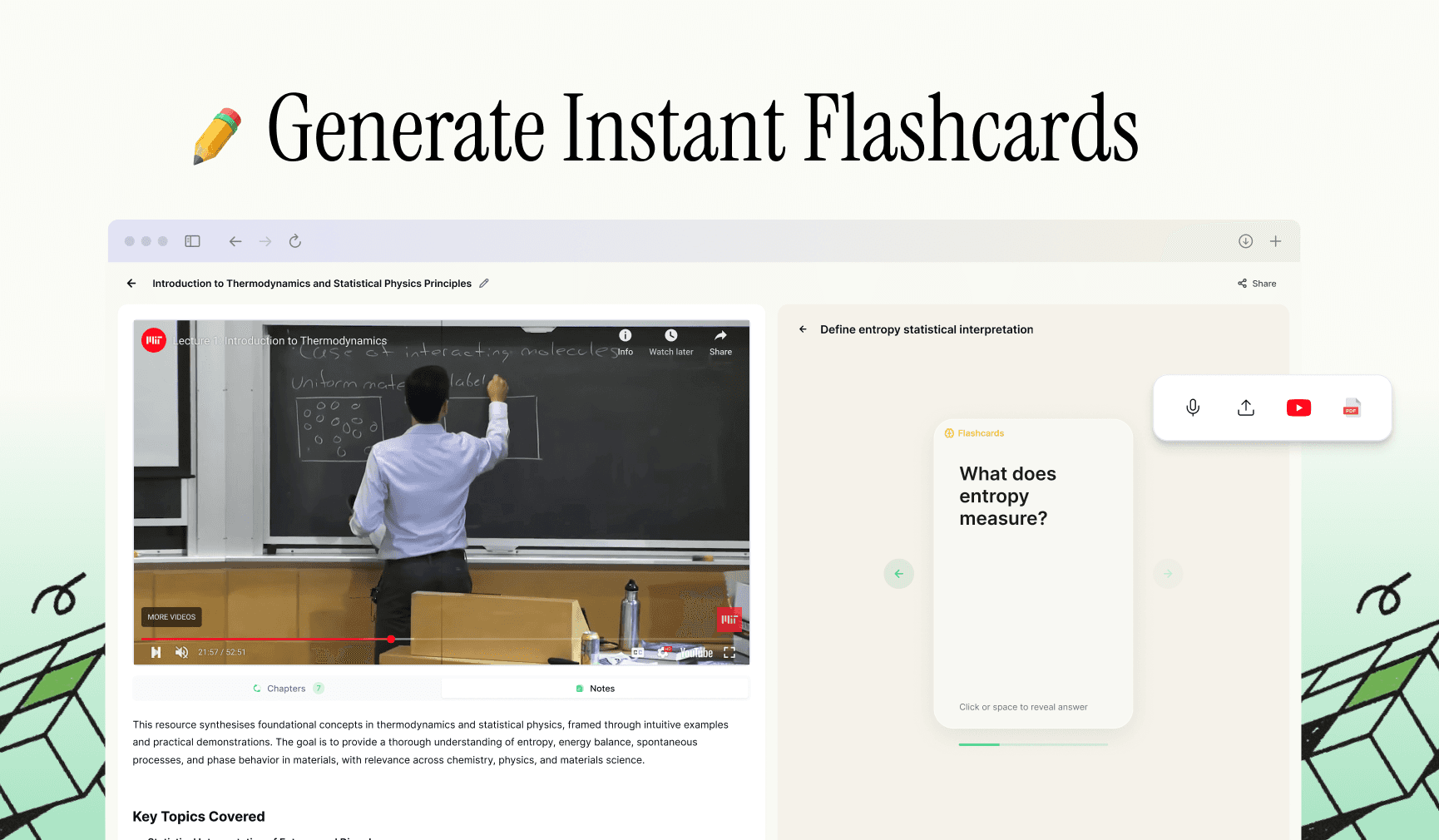
How to study Buffers with flashcards (a simple system)
Don't just flip through cards; use a recursive system. Start by building your deck from your textbook or lecture slides, then go through a "two-pass" review. The first pass helps you identify what you don't know, and the second pass reinforces the difficult math.
Make a deck from your notes or generate it automatically from your PDF.
Do one quick round to find weak spots in your understanding of pKa.
Review weak cards daily to cement the mental math.
Mix in a few stoichiometry cards to keep your skills sharp.
Do a final mixed review 24 hours before your chemistry exam.
Generate Buffers flashcards automatically in Duetoday
Making chemistry flashcards manually is a chore. Drawing out chemical structures and typing equations into standard apps takes hours you could spend actually studying. Duetoday streamlines this by doing the heavy lifting for you.
Positioned as your AI study partner, Duetoday takes your PDF slides or voice recordings and turns them into organized decks. Upload your materials, click generate, and start practicing active recall in seconds.
Upload or paste your Buffers material
Click Generate Flashcards
Review, edit, and start studying
Generate Buffers Flashcards in Duetoday
Start with your notes and get a deck you can actually use today. Stop rereading and start recalling.
Common Buffers flashcard mistakes (and how to fix them)
Most students make cards that are essentially just textbook snippets. These are hard to memorize and even harder to apply during a timed quiz.
Cards are too long: If a card has the entire titration curve explanation, split it into three cards.
Only memorizing the formula: Add "When do I use this?" prompts to your cards.
Confusing pKa and pH: Create specific comparison cards to highlight the difference.
No review schedule: Use spaced repetition to ensure you don't forget the early material.
Ready to generate your Buffers flashcards?
Stop wasting time on manual data entry. Upload your chemistry notes, generate your deck, and master the Henderson-Hasselbalch equation today. Works with notes, PDFs, slides, and transcripts.
Start Generating Flashcards
FAQ
How many flashcards do I need for Buffers? Typically, 20-30 well-constructed cards cover the core concepts of Buffers, including definitions, formulas, and common calculation steps.
What’s the best format for Buffers flashcards? Question-and-answer format is best. Use the front for the prompt (e.g., "Calculate pH") and the back for the formula and step-by-step solution.
How often should I review Buffers flashcards? Review them daily leading up to your exam, then once every three days to keep the concepts in your long-term memory.
Should I make cards from a textbook or lecture notes? Lecture notes are usually better because they focus on what your specific professor emphasizes for the exam.
How do I stop forgetting the Henderson-Hasselbalch equation? Use a flashcard that asks you to derive it or explain what each variable represents rather than just reciting the letters.
What if my flashcards feel too easy? Add application-based cards, such as "What happens to pH when 0.01mol of HCl is added to this specific buffer?"
Can I generate Buffers flashcards from a PDF automatically? Yes, Duetoday allows you to upload any chemistry PDF and transforms the text into study-ready flashcards instantly.
Are digital flashcards better than paper for Buffers? Digital cards are often better because they allow for easier editing of complex equations and use built-in spaced repetition algorithms.
How long does it take to make a full Buffers deck? Manually, it takes about an hour. With Duetoday, it takes less than a minute.
Can Duetoday organize my chemistry flashcards for me? Yes, Duetoday categorizes your cards by topic and tracks your mastery levels as you study.

Duetoday is an AI-powered learning OS that turns your study materials into personalised, bite-sized study guides, cheat sheets, and active learning flows.