Generate Flashcards for Botany
Easily generate or make Botany flashcards from your notes to master plant biology, taxonomy, and physiology.
Generate Flashcards with AI Free

Generate Flashcards for Botany
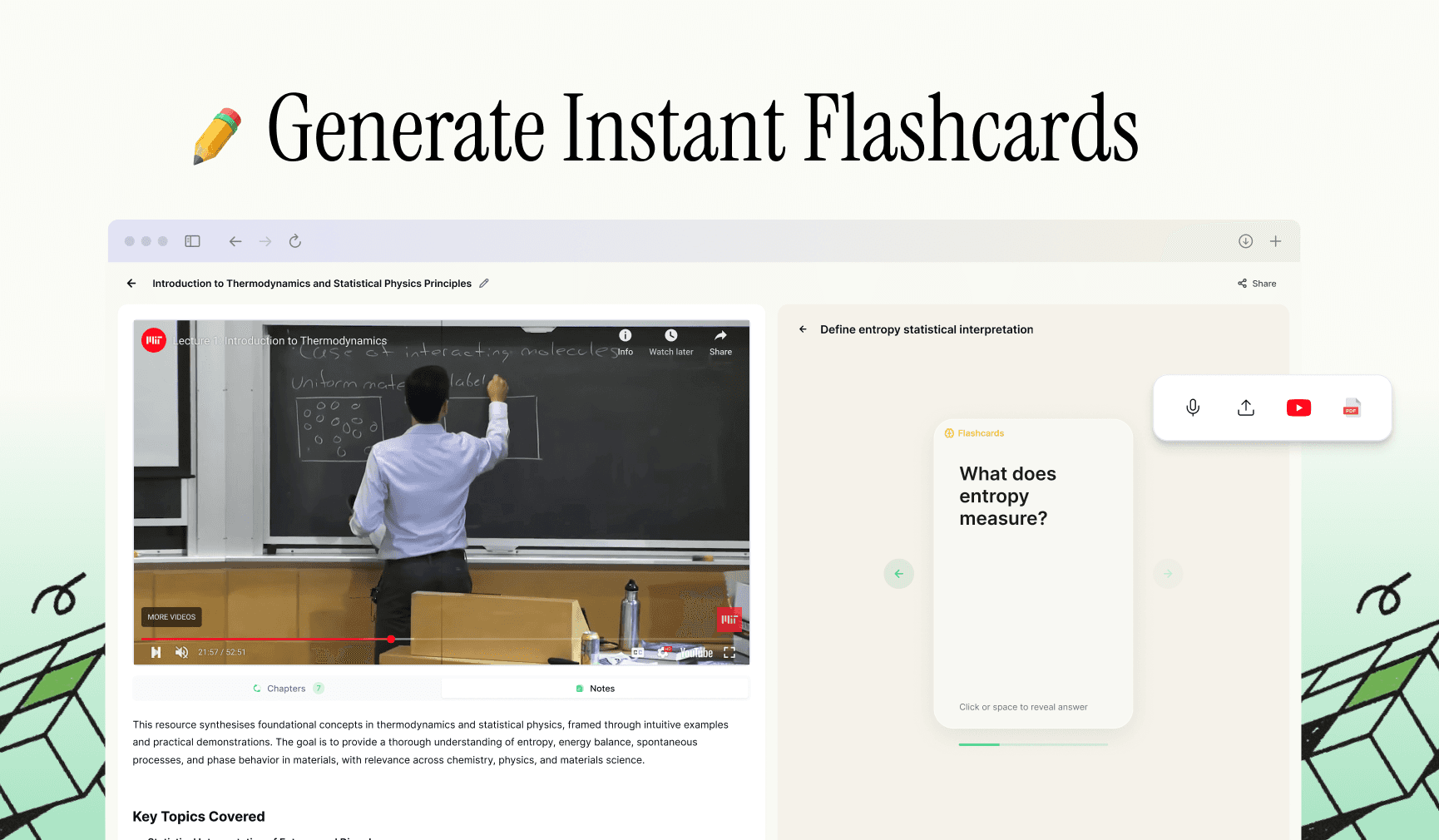
Turn your notes, PDFs, slides, or lectures into Botany flashcards so you can review faster and remember more. Whether you are studying plant physiology, taxonomy, or ecology, manually creating cards takes hours you don't have. With Duetoday, you can transform complex botanical diagrams and definitions into a structured study deck in seconds.
Generate Botany FlashcardsUpload notes / paste text
In Duetoday, the process is simple: upload your course material, generate your cards, refine them with our AI, and start your review. It is the fastest way to move from passive reading to active mastery.
What are Botany flashcards?
Botany flashcards are concentrated study tools designed to cover the vast terminology of plant sciences. They focus on key terms like xylem and phloem, the steps of photosynthesis, floral formulas, and the distinct characteristics of plant families. They take dense textbook chapters and break them into bite-sized questions that force your brain to retrieve information.
The outcome is simple: instead of rereading the same paragraph about the Calvin cycle five times, you test yourself on each stage until it becomes second nature. If you already have notes, Duetoday can generate a clean deck in minutes so you can start testing your knowledge immediately.
Why flashcards work for Botany
Botany is a heavy-vocabulary subject that requires a mix of rote memorization for taxonomic names and conceptual understanding for physiological processes. Flashcards bridge this gap by using active recall to strengthen the neural pathways associated with these specific terms.
Remember complex Latin binomials without cramming
Separate similar concepts (e.g., Monocots vs. Dicots)
Learn metabolic processes step-by-step (transpiration, respiration)
Practice identifying plant structures from descriptions or diagrams
What to include in your Botany flashcards
Effective Botany flashcards follow the atomic rule: one idea per card. When cards are too cluttered, your brain struggles to build a clear association. Use question-based prompts to keep your sessions engaging and effective.
Definitions & key terms: What is the function of the stomata?
Processes & steps: What happens during the light-independent reactions?
Comparisons: How does a gymnosperm differ from an angiosperm?
Application: Identify this leaf venation pattern: Parallel.
Example prompts: Define phototropism, What are the three main tissue systems in plants?, or List the stages of the plant life cycle in order.
How to study Botany with flashcards (a simple system)
Don't just flip cards mindlessly. Use a two-pass approach: first, build your deck from your lectures, then move into focused review rounds. This ensures you aren't just memorizing the order of the cards, but the content itself.
Make a deck from your notes (or generate it from content).
Do one quick round to find weak spots in plant anatomy or cycles.
Review weak cards daily using spaced repetition.
Mix in a few harder taxonomy cards each session to build variety.
Do a final mixed review before your botany lab or exam.
Generate Botany flashcards automatically in Duetoday
Making cards manually is slow, messy, and often leads to wall-of-text cards that are impossible to study. Duetoday eliminates the grunt work by using AI to identify the most important concepts in your Botany material.
Simply upload your PDF lab manuals, lecture slides, or plant biology transcripts. Our engine extracts the definitions, processes, and categories to create a ready-to-use deck instantly.
Upload or paste your Botany material
Click Generate Flashcards
Review, edit, and start studying
Generate Botany Flashcards in Duetoday
Common Botany flashcard mistakes
Most students make the mistake of putting an entire textbook paragraph on one side of a card. This leads to recognition (thinking you know it because you see it) rather than recall.
Cards are too long → split into one specific plant part or function per card
Only memorizing names → add why prompts to understand ecological roles
Ignoring diagrams → use cards to describe the visual layout of plant cells
No review schedule → utilize Duetoday's system to repeat difficult terms frequently
Ready to generate your Botany flashcards?
Stop rereading your notes and start actively recalling the material. Upload your Botany materials today and get a study-ready deck in seconds.
Start Generating Flashcards
Works with notes, PDFs, slides, and transcripts.
FAQ
How many flashcards do I need for Botany?
For a standard introductory course, 150-300 cards per semester is common, but it's better to have many simple cards than a few complex ones.
What’s the best format for Botany flashcards?
A mix of 'term/definition' for taxonomy and 'sequential steps' for processes like photosynthesis works best for botanical sciences.
How often should I review Botany flashcards?
Daily review is ideal for high-vocabulary subjects like Botany to ensure Latin names stay in your long-term memory.
Should I make cards from a textbook or lecture notes?
Always start with lecture notes as they highlight what your instructor deems important, then supplement with textbook details.
How do I stop forgetting plant families after a few days?
Use spaced repetition; Duetoday shows you the cards you struggle with more frequently until they stick.
What if my Botany flashcards feel too easy?
Increase the difficulty by adding application questions, such as 'How does this plant survive in an arid environment?' instead of just its name.
Can I generate Botany flashcards from a PDF automatically?
Yes, Duetoday is designed to ingest PDFs and extract key botanical concepts into flashcards instantly.
Are digital flashcards better than paper for Botany?
Digital cards are superior for Botany because they allow for easier organization of the massive amount of terminology and faster editing.
How long does it take to make a full Botany deck?
Manually, it could take hours. With Duetoday, you can generate a full deck from a lecture in less than a minute.
Can Duetoday organize my flashcards by plant group?
Yes, you can generate separate decks or tags for different units like Bryophytes, Pteridophytes, and Spermatophytes.

Duetoday is an AI-powered learning OS that turns your study materials into personalised, bite-sized study guides, cheat sheets, and active learning flows.