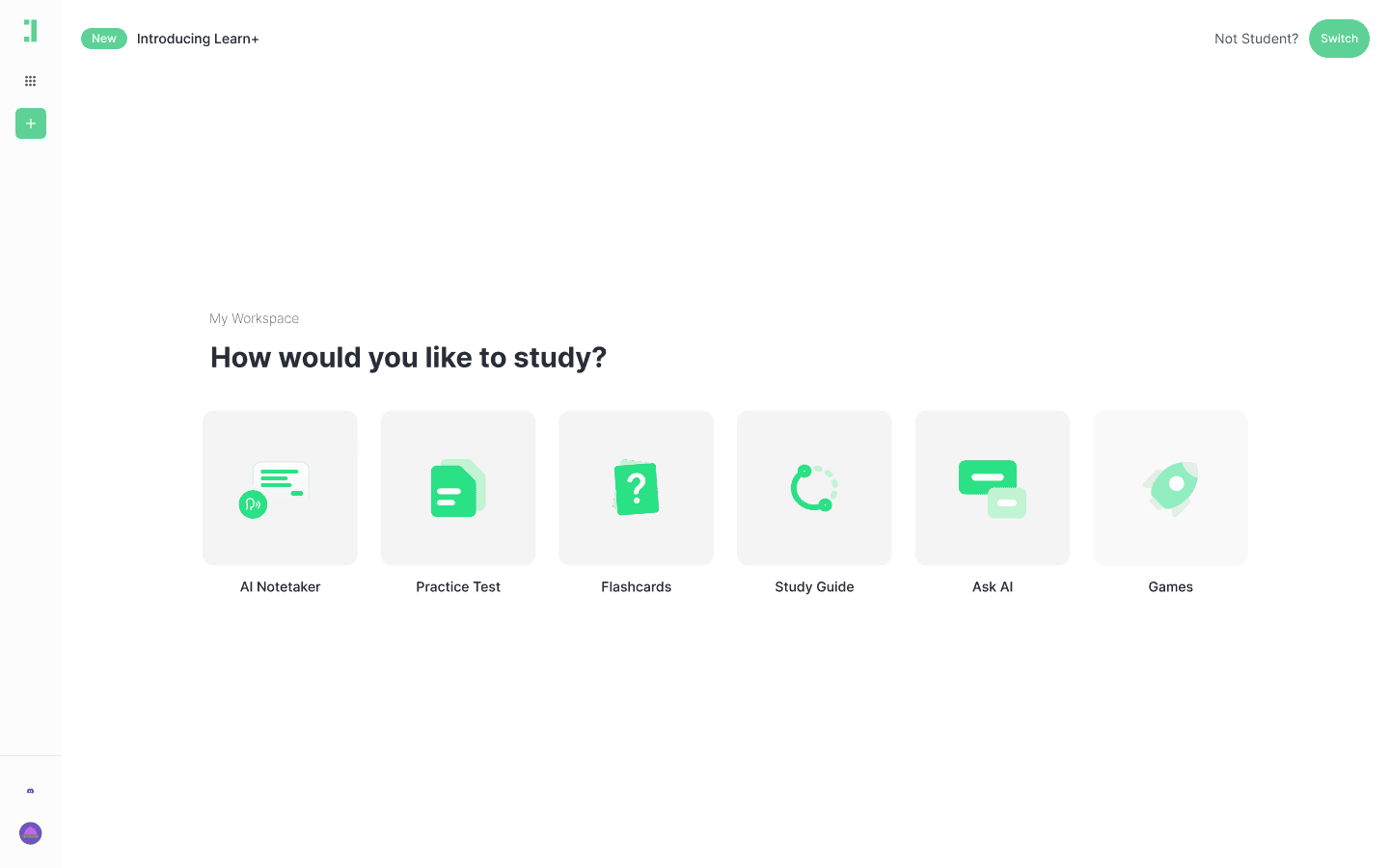
Generate Flashcards for Biomedical Engineering
Easily generate or make Biomedical Engineering flashcards. This guide shows how to turn complex engineering notes into study decks.
Generate Flashcards with AI Free
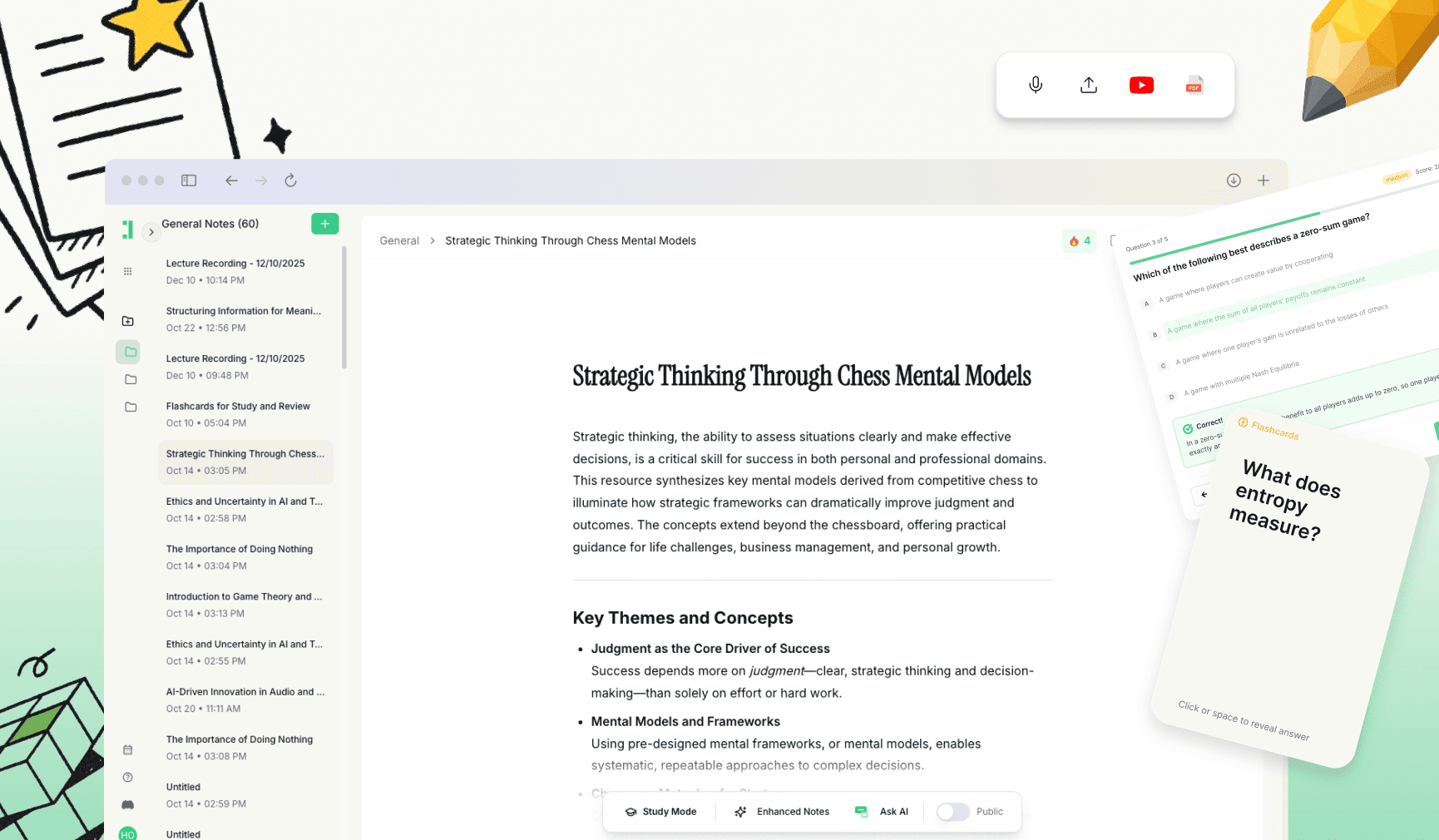
Turn your notes, PDFs, slides, or lectures into Biomedical Engineering flashcards so you can review faster and remember more.
Biomedical engineering is a massive field that bridges the gap between complex engineering principles and biological sciences. Whether you are studying biomechanics, biomaterials, or medical imaging, Duetoday helps you transform dense textbooks and lecture transcripts into bite-sized, interactive study tools.
How it works in Duetoday: Simply upload your material, generate your deck, review or edit the content, and start your study session immediately. No more hours spent manually typing out definitions.
What are Biomedical Engineering flashcards?
Biomedical Engineering flashcards are specialized study aids designed to help you master the intersection of biology and technology. They cover everything from physiological systems and cellular biology to circuit design, fluid mechanics, and material properties. By breaking down these high-level concepts into specific questions, you force your brain to engage in active recall.
The goal is simple: instead of passively rereading a 50-page chapter on signal processing, you test yourself on specific filters or algorithms. This builds stronger neural connections and ensures you can apply the theory in a lab or exam setting.
Why flashcards are one of the best ways to study Biomedical Engineering
Biomedical Engineering requires a unique mix of rote memorization (like anatomy and regulatory standards) and deep conceptual understanding (like system modeling). Flashcards are the perfect medium to manage both. By using active recall and spaced repetition, you ensure that the material you learned in week one stays fresh by the time finals roll around.
Memorize physiological systems and anatomical terminology without cramming.
Differentiate between similar biomaterials (e.g., polymers vs. ceramics) and their biocompatibility.
Master complex processes like the action potential or the clotting cascade step-by-step.
Quickly practice applying formulas for stress, strain, or fluid dynamics.
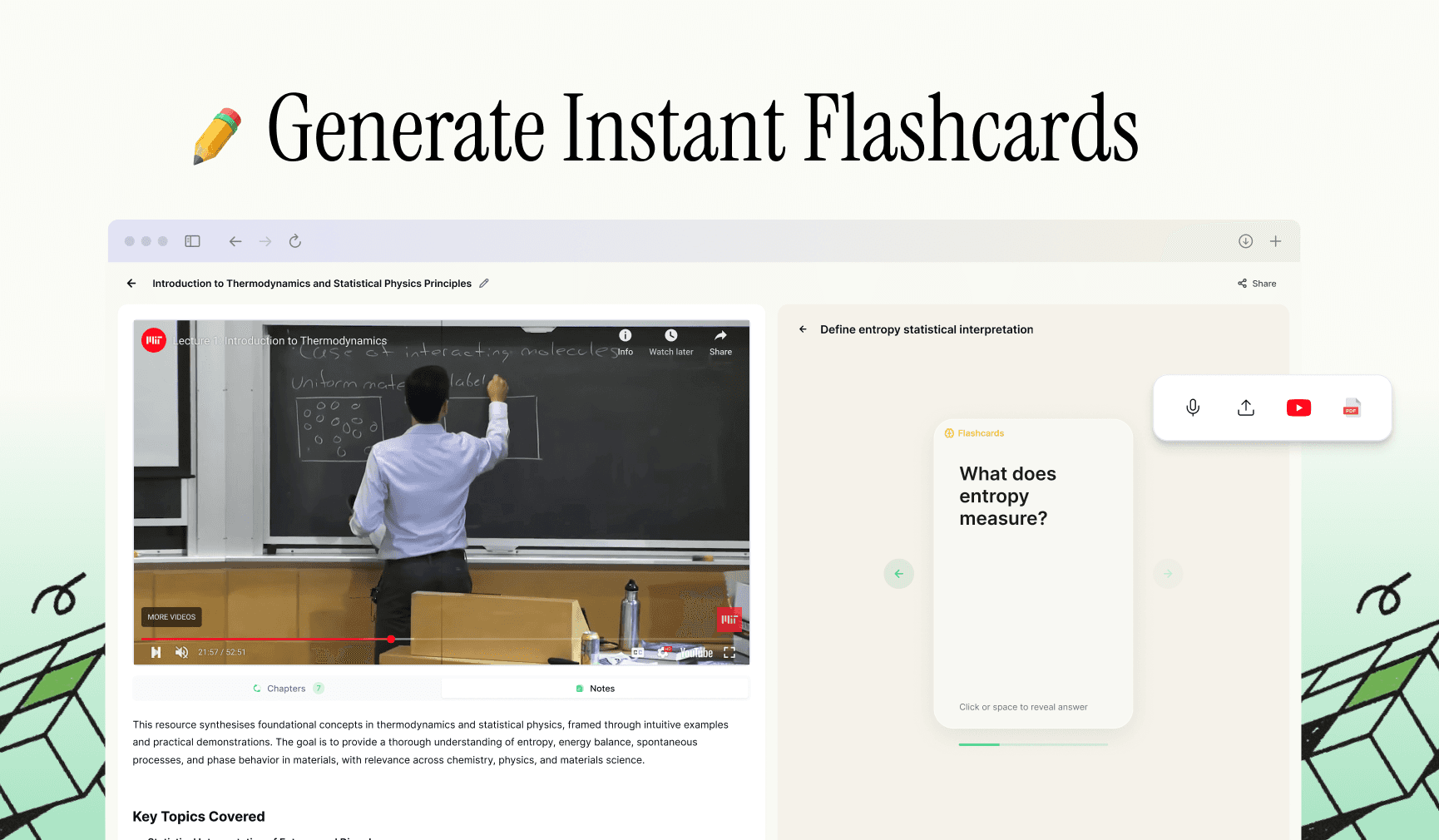
What to include in your Biomedical Engineering flashcards
Effective BME flashcards follow the principle of atomicity: keep one idea per card. If a card is too long, you'll memorize the sequence of words rather than the concept itself. Focus on creating questions that require you to explain the 'why' and 'how' behind a device or biological process.
Definitions & Key Terms: What is Osseointegration? Define Biocompatibility.
Processes & Steps: What are the steps in the PCR cycle? What happens during the systole phase of the cardiac cycle?
Comparisons: Compare an MRI vs. a CT scan in terms of tissue contrast.
Application: Which material is preferred for a hip implant and why? Calculate the Reynolds number given these parameters.
How to study Biomedical Engineering with flashcards
Mastering BME requires a systematic approach. Start by generating your deck directly from your lecture slides or textbook chapters using Duetoday. Once your deck is ready, go through a 'warm-up' round to identify which formulas or concepts are tripping you up. Use the two-pass system: quickly filter out what you know, and spend 80% of your time on the 20% of the material that is difficult.
Generate your deck from notes or PDFs in Duetoday.
Do a quick initial sweep to identify 'weak' cards.
Review difficult concepts (like impedance matching or tissue engineering scaffolds) daily.
Mix engineering cards with biology cards to simulate the interdisciplinary nature of exams.
Perform a final comprehensive review 48 hours before your test.
Generate Biomedical Engineering flashcards automatically in Duetoday
Manual card creation is the biggest hurdle to effective studying. In the time it takes to write out 50 cards for Medical Instrumentation, you could have finished three study rounds. Duetoday eliminates the busywork.
Upload your BME PDFs, slides, or lab reports.
Click 'Generate Flashcards' and watch the AI extract key concepts.
Edit the cards to add specific classroom insights and start studying.
Common Biomedical Engineering flashcard mistakes
Avoid the 'knowledge leak' by ensuring your cards aren't just copies of textbook sentences. If your cards are too long, you won't use them. If they are too simple, you won't be ready for the engineering problems on the exam.
Cards are too wordy; keep them focused on one specific mechanism.
Over-prioritizing biology and skipping the physics/math components.
Forgetting to include diagram-based questions (e.g., identifying parts of a circuit).
Not refreshing old decks, leading to 'forgetting curves' for early semester material.
Ready to generate your Biomedical Engineering flashcards?
Stop rereading and start recalling. Turn your complex BME materials into a structured study plan in seconds.
Works with notes, PDFs, slides, and transcripts.
FAQ
How many flashcards do I need for Biomedical Engineering? It depends on the sub-topic; a single organ system might require 40-60 cards, while a math-heavy course like signals might only need 30 focused on core formulas and transforms.
What’s the best format for BME flashcards? A mix of 'Question and Answer' for definitions and 'Problem Samples' for engineering calculations works best.
How often should I review my BME flashcards? Aim for short 15-minute sessions daily rather than one 4-hour session. Spaced repetition is key for long-term retention.
Should I make cards from a textbook or my professor's slides? Start with slides as they highlight what the professor deems 'exam-worthy,' then use textbooks to fill in gaps for complex biological pathways.
How do I stop forgetting formulas after a few days? Create cards that ask 'When do you use this formula?' instead of just 'What is the formula?' to build context.
Can I generate Biomedical Engineering flashcards from a PDF automatically? Yes, Duetoday is designed to parse complex BME PDFs and technical documents to create structured flashcards instantly.
Are digital flashcards better than paper for BME? Digital cards are superior for BME because you can easily include complex diagrams and equations that are difficult to draw by hand.
How long does it take to make a full BME deck? With Duetoday, you can generate a complete deck from a lecture in under a minute, compared to over an hour of manual typing.
Can Duetoday handle mathematical equations in flashcards? Yes, the AI is capable of identifying and structuring mathematical and engineering formulas into your study decks.

Duetoday is an AI-powered learning OS that turns your study materials into personalised, bite-sized study guides, cheat sheets, and active learning flows.