Generate Flashcards for Bayesian Statistics
Generate or make Bayesian Statistics flashcards from your notes to master prior, likelihood, and posterior distributions.
Generate Flashcards with AI Free
What are Bayesian Statistics flashcards?
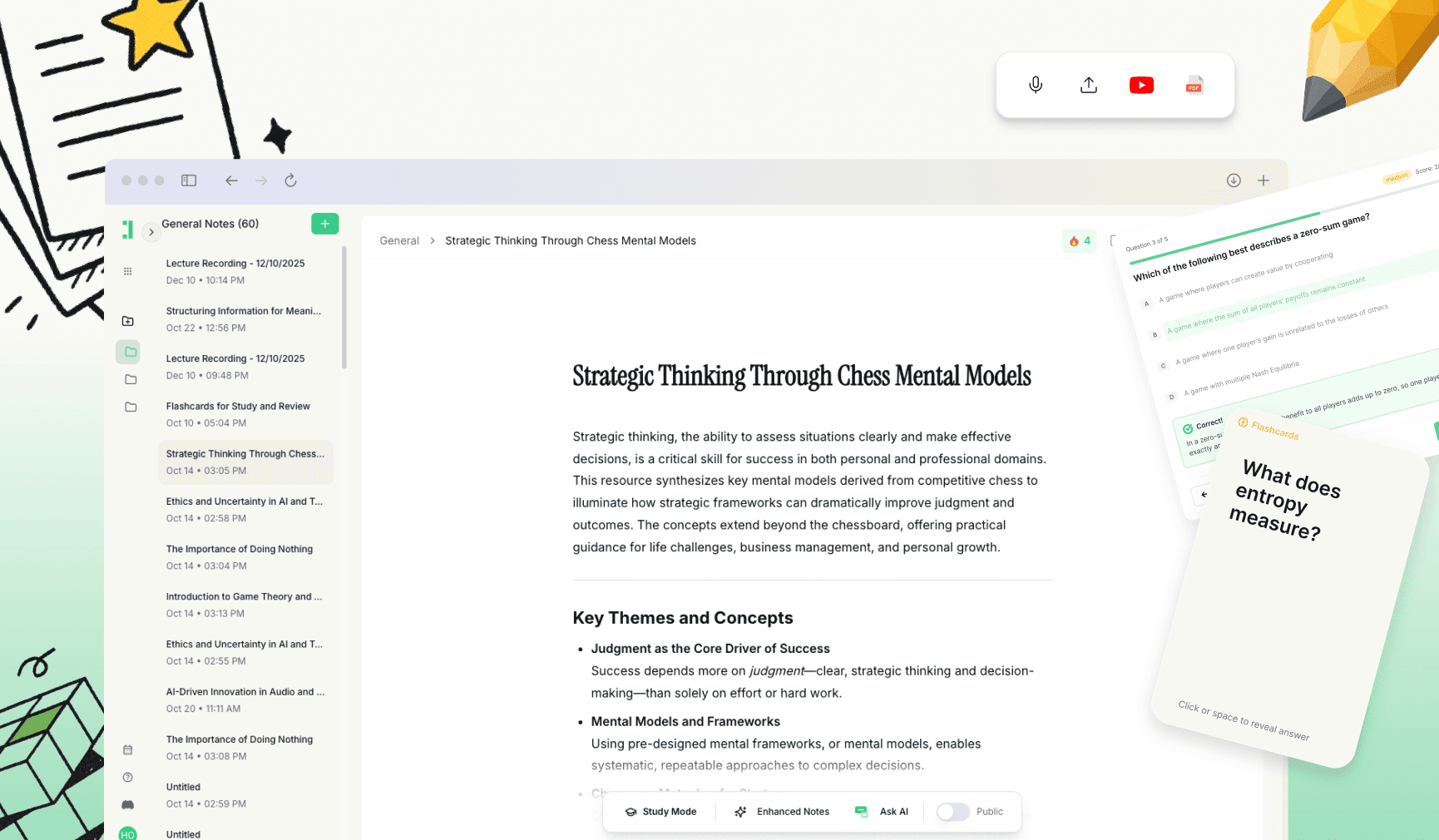
Bayesian Statistics flashcards are specialized study tools designed to help you master the probabilistic framework of Bayesian inference. These cards cover essential concepts such as prior distributions, likelihood functions, posterior probabilities, and Markov Chain Monte Carlo (MCMC) methods. Instead of just reading about Bayes' Theorem, these flashcards force you to define terms, identify relationships between variables, and apply formulas to conditional probability problems.
The goal is to shift from passive reading to active testing. By using flashcards, you ensure that you can calculate a posterior distribution or explain the difference between frequentist and Bayesian approaches without looking at your textbook. If you already have lecture notes or slides, Duetoday can generate a clean deck in minutes so you can stop formatting and start studying.
Why flashcards work for Bayesian Statistics
Bayesian Statistics requires a deep understanding of how information is updated with new evidence. This involves a mix of mathematical formulas, conceptual logic, and computational steps. Flashcards are ideal for this subject because they break down complex, multi-layered problems into digestible pieces that fit into your working memory.
Remember complex formulas for Bayes' Theorem without cramming.
Separate similar concepts like prior, likelihood, and evidence.
Learn the steps of Gibbs sampling or Metropolis-Hastings algorithms.
Practice interpreting credible intervals versus frequentist confidence intervals.
What to include in your Bayesian Statistics flashcards
Effective Bayesian cards follow the "one idea per card" rule. You should focus on why we use specific distributions and how they interact. Your deck should contain a mix of theoretical definitions and practical application scenarios.
Definitions & Key Terms: "What is a conjugate prior?" or "Define the Likelihood Principle."
Processes & Steps: "What are the four steps of Bayesian inference?" or "How do you check for MCMC convergence?"
Comparisons: "How does a Bayesian Credible Interval differ from a Confidence Interval?"
Application: "If the prior is Beta and the likelihood is Binomial, what is the posterior?"
Example prompts for your deck: 'Define p(θ|x)', 'What is the role of the normalizing constant?', 'Explain the purpose of a non-informative prior', and 'What happens to the posterior as the sample size increases?'

How to study Bayesian Statistics with flashcards
Mastering Bayesian methods requires a two-pass approach. First, you build your deck to capture the core logic of probability updating. Then, you move into a review cycle that prioritizes the cards you find most difficult. Because Bayesian concepts build on each other, frequent short sessions are more effective than long marathons.
Generate a deck from your syllabus, PDFs, or lecture transcripts.
Perform a rapid first pass to identify which distributions confuse you.
Review high-difficulty cards daily to strengthen your mental model.
Mix in conceptual questions with calculation-based prompts.
Do a final comprehensive review before your midterms or finals.
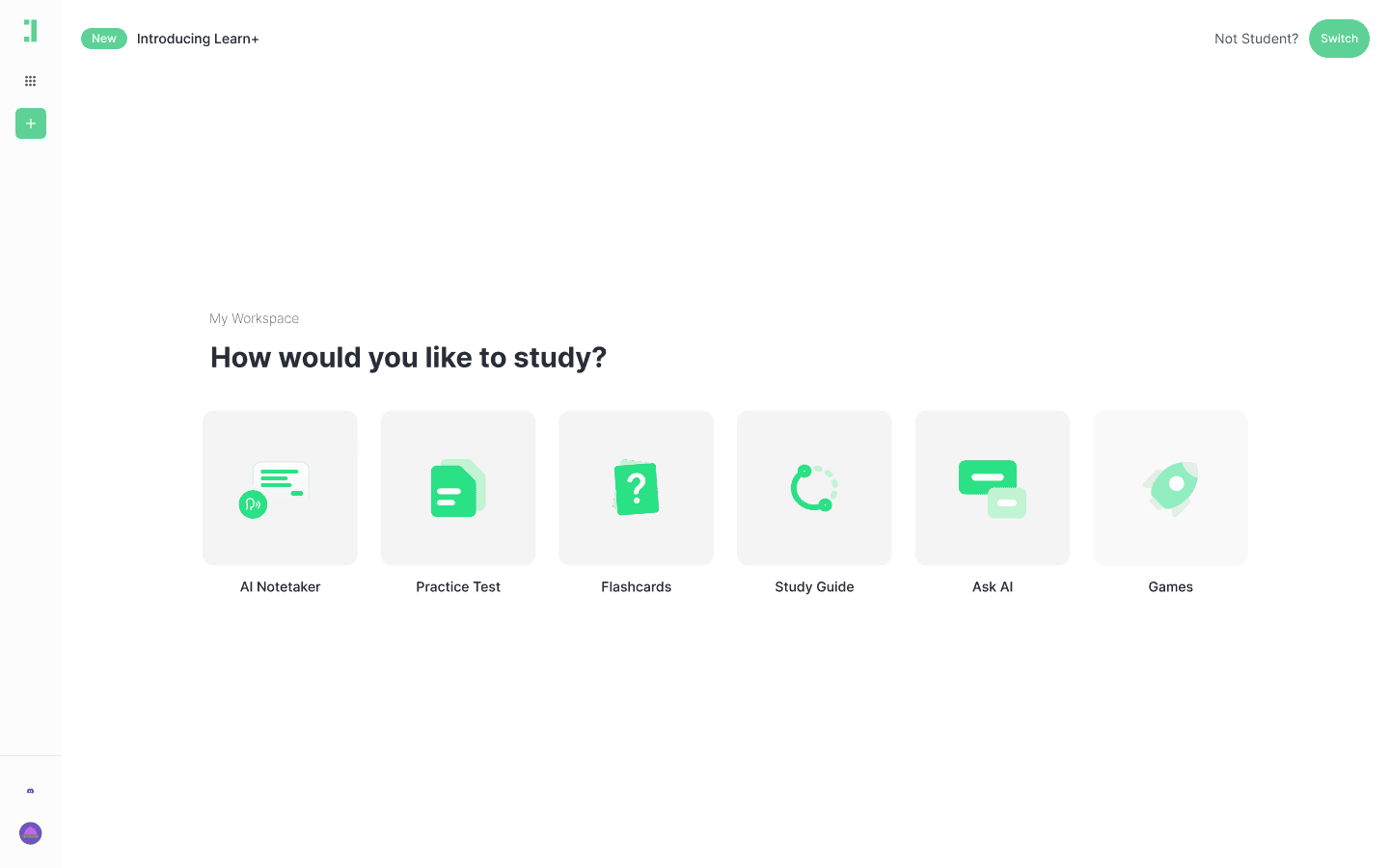
Generate Bayesian Statistics flashcards automatically in Duetoday
Creating Bayesian flashcards by hand is tedious. Drawing out likelihood icons or typing LaTeX formulas for every card takes time away from actual learning. Duetoday solves this by automating the creation process, letting you focus on the math rather than the formatting.
Upload your Bayesian Statistics textbook chapters or PDFs.
Click 'Generate Flashcards' to let the AI identifies the core statistical concepts.
Review, edit for personal nuance, and start your study session.
Common Bayesian Statistics flashcard mistakes
Most students make their cards too dense, trying to fit an entire derivation on one side. This prevents quick recall. To fix this, break derivations into individual steps. Another common mistake is focusing only on the math while ignoring the conceptual 'why' behind the prior selection. Make sure to include cards that ask you to justify your choice of prior distribution.
FAQ
How many flashcards do I need for Bayesian Statistics? A typical introductory course usually requires 60-100 cards covering the foundations, common distributions, and MCMC methods.
What’s the best format for Bayesian flashcards? A mix of 'Q&A' for definitions and 'Completion' for mathematical formulas works best.
How often should I review my cards? Review daily when first learning new distributions, then move to every 3-4 days once you can comfortably calculate posteriors.
Should I make cards from my textbook or R/Python code? Both. Use textbooks for the theory and your coding scripts for the implementation of Bayesian models.
How do I stop forgetting the difference between priors? Use comparison cards that explicitly ask you to contrast 'Informed' vs 'Uninformed' priors side-by-side.
What if my flashcards feel too hard? Break the card down. If you can't remember a whole formula, make three cards that each cover one-third of it.
Can I generate Bayesian flashcards from a PDF? Yes, Duetoday can read your lecture PDFs and instantly extract the core definitions and formulas into cards.
Are digital flashcards better for statistics? Yes, because they allow for easy editing of complex formulas and use algorithms to show you the hardest math problems more often.
How long does it take to make a full deck? Manually it can take hours; with Duetoday, you can have a full deck ready in under 60 seconds.
Can Duetoday organize my cards by topic? Yes, you can generate separate decks for 'Probability Foundations' and 'Advanced MCMC' to keep your studying organized.

Duetoday is an AI-powered learning OS that turns your study materials into personalised, bite-sized study guides, cheat sheets, and active learning flows.