Generate Flashcards for Balancing Chemical Equations
Master chemistry faster. Generate Balancing Chemical Equations flashcards from notes. Try for free!
Generate Flashcards with AI Free
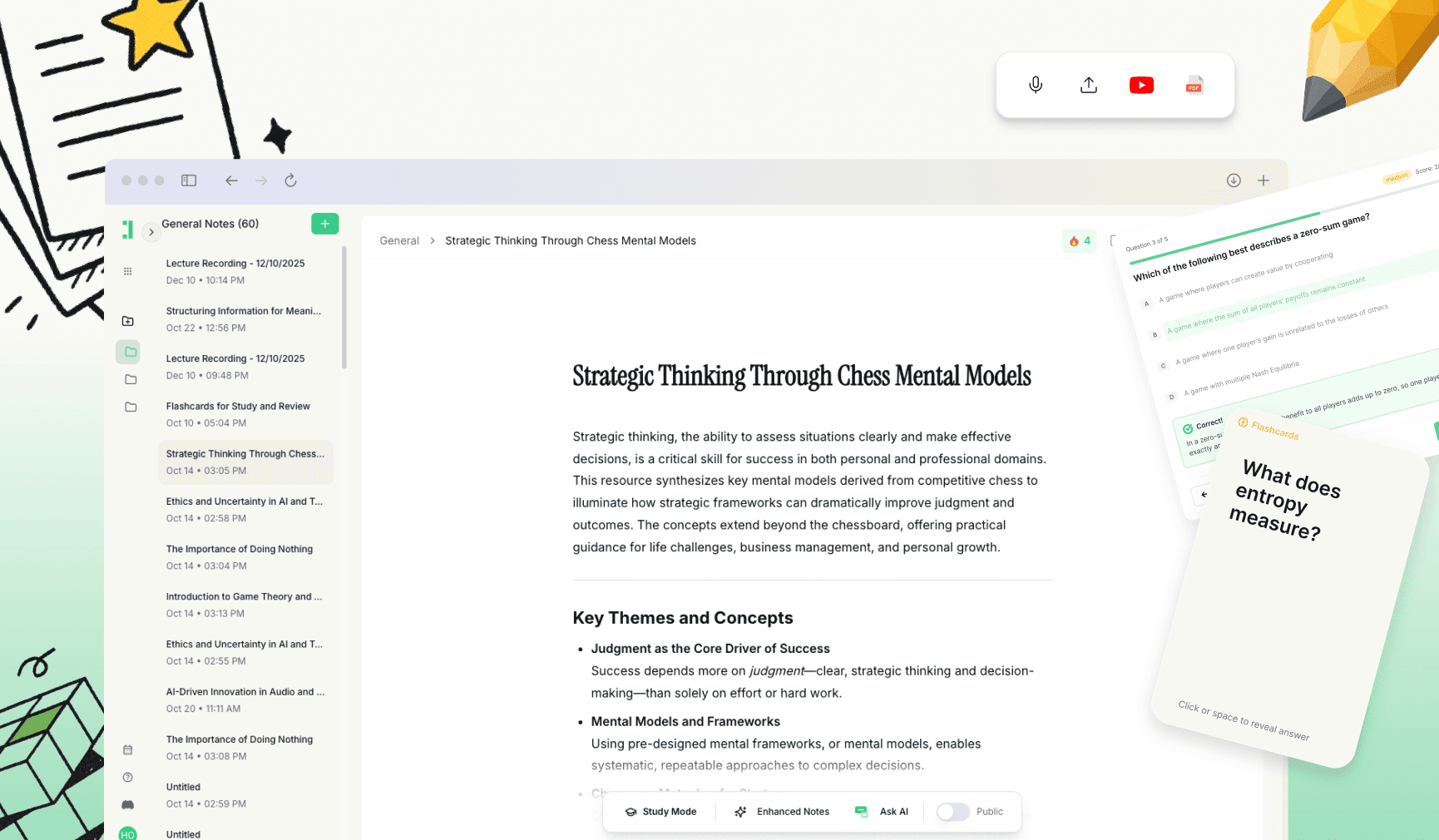
Generate Flashcards for Balancing Chemical Equations
Turn your notes, PDFs, slides, or chemistry lectures into Balancing Chemical Equations flashcards so you can review faster and remember more. Master the law of conservation of mass without the manual data entry.
Generate Balancing Chemical Equations Flashcards Upload notes / paste text
In Duetoday, simply upload your chemistry materials, and our AI identifies key reactions to generate a custom deck. You can then review, edit, and use active recall to ensure your equations are always balanced before exam day.
What are Balancing Chemical Equations flashcards?
Flashcards for this topic cover the fundamental skill of ensuring the number of atoms for each element is equal on both the reactant and product sides of a chemical equation. They typically include practice problems, identification of coefficients, and the rules of stoichiometry.
The outcome is a shift from passive reading to active problem-solving. Instead of staring at a textbook, you test your ability to quickly identify unbalanced atoms and apply the correct multipliers to satisfy the Law of Conservation of Mass.
If you already have notes, Duetoday can generate a clean deck in minutes.
Why flashcards work for Balancing Chemical Equations
Balancing equations is a procedural skill that requires recognizing patterns and applying rules quickly. Flashcards are ideal because they force you to visualize the relationship between reactants and products repeatedly until the logic becomes second nature.
By using active recall and spaced repetition, you move these rules from short-term memory into long-term mastery, ensuring you don't stall during a timed chemistry test.
Identify unbalanced elements in seconds
Separate subscripts (permanent) from coefficients (changeable)
Learn the step-by-step process for complex combustion reactions
Practice applying the Law of Conservation of Mass rapidly
What to include in your Balancing Chemical Equations flashcards
Effective chemistry flashcards follow the "one idea per card" rule. Rather than putting a massive multi-step problem on one card, break the process down into specific questions that trigger immediate recall.
Use these four main card types to build a comprehensive understanding of the topic:
Definitions & Key Terms: "What is a coefficient?" "What does the arrow represent?"
Processes & Steps: "Which element should you balance last in a combustion reaction?"
Comparisons: "How do subscripts differ from coefficients in a balanced equation?"
Application: "Balance this: H2 + O2 -> H2O." "What coefficient goes in front of O2?"
Example prompts for your deck: "State the Law of Conservation of Mass," "Define a stoichiometric coefficient," "Balance the equation for the synthesis of ammonia," and "Check if 2Mg + O2 -> 2MgO is balanced."
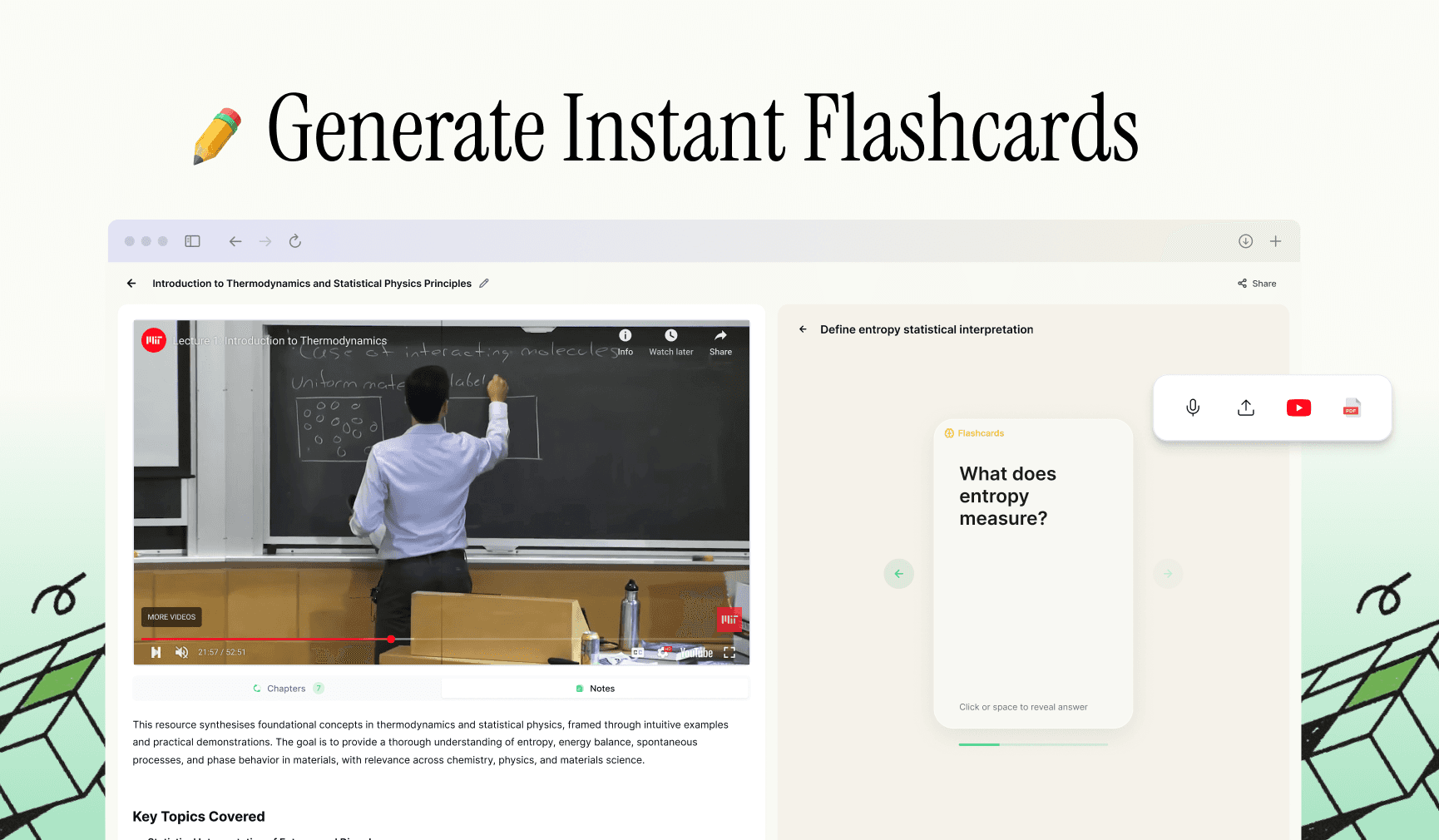
How to study Balancing Chemical Equations with flashcards
We recommend a "two-pass" approach. First, build your deck using your lecture notes or textbook chapters. Then, move through your cards in rapid-fire rounds to build muscle memory for common chemical symbols and reaction types.
Keep your study sessions short—around 15 to 20 minutes—focusing specifically on the equations that trip you up logically, such as those involving polyatomic ions.
Make a deck from your notes (or generate it from Duetoday).
Do one quick round to find which reactions take you the longest to balance.
Review those "weak" cards daily for three days.
Mix in harder combustion or redox equations to challenge your logic.
Do a final mixed review of all reaction types before your quiz.
Generate Balancing Chemical Equations flashcards automatically
Making chemistry cards manually is slow and tedious, especially when trying to format chemical symbols and subscripts correctly on paper. It often leads to messy cards that are hard to read during quick study sessions.
Duetoday solves this by processing your material directly. You can upload a PDF of your textbook or a photo of your handwritten notes, and the AI will extract the equations and concepts for you.
Upload or paste your chemistry material.
Click "Generate Flashcards."
Review, edit, and start studying immediately.
Generate Balancing Chemical Equations Flashcards in Duetoday
Start with your notes and get a deck you can actually use today.
Common Balancing Chemical Equations flashcard mistakes
Many students create cards that are too complex, leading to frustration rather than learning. Avoid these common pitfalls to keep your study sessions productive:
Cards are too long: Don't put a 5-step reaction on one side. Ask for one coefficient at a time.
Confusing subscripts: Ensure your cards clearly distinguish between the formula of a molecule and the number of molecules.
Ignoring physical states: Forgetting to include (s), (l), (g), or (aq) can lead to errors in advanced stoichiometry.
No review schedule: Balancing is a skill that gets rusty; repeat your practice sessions every few days.
Ready to generate your Balancing Chemical Equations flashcards?
Stop rereading your chemistry textbook and start recalling. Upload your notes, generate your deck, and master your equations with the power of active recall.
Start Generating Flashcards
Works with notes, PDFs, slides, and transcripts.
FAQ
How many flashcards do I need for Balancing Chemical Equations? Usually, 30-50 cards are enough to cover the basic rules, the different types of reactions (synthesis, decomposition, etc.), and 15-20 practice problems of varying difficulty.
What’s the best format for these flashcards? The "Problem on Front, Solution on Back" format is best for practice. For conceptual cards, use the "Question on Front, Concise Answer on Back" format.
How often should I review my chemistry flashcards? Review them daily leading up to an exam. Once you've mastered the logic, a weekly "refresher" session will keep the skill sharp for the rest of the semester.
Should I make cards from a textbook or my own notes? Both are great! Textbooks provide standard problems, while your notes often contain specific tips or methods taught by your instructor that might appear on the exam.
How do I stop forgetting how to balance complex reactions? Use spaced repetition. Duetoday’s system shows you the hardest equations more frequently until your brain recognizes the coefficients automatically.
What if my flashcards feel too easy? Increase the difficulty by including reactions with polyatomic ions or transitioning into stoichiometry problems where balancing is only the first step.
Can I generate chemistry flashcards from a PDF automatically? Yes, Duetoday is designed to read chemistry PDFs, recognize chemical formulas, and turn them into interactive flashcards and quizzes.
Are digital flashcards better than paper for chemistry? Digital cards are often better because they allow for easier editing of complex symbols and use algorithms to ensure you see the hardest equations at the perfect time.
How long does it take to make a full deck? Manually, it could take an hour. With Duetoday’s AI, you can generate a comprehensive deck from your notes in less than 60 seconds.
Can Duetoday handle subscripts and chemical symbols? Absolutely. Duetoday understands chemical notation, ensuring your flashcards look professional and are easy to read during your study sessions.

Duetoday is an AI-powered learning OS that turns your study materials into personalised, bite-sized study guides, cheat sheets, and active learning flows.