Generate Flashcards for Automata Theory
Make Automata Theory flashcards to study DFA, NFA, and Turing machines. Generate a study guide from your notes.
Generate Flashcards with AI Free
Generate Flashcards for Automata Theory
Turn your notes, PDFs, slides, or lecture transcripts into Automata Theory flashcards so you can review faster and remember complex proofs more effectively. Automata Theory is a foundational pillar of computer science, but its abstract nature makes it difficult to master through passive reading.
Primary: Generate Automata Theory Flashcards
Secondary: Upload notes / paste text
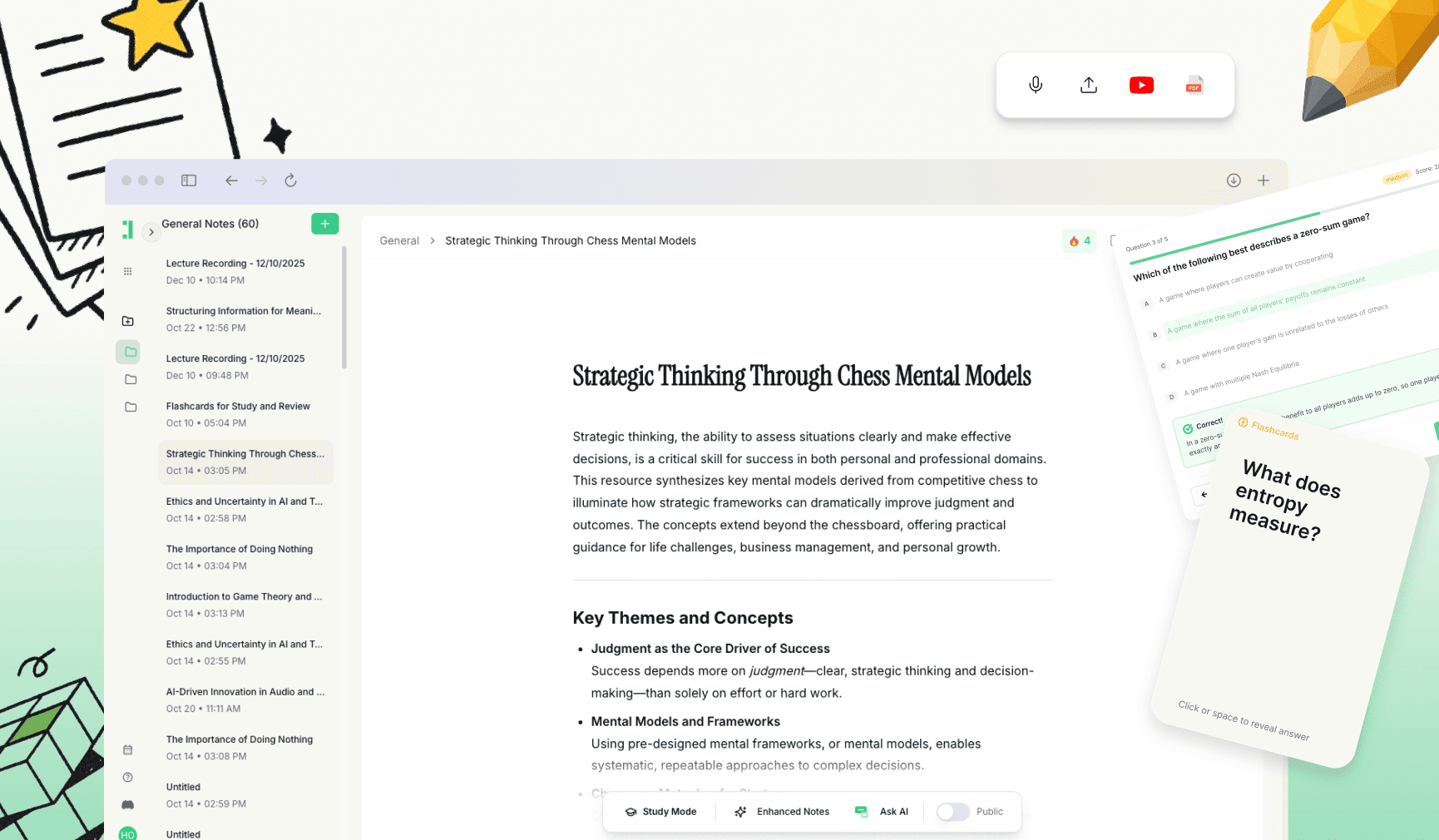
Using Duetoday is simple: upload your course material, our AI extracts the core logic and theorems, and you receive a structured deck of flashcards ready for review and editing.
What are Automata Theory flashcards?
Automata Theory flashcards cover the mathematical models of computation. They break down complex topics like Deterministic Finite Automata (DFA), Non-deterministic Finite Automata (NFA), Regular Expressions, Context-Free Grammars, and Turing Machines into manageable questions. Instead of staring at a state transition diagram and hoping it makes sense, you test your ability to explain transition functions, language acceptance, and the hierarchy of formal languages.
The outcome is simple: instead of rereading dense textbooks, you force your brain to retrieve information. This builds the muscle memory needed to solve computation problems quickly during exams.
Why flashcards work for Automata Theory
Automata Theory requires a mix of logical definitions, sequence-based steps, and understanding the relationships between different classes of languages. Flashcards focus on active recall, which is significantly more effective than highlighting for technical subjects.
Remember formal definitions of quintuples (Q, Σ, δ, q0, F) without cramming.
Separate similar concepts like the difference between DFA and NFA.
Learn the steps of the Pumping Lemma for regular and context-free languages.
Practice applying closure properties across different language classes.
What to include in your Automata Theory flashcards
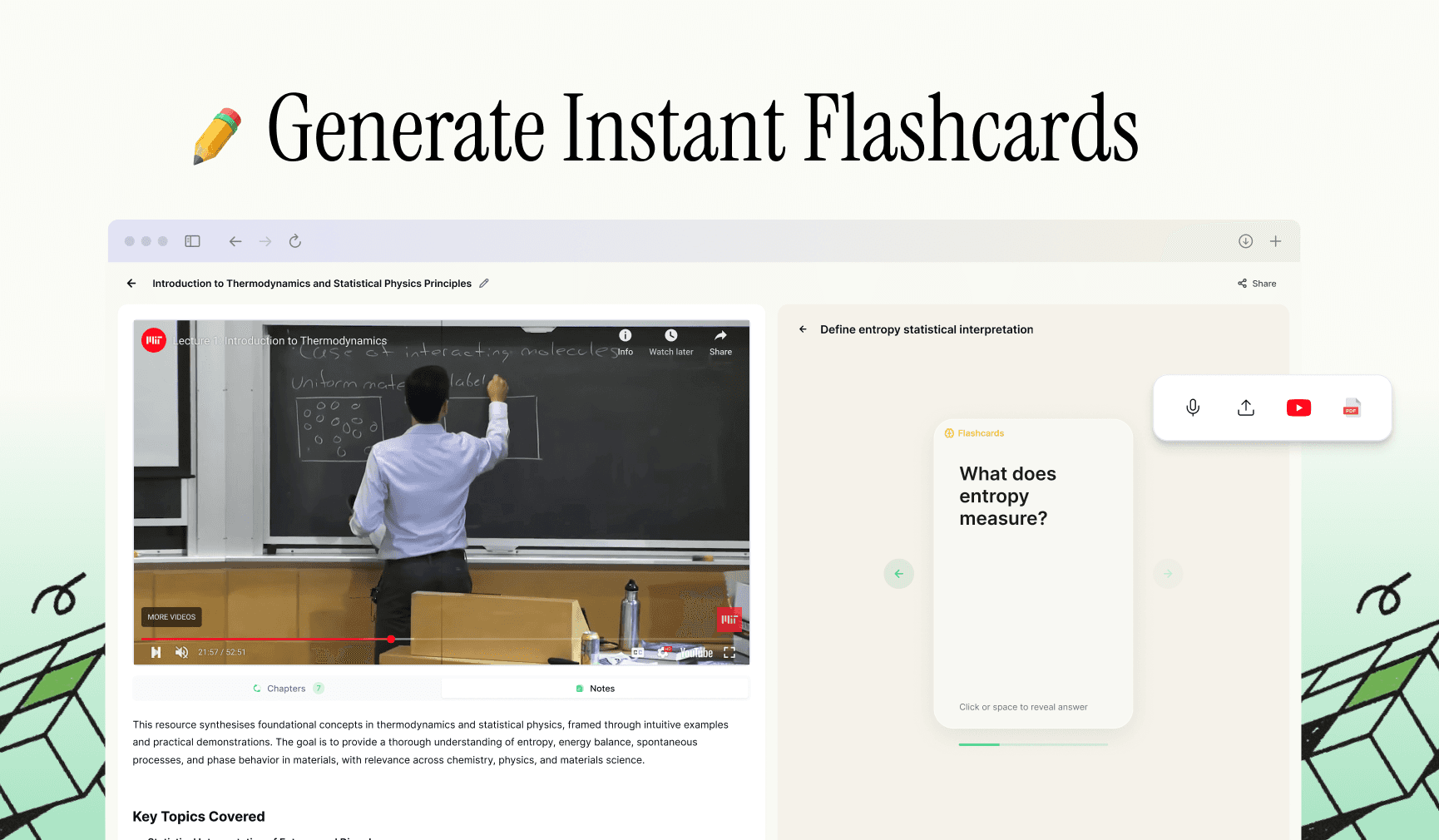
The most effective flashcards follow the one idea per card rule. For Automata Theory, this means focusing on specific transitions, definitions, or steps in a proof rather than trying to fit an entire diagram on one card.
Definitions & key terms: What is the definition of a regular language? or Define a configuration of a Turing Machine.
Processes & steps: What are the steps to convert an NFA to a DFA using subset construction?
Comparisons: How does a Pushdown Automaton differ from a Finite Automaton?
Application: Is the language {a^n b^n | n ≥ 0} regular or context-free?
Example prompts include: What is the pumping length?, State the Myhill-Nerode Theorem, and What is the difference between decidability and recognizability?
How to study Automata Theory with flashcards
To master this subject, use a two-pass approach. First, generate your deck from your syllabus or class notes. Then, go through the cards to identify which concepts—like the Greibach Normal Form or Rice's Theorem—are the hardest for you to grasp. Review those difficult cards daily to move them into your long-term memory.
Generate Automata Theory flashcards automatically in Duetoday
Manually drawing state diagrams and writing out formal proofs on physical index cards is slow and frustrating. Duetoday automates the tedious part of studying so you can focus on the logic. Just upload your PDF or paste your lecture notes, and our AI generates a custom deck in seconds. You can then edit the cards for clarity and start your study session immediately.
Common Automata Theory flashcard mistakes
Cards are too long: Don't paste the entire formal definition; break it into its parts.
Ignoring the 'Why': Don't just memorize the name of a theorem; include a prompt for when it is applied.
Confusing Automata types: Ensure you have specific cards that distinguish between Mealy and Moore machines.
FAQ
How many flashcards do I need for Automata Theory? Typically, 50 to 100 cards cover the core concepts of a standard undergraduate course, from finite state machines to NP-completeness.
What’s the best format for Automata Theory flashcards? Question-and-answer format works best for definitions, while step-by-step prompts are better for algorithms like the CYK algorithm.
How often should I review my flashcards? Review new concepts daily and use spaced repetition to revisit older concepts every few days.
Should I make cards from a textbook or slides? Both. Use textbooks for formal definitions and slides for the specific examples your professor emphasizes.
Can I generate flashcards from a PDF automatically? Yes, Duetoday is designed to parse PDFs and extract the most relevant logical points for your cards.
Are digital flashcards better than paper for this topic? Yes, because digital tools allow you to easily edit complex formulas and organize decks by topic, such as 'Regular Languages' or 'Decidability'.
How long does it take to create a full deck? With Duetoday, it takes less than a minute to generate a deck from your uploaded materials.
Can Duetoday handle mathematical symbols? Yes, Duetoday processes standard mathematical notation used in Automata Theory to ensure your cards are accurate.

Duetoday is an AI-powered learning OS that turns your study materials into personalised, bite-sized study guides, cheat sheets, and active learning flows.