Generate Flashcards for Atomic Physics Basics
Generate Atomic Physics flashcards in seconds. Boost your recall and ace your exams. Try for free today!
Generate Flashcards with AI Free

Generate Flashcards for Atomic Physics Basics
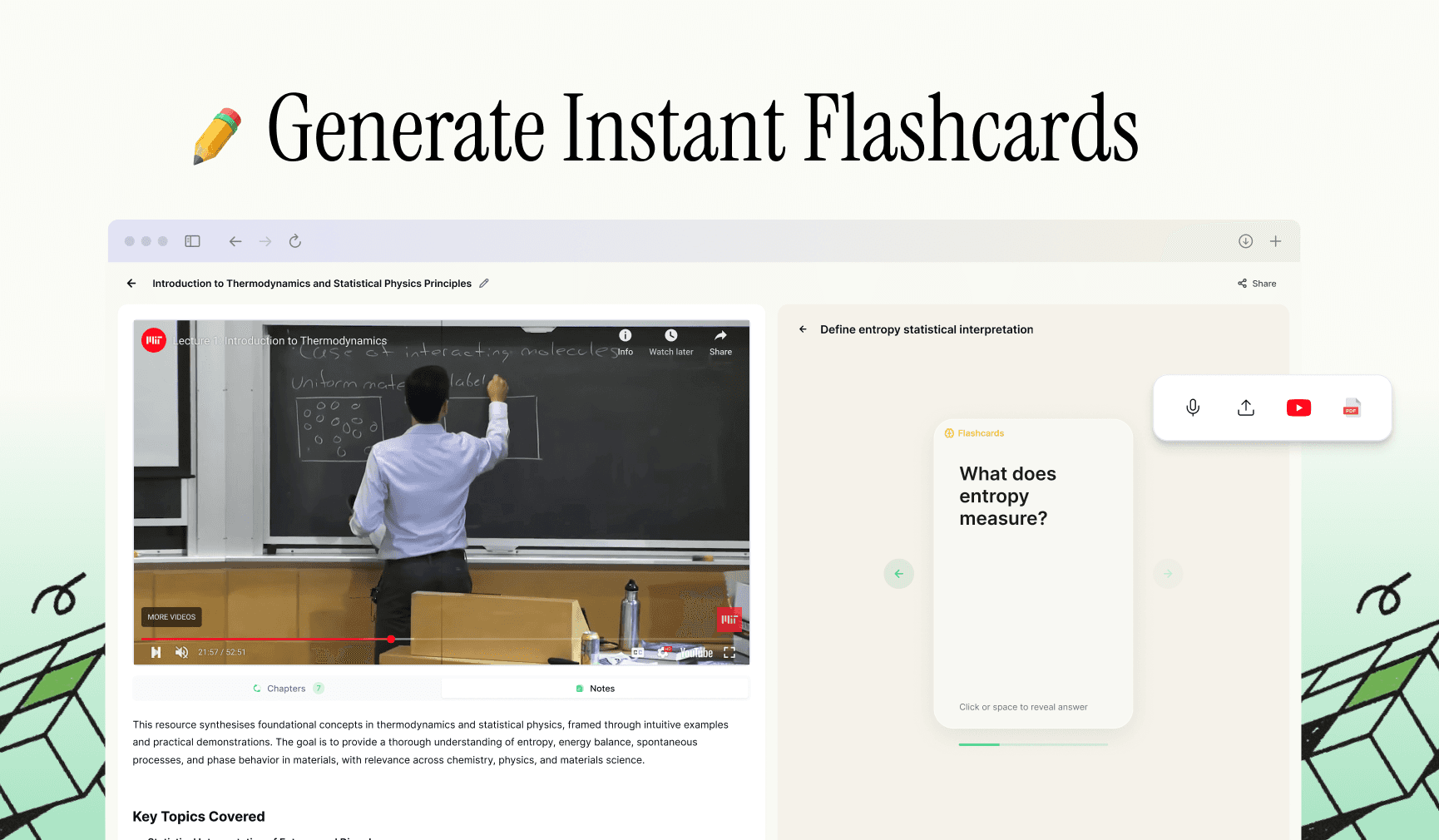
Turn your notes, PDFs, slides, or physics lectures into Atomic Physics Basics flashcards so you can review faster and remember more. Understanding the fundamental building blocks of matter requires precision, and our tool helps you capture every detail.
Generate Atomic Physics Flashcards
Upload notes / paste text
In Duetoday, the process is simple: just upload your materials, let the AI generate your cards, review or edit the content, and start your study session immediately.
What are Atomic Physics Basics flashcards?
Atomic Physics Basics flashcards cover the essential components of the atom, including atomic structure, subatomic particles, energy levels, and radiation. They break down complex formulas and theories into bite-sized questions that test your knowledge of how matter and energy interact at the smallest scales.
The outcome is simple: instead of passively rereading a textbook, you test yourself quickly and build lasting recall. If you already have notes, Duetoday can generate a clean deck in minutes so you can spend your time studying rather than formatting.
Why flashcards are one of the best ways to study Atomic Physics Basics
Atomic physics relies heavily on a mix of terminology, mathematical relationships, and specific sequences. Flashcards are ideal for this because they force you to recall specific facts—like the mass of a proton or the definition of an isotope—without looking at the answer first.
By using active recall and spaced repetition, you move information from your short-term memory into long-term mastery. This system ensures you don't forget the basics when you move on to more advanced nuclear physics topics.
Remember key terms like 'bohr model' and 'quantum numbers' without cramming.
Separate similar concepts (e.g., isotopes vs. isobars).
Learn processes step-by-step, such as alpha and beta decay pathways.
Practice applying the Rydberg formula or calculating binding energy quickly.
What to include in your Atomic Physics Basics flashcards
Good flashcards follow the "one idea per card" rule. For atomic physics, this means keeping your questions specific enough to trigger a single, clear answer. Mixed-concept cards often lead to confusion during high-pressure exams.
We recommend focusing on four main card types to ensure full coverage of the material:
Definitions & key terms: "What is the Heisenberg Uncertainty Principle?"
Processes & steps: "What are the stages of electron excitation?"
Comparisons: "How does a cation differ from an anion?"
Application: "What happens to the atomic number during alpha decay?"
Example prompts: "Define the half-life of a radioisotope," "What is the mass of an electron relative to a proton?", or "Identify the four quantum numbers."
How to study Atomic Physics Basics with flashcards
We suggest a "two-pass" approach. First, generate your deck and do one quick round to see which concepts (like electron configurations) are sticking and which aren't. This establishes your baseline.
Next, focus on your weak points. Review the difficult cards daily for a few days while mixing in some easier "refreshers." This keep the material fresh and prevents the "forgetting curve" from taking hold before your test.
Generate Atomic Physics flashcards automatically in Duetoday
Making cards manually is slow, messy, and often leads to inconsistent study habits. Duetoday streamlines this by letting you upload your PDF slides or lecture transcripts to create a comprehensive study guide in seconds.
Upload or paste your Atomic Physics Basics material.
Click Generate Flashcards.
Review, edit, and start studying.
Generate Atomic Physics Flashcards in Duetoday
Common Atomic Physics Basics flashcard mistakes
Many students create cards that are too long, essentially copying whole paragraphs from the textbook. This makes it impossible to test yourself effectively. If a card has more than two sentences, it's likely too complex.
Cards are too long: split into one concept per card.
Only memorizing words: add "why" to understand the logic behind the physics.
Confusing isotopes: use comparison cards to highlight the differences in neutron counts.
No review schedule: use Duetoday's system to repeat weak cards more often.
FAQ
How many flashcards do I need for Atomic Physics Basics? A typical introductory unit usually requires between 50 to 100 cards to cover all terms, formulas, and decay processes effectively.
What’s the best format for physics flashcards? Question-and-answer format is best. For formulas, put the name of the formula on the front and the equation on the back.
How often should I review my cards? Daily review is best during the first week, then you can transition to every few days as the concepts become more familiar.
Should I make cards from my textbook or lecture slides? Use both. Lecture slides often highlight what the professor thinks is most important, while textbooks provide the necessary detail.
How do I stop forgetting nuclear decay rules? Use "if/then" cards. For example: "If an atom undergoes beta decay, then the atomic number increases by one."
Can I generate flashcards from a PDF automatically? Yes, Duetoday allows you to upload any Atomic Physics PDF and converts the content into study-ready cards instantly.
Are digital flashcards better than paper? Digital cards are often superior because they can use AI to track which cards you struggle with and show them to you more frequently.
How long does it take to create a full deck? With Duetoday, it takes less than a minute. Manually, it could take several hours of writing and formatting.
Can Duetoday organize my physics cards? Yes, the tool categorizes your cards by topic so you can focus your study sessions on specific areas like subatomic particles or radiation.

Duetoday is an AI-powered learning OS that turns your study materials into personalised, bite-sized study guides, cheat sheets, and active learning flows.