Generate Flashcards for Astrophysics
Make and generate astrophysics flashcards from your notes to master celestial physics and cosmology subjects.
Generate Flashcards with AI Free
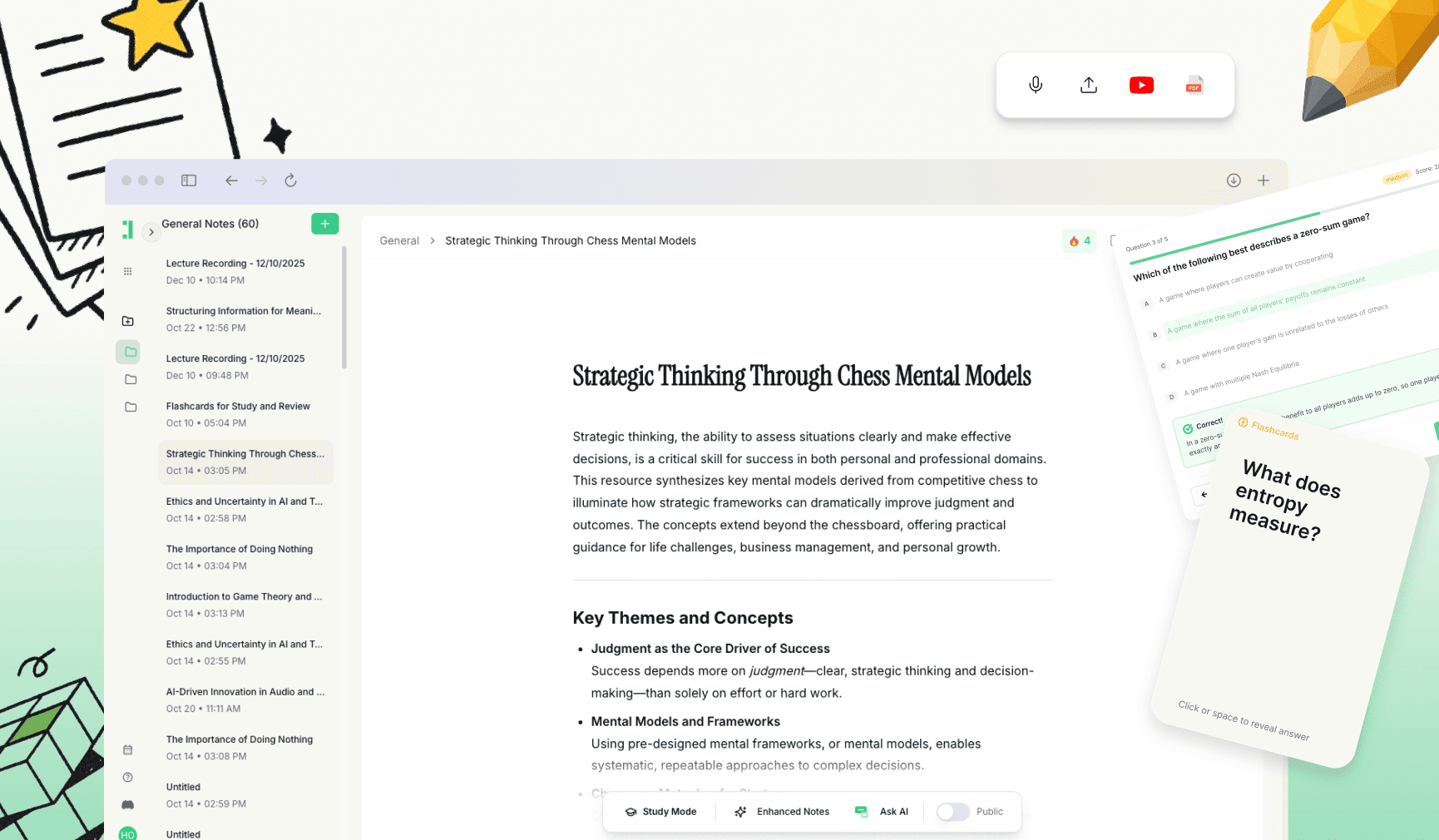
Generate Flashcards for Astrophysics
Turn your notes, PDFs, slides, or lectures into Astrophysics flashcards so you can review faster and remember more. Science this complex requires more than just reading; it requires active engagement with the material.
Generate Astrophysics FlashcardsUpload notes / paste text
In Duetoday, the process is simple: upload your complex astrophysics material, generate a structured deck, review or edit the cards, and start studying with spaced repetition immediately.
What are Astrophysics flashcards?
Astrophysics flashcards are specialized study tools that cover the physical properties and dynamic processes of celestial objects. They break down massive concepts like stellar evolution, orbital mechanics, dark matter, and general relativity into digestible, testable units.
Instead of passively rereading a textbook chapter on nucleosynthesis, these flashcards force you to recall specific facts, formulas, and theories, building a stronger neural connection to the material. If you already have notes, Duetoday can generate a clean deck in minutes.
Why flashcards work for Astrophysics
Astrophysics requires a unique blend of conceptual understanding and mathematical application. Flashcards allow you to isolate these variables and master them individually before combining them in complex problem-solving. By using active recall and spaced repetition, you ensure that the life cycle of a star or the Friedmann equations stay fresh in your mind.
Remember key terms like 'Chandrasekhar limit' and 'Event Horizon' without cramming.
Separate similar concepts (e.g., Pulsars vs. Quasars).
Learn processes step-by-step like the Proton-Proton chain or the stages of a Supernova.
Practice applying astrophysical constants and formulas quickly.
What to include in your Astrophysics flashcards
Effective astrophysics flashcards follow the 'atomic' rule: one idea per card. This prevents you from glazing over complex details and ensures you actually know the answer to every part of the question. Your deck should balance theoretical definitions with practical application prompts.
The four main card types for this subject include:
Definitions & key terms: "What is the Schwarzschild radius?"
Processes & steps: "What are the stages of evolution for a low-mass star?"
Comparisons: "How does a Type Ia supernova differ from a Type II supernova?"
Application: "Using Wien's Law, what happens to the peak wavelength if temperature doubles?"
Example prompts: "State the three types of black holes by mass," "Identify the main components of the Lambda-CDM model," or "Define the cosmic microwave background radiation."
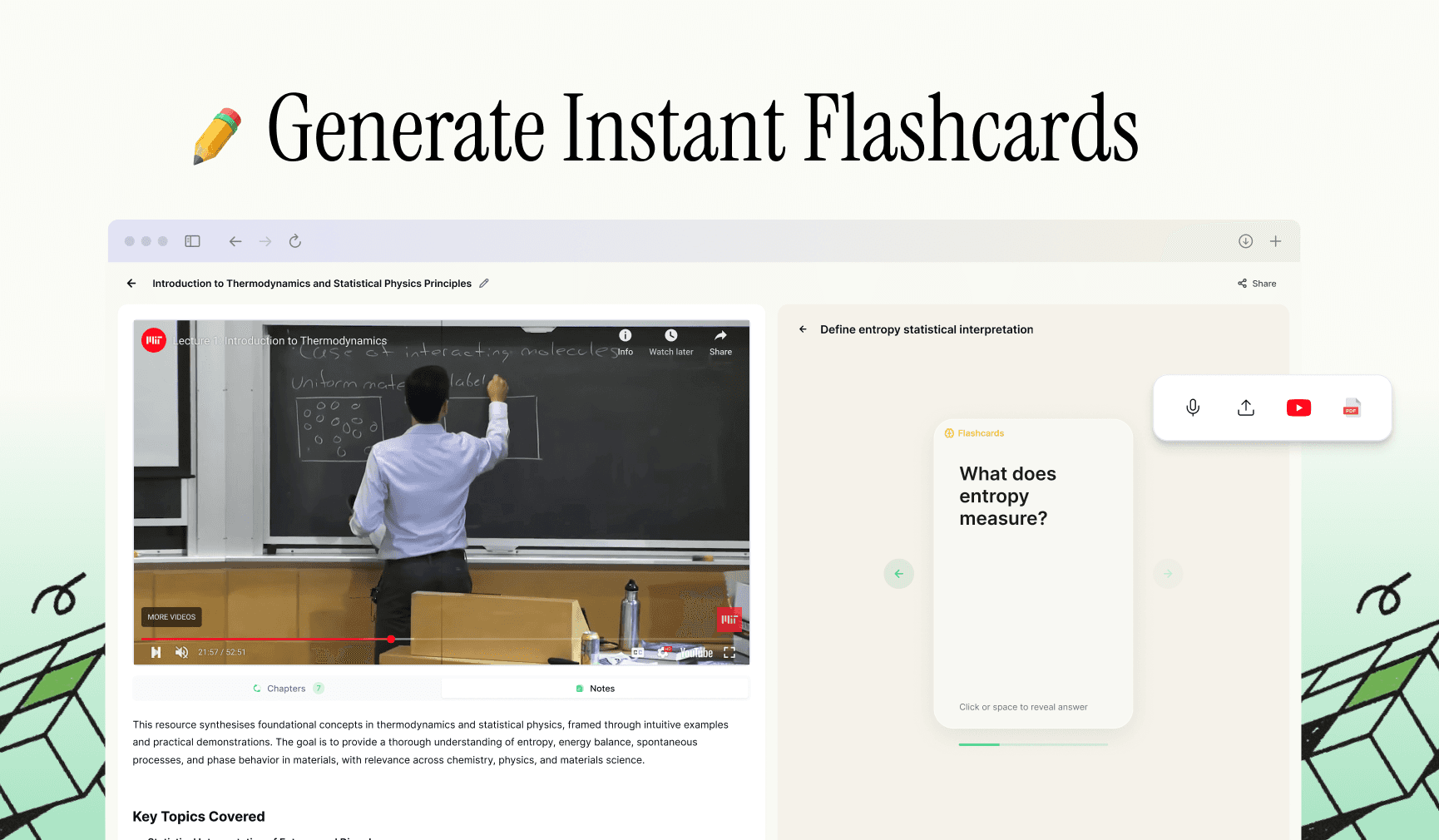
How to study Astrophysics with flashcards (a simple system)
Studying the stars requires a systematic approach. We recommend a 'two-pass' system: first, build your deck from your syllabus or notes, then move into iterative review rounds to solidify the information.
Start with a high-volume review to identify which concepts—like gravitational lensing or redshift—are tripping you up. Focus your energy on those difficult cards while keeping the easier ones in a long-term rotation.
Make a deck from your notes or generate it from your textbook PDF.
Do one quick round to find weak spots in your conceptual understanding.
Review weak cards daily for a few days to build familiarity.
Mix in harder mathematical cards each session to keep your skills sharp.
Do a final mixed review before your midterms or final exams.
Generate Astrophysics flashcards automatically in Duetoday
Manually writing out cards for every spectral class or galaxy type is slow and takes time away from actual studying. It’s easy to get bogged down in the formatting rather than the learning.
Duetoday solves this by automating the creation process. Simply upload your PDF, lecture slides, or even YouTube transcripts, and our AI identifies the most important astrophysical concepts to create a high-quality deck instantly.
Upload or paste your Astrophysics material
Click Generate Flashcards
Review, edit, and start studying
Generate Astrophysics Flashcards in Duetoday
Start with your notes and get a deck you can actually use today.
Common Astrophysics flashcard mistakes (and how to fix them)
Most students make cards that are too 'wordy,' which leads to recognition rather than true recall. If you are just memorizing a paragraph, you aren't learning the physics.
Cards are too long → Split into one idea per card (e.g., separate the definition of a Parsec from its calculation).
Only memorizing words → Add "explain why/how" prompts to test your understanding of the underlying physics.
Confusing similar concepts → Add specific comparison cards for things like Dark Matter vs. Dark Energy.
No review schedule → Use a spaced repetition system to repeat weak cards more often.
Ready to generate your Astrophysics flashcards?
Stop rereading your heavy textbooks and start testing your knowledge. Upload your notes, generate your deck, and master the universe with active recall.
Start Generating Flashcards
Works with notes, PDFs, slides, and transcripts.
FAQ
How many flashcards do I need for Astrophysics? A single chapter usually requires 30–50 cards to cover terms, formulas, and conceptual processes thoroughly.
What’s the best format for Astrophysics flashcards? Question-and-answer style is best, especially when you include a specific scenario or a formula to be applied.
How often should I review Astrophysics flashcards? Ideally, every day for new or difficult cards, and every 3–5 days for concepts you have already mastered.
Should I make cards from a textbook or lecture notes? Use lecture notes for what your professor emphasizes, and use the textbook for more detailed definitions and formula derivations.
How do I stop forgetting Astrophysics after a few days? Use spaced repetition. The goal is to review the material just as you are about to forget it to strengthen the memory.
What if my flashcards feel too easy? If a card is too easy, it means you’ve mastered it. Move it to a 'long-term' review pile or add more complex 'apply' questions.
Can I generate Astrophysics flashcards from a PDF automatically? Yes, Duetoday can scan your textbook or research paper PDFs and extract the most relevant study points for cards.
Are digital flashcards better than paper for Astrophysics? Digital is often better because you can easily include diagrams of star cycles or complex orbital paths that are hard to draw by hand.
How long does it take to make a full Astrophysics deck? Manually, it can take hours; with Duetoday, you can generate a full deck in under a minute.
Can Duetoday generate and organize my flashcards for me? Yes, Duetoday categorizes your cards and allows you to edit them to ensure they align perfectly with your study goals.

Duetoday is an AI-powered learning OS that turns your study materials into personalised, bite-sized study guides, cheat sheets, and active learning flows.