Generate Flashcards for Asian History
Make Asian History flashcards and study guides to help you generate better grades in history and social studies subjects.
Generate Flashcards with AI Free
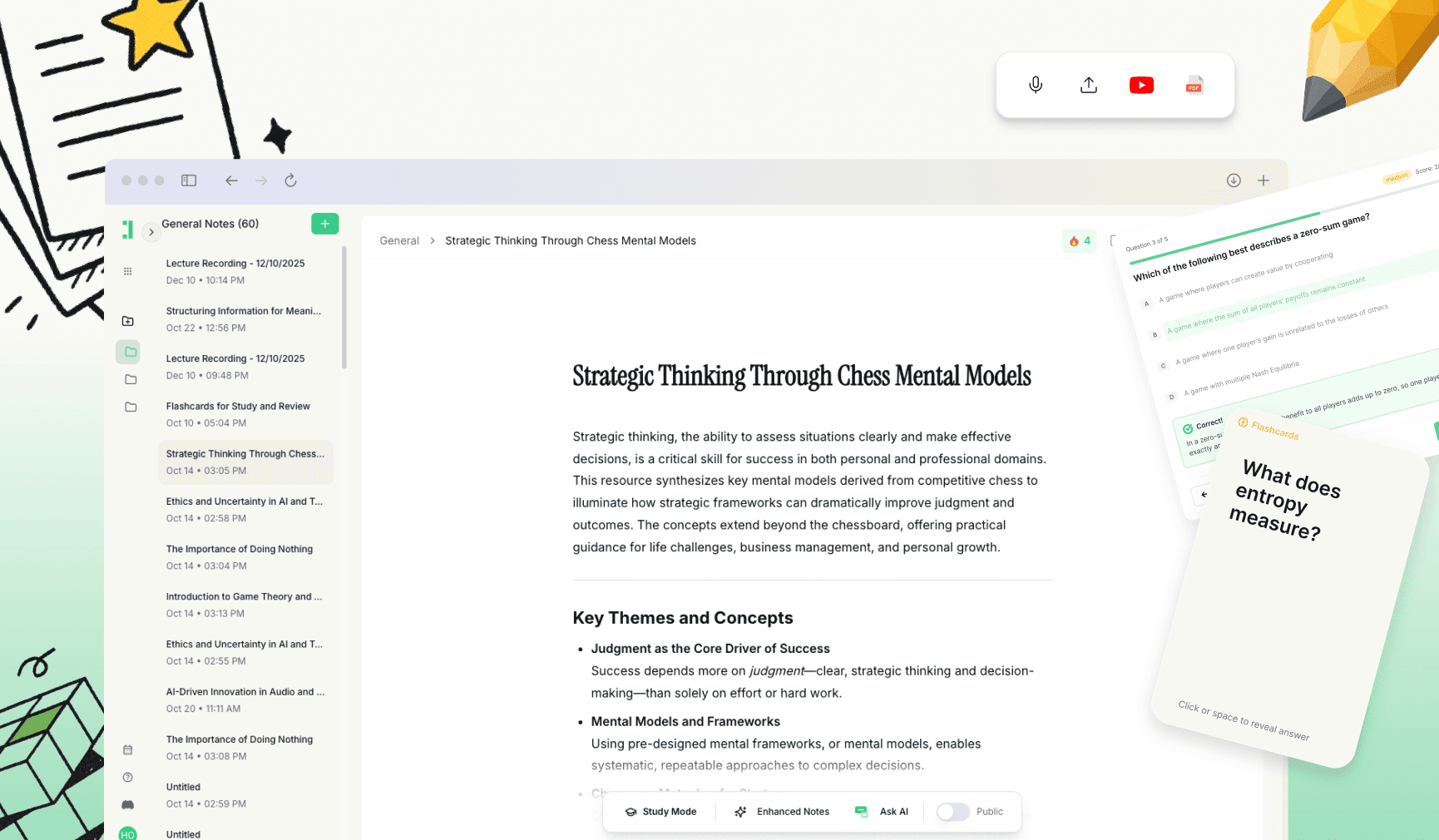
What are Asian History flashcards?
Asian History flashcards are targeted study tools designed to help you master the vast timelines, complex dynasties, and pivotal cultural shifts of the world’s largest continent. These flashcards cover everything from the Silk Road and the Meiji Restoration to the nuances of many philosophical traditions like Confucianism or Buddhism.
The outcome is simple: instead of passively rereading hundreds of pages of textbooks, you test your knowledge through active recall. By shifting from reading to retrieving, you build stronger neural pathways and ensure you don't confuse the Ming Dynasty with the Qing, or the Partition of India with the Meiji Era.
If you already have notes, Duetoday can generate a clean deck in minutes.
Why flashcards are one of the best ways to study Asian History
Asian History requires a balance between memorizing specific dates and understanding broad socioeconomic relationships. Flashcards bridge this gap by forcing you to identify key figures and events instantly without the context clues of a full page of text.
Spaced repetition and active recall allow you to manage the massive scope of Asian history without feeling overwhelmed. By isolating facts, you can focus your energy on the specific eras or regions where your memory is weakest.
Remember key emperors and dynasties without late-night cramming.
Separate similar concepts (e.g., Shintoism vs. Zen Buddhism).
Learn historical processes step-by-step (the rise of the Mongol Empire or the decolonization of Southeast Asia).
Practice identifying the causes and consequences of major revolutions.
What to include in your Asian History flashcards
The most effective Asian History flashcards follow the atomic rule: one specific idea per card. This prevents recognition bias, where you think you know the answer just because you recognize the general topic.
To build a comprehensive deck, you should utilize four distinct card types that challenge different parts of your historical understanding:
Definitions & Key Terms: What was the Mandate of Heaven? or Define the Bushido code.
Processes & Steps: What were the three stages of the Taiping Rebellion?
Comparisons: How did the Mughal Empire differ from the Delhi Sultanate in religious policy?
Application: How did the Treaty of Versailles influence the May Fourth Movement in China?
Try these prompts for your deck: Who founded the Maurya Empire?, What was the primary goal of the Great Leap Forward?, List the four main islands of Japan, or What triggered the 1857 Indian Rebellion?

How to study Asian History with flashcards (a simple system)
To master Asian History, use a two-pass approach. Start by generating a complete deck covering your current unit. In your first pass, go through every card to identify which dynasties or conflicts you struggle to remember. This creates a baseline for your study sessions.
Once identified, focus on your weak cards daily. History is built on layers; once you master the dates and names, the broader themes of cultural exchange and political evolution become much easier to grasp.
Make a deck from your lecture notes or textbook chapters.
Do one quick round to find weak spots in specific regions or eras.
Review weak cards daily to move them into long-term memory.
Mix in older cards (like early civilizations) while studying modern history.
Do a final mixed-era review before your exams.
Generate Asian History flashcards automatically in Duetoday
Manually writing out hundreds of cards for a subject as broad as Asian History is slow and often leads to messy, inconsistent notes. You end up spending more time writing than actually studying.
Duetoday changes this by automating the creation process. Simply upload your materials and let the AI extract the most important historical facts for you.
Upload or paste your Asian History PDFs, slides, or notes.
Click Generate Flashcards.
Review, edit for personal context, and start studying.
Generate Asian History Flashcards in Duetoday
Start with your notes and get a deck you can actually use today.
Common Asian History flashcard mistakes
The biggest mistake students make is creating encyclopedia cards—cards that have too much text on the back. If a card takes 30 seconds to read, it isn't a flashcard; it's a note. Keep them snappy.
Cards are too long: Split multi-fact events into separate cards.
Ignoring Geography: Ensure you include cards about map locations and borders.
Confusing Eras: Use comparison cards to distinguish between similar-sounding periods.
No Chronology: Always include the why behind the date to understand the sequence.
Ready to generate your Asian History flashcards?
Stop wasting hours on manual data entry. Upload your notes, generate your deck, and spend your time actually learning the history. Duetoday makes it easy to turn complex lectures into simple, effective study tools.
Start Generating Flashcards
Works with notes, PDFs, slides, and transcripts.
FAQ
How many flashcards do I need for Asian History?
For a single unit (like Ancient China or Modern Japan), 40–60 cards is usually sufficient. For a full semester course, you may end up with 300+ cards categorized by region.
What’s the best format for Asian History flashcards?
The Question and Answer format is best for dates and names, while Concept and Significance works better for understanding the impact of historical movements.
How often should I review Asian History flashcards?
Review new cards daily for the first week. Once you feel confident, transition to a spaced repetition schedule where you see them every 3–5 days.
Should I make cards from a textbook or lecture notes?
Use lecture notes for the must-know information emphasized by your teacher, and use the textbook to fill in gaps regarding specific dates or definitions.
How do I stop forgetting dynasties after a few days?
Use comparison cards. Instead of just memorizing the Tang Dynasty, create a card that asks for one major difference between the Tang and the Song.
Can I generate Asian History flashcards from a PDF automatically?
Yes, Duetoday allows you to upload any history PDF or slide deck and instantly converts the text into structured flashcards.
Are digital flashcards better than paper for history?
Digital is generally better for history because you can easily add images of maps or historical art, and the AI can handle the organization for you.
How long does it take to make a full Asian History deck?
Manually, it can take hours. With Duetoday, you can generate a comprehensive deck from your notes in under a minute.
What if my flashcards feel too easy?
If they are too easy, start adding Why and How questions to the back of the cards to force a deeper level of analysis beyond simple names and dates.
Can Duetoday organize my cards by sub-topic?
Yes, you can generate separate decks for different regions like East Asia, South Asia, and Southeast Asia to keep your studies organized.

Duetoday is an AI-powered learning OS that turns your study materials into personalised, bite-sized study guides, cheat sheets, and active learning flows.