Generate Flashcards for Analytical Chemistry
Learn how to make or generate Analytical Chemistry flashcards to master spectroscopy and lab methods fast.
Generate Flashcards with AI Free
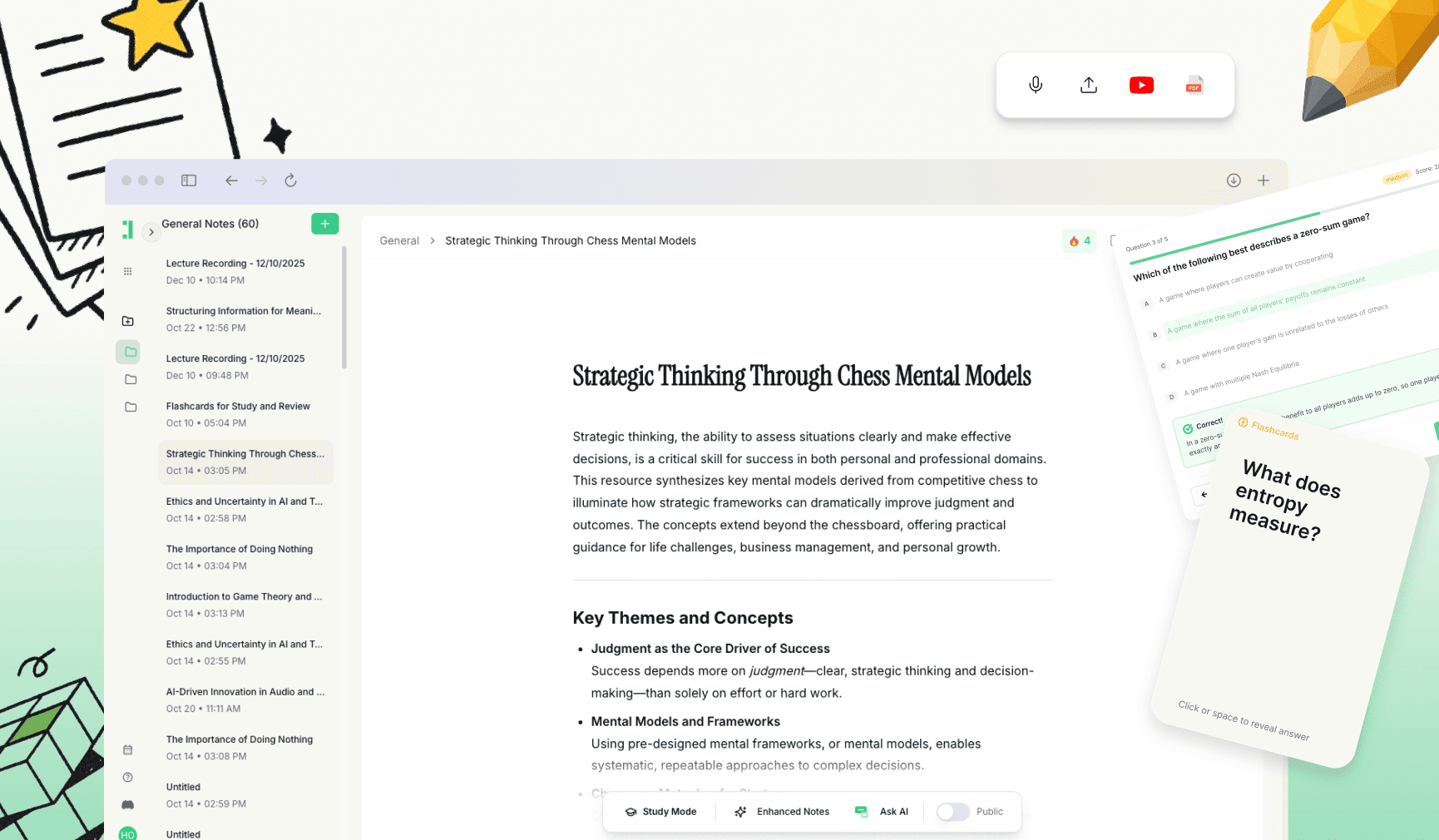
Generate Analytical Chemistry Flashcards in Seconds
Turn your complex lab notes, textbooks, and lecture slides into organized Analytical Chemistry flashcards. Whether you are tackling stoichiometry or advanced mass spectrometry, Duetoday helps you review faster and retain technical details longer.
Generate Analytical Chemistry FlashcardsUpload Lab Notes / Paste Text
Using Duetoday is simple: upload your study materials, and our AI instantly generates a structured deck of flashcards. You can review, edit, and start practicing active recall immediately to ace your next chemistry exam.
What are Analytical Chemistry flashcards?
Analytical Chemistry flashcards cover the systematic study of the separation, identification, and quantification of chemical components. These digital cards simplify dense topics like acid-base equilibria, electrochemical cells, statistical data analysis, and instrumental methods.
Instead of passively rereading hundreds of pages on molarity and signal-to-noise ratios, flashcards force you to test your knowledge. This active engagement builds a stronger mental connection to the material, turning complex formulas into second nature.
If you already have notes, Duetoday can generate a clean deck in minutes, saving you hours of manual data entry.
Why flashcards are one of the best ways to study Analytical Chemistry
Analytical Chemistry requires a mix of precise terminology, mathematical formulas, and logical sequences. Flashcards are specifically designed to help you master these distinct types of information through active recall.
Remember specific chemical indicators and their pH ranges without cramming.
Separate similar concepts like precision vs. accuracy or LOD vs. LOQ.
Learn multi-step sample preparation and titration processes step-by-step.
Practice applying the Beer-Lambert law or Nernst equation quickly.
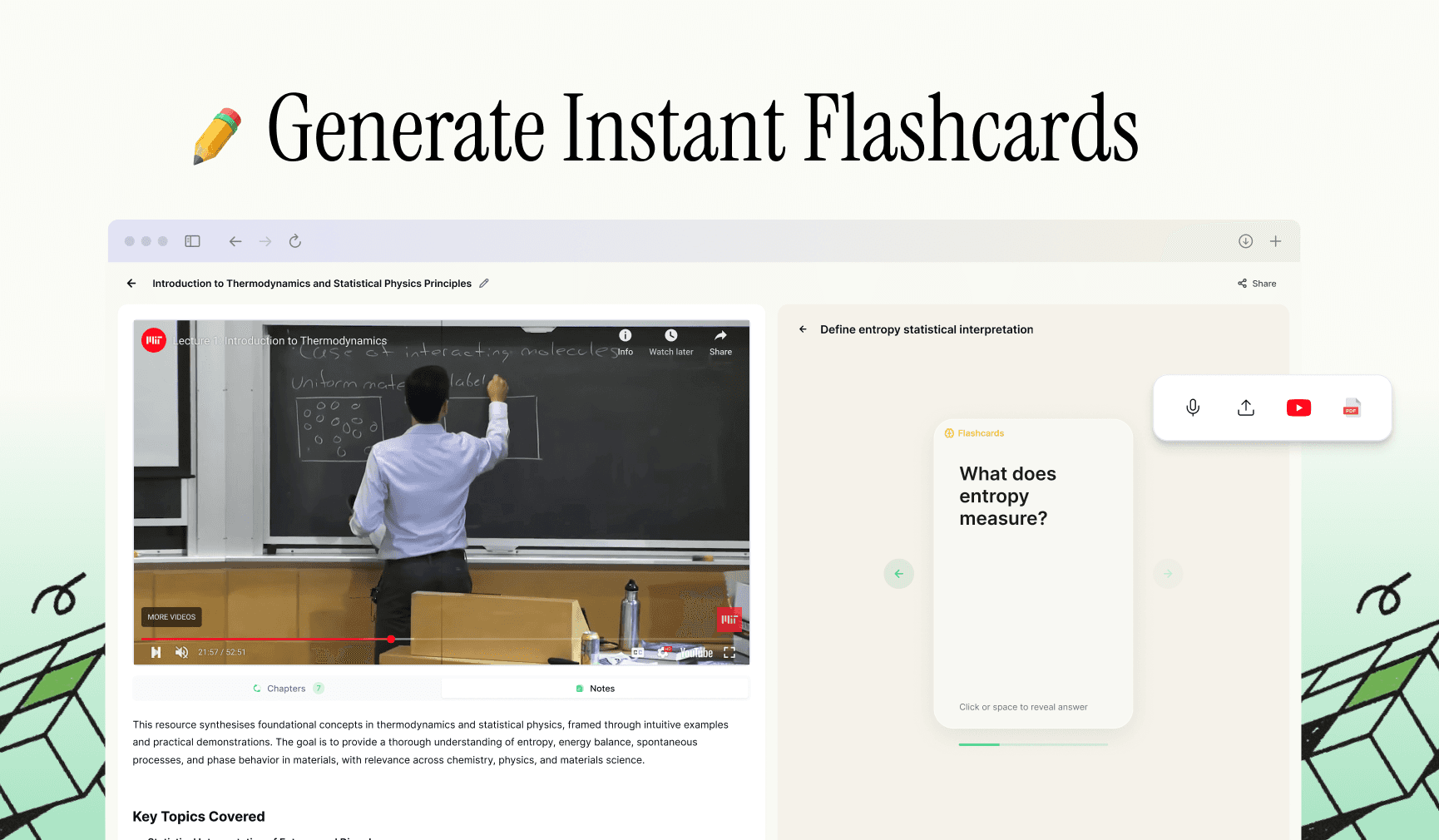
What to include in your Analytical Chemistry flashcards
The most effective Analytical Chemistry cards follow the atomic rule: one specific idea per card. This prevents you from glazing over complex details during a study session.
Definitions & Key Terms: Define the Matrix Effect. What is a standard addition?
Processes & Steps: What is the first step in a gravimetric analysis?
Comparisons: How does HPLC differ from Gas Chromatography?
Application: Calculate the pH of 0.01M HCl. What happens to absorbance if concentration doubles?
Example Prompts for your deck:
- Define 'Standard Deviation' in the context of lab data.
- What is the purpose of a blank solution?
- State the principle behind Fluorescence Spectroscopy.
- Contrast qualitative vs. quantitative analysis.
- Name three factors that affect chromatographic resolution.
How to study Analytical Chemistry with flashcards
To master a subject this technical, we recommend a two-pass approach. First, build your deck from your syllabus and notes, then move into focused review rounds.
Generate a deck from your lab manuals or lecture slides.
Complete a rapid first pass to identify which formulas or methods you find hardest.
Review these weak cards daily for 10-15 minutes.
Mix in easy cards periodically to ensure long-term retention.
Do a full mixed review 48 hours before your exam.
Generate Analytical Chemistry flashcards automatically in Duetoday
Making cards by hand for chemistry is a nightmare—drawing structures and typing formulas takes forever. Duetoday automates the tedious work so you can spend your time actually learning.
Upload your PDF textbooks or paste your typed notes.
Click Generate Flashcards to see AI-powered summaries of your material.
Edit the output as needed and start studying on any device.
Generate Analytical Chemistry Flashcards in Duetoday
Start with your notes and get a deck you can actually use today. Stop rereading and start recalling.
Common Analytical Chemistry flashcard mistakes
Cards are too long: Don't put an entire lab procedure on one card. Break it into individual steps.
Ignoring Units: Always include the required units for constants and formulas to avoid simple errors.
No Application: Don't just memorize the name of the 'Nernst Equation'; include a card that asks how to solve for Cell Potential.
Inconsistent Review: If you don't use spaced repetition, you'll forget the specific wavelengths for spectroscopy within 48 hours.
FAQ
How many flashcards do I need for Analytical Chemistry?
A typical semester-long course usually requires 200–400 cards to cover all methods, formulas, and statistical tests.
What’s the best format for chemistry flashcards?
The 'Question-Answer' format is best. Use the front for a prompt like 'Define P-value' and the back for the specific definition and its significance.
How often should I review my cards?
Daily review is best for active lab topics, while spaced repetition (every 3-5 days) works well for established theoretical concepts.
Should I make cards from my textbook or lab reports?
Both. Use textbooks for theoretical definitions and lab reports for understanding practical applications and error analysis.
How do I stop forgetting complex formulas?
Break the formula down. Have one card for the formula itself and another for what each variable represents.
Can I generate flashcards from a PDF automatically?
Yes, with Duetoday you can upload a PDF of your chapter or notes and it will extract the key concepts into cards instantly.
Are digital flashcards better than paper for chemistry?
Digital is usually better because you can easily search for topics and use AI to generate cards with accurate scientific terminology.
How long does it take to make a full deck?
Manually, it takes hours. With Duetoday's AI generator, you can have a full deck ready in under 60 seconds.

Duetoday is an AI-powered learning OS that turns your study materials into personalised, bite-sized study guides, cheat sheets, and active learning flows.