Generate Flashcards for Faraday’s Law
Generate Faraday’s Law flashcards in seconds. Use AI to turn notes into study tools. Try for free!
Generate Flashcards with AI Free

Generate Flashcards for Faraday’s Law
Turn your notes, PDFs, slides, or physics lectures into Faraday’s Law flashcards so you can review faster and remember more. Whether you are prepping for an electromagnetism quiz or a final exam, jumping straight into active recall is the best way to master physics.
Generate Faraday’s Law FlashcardsUpload notes / paste text
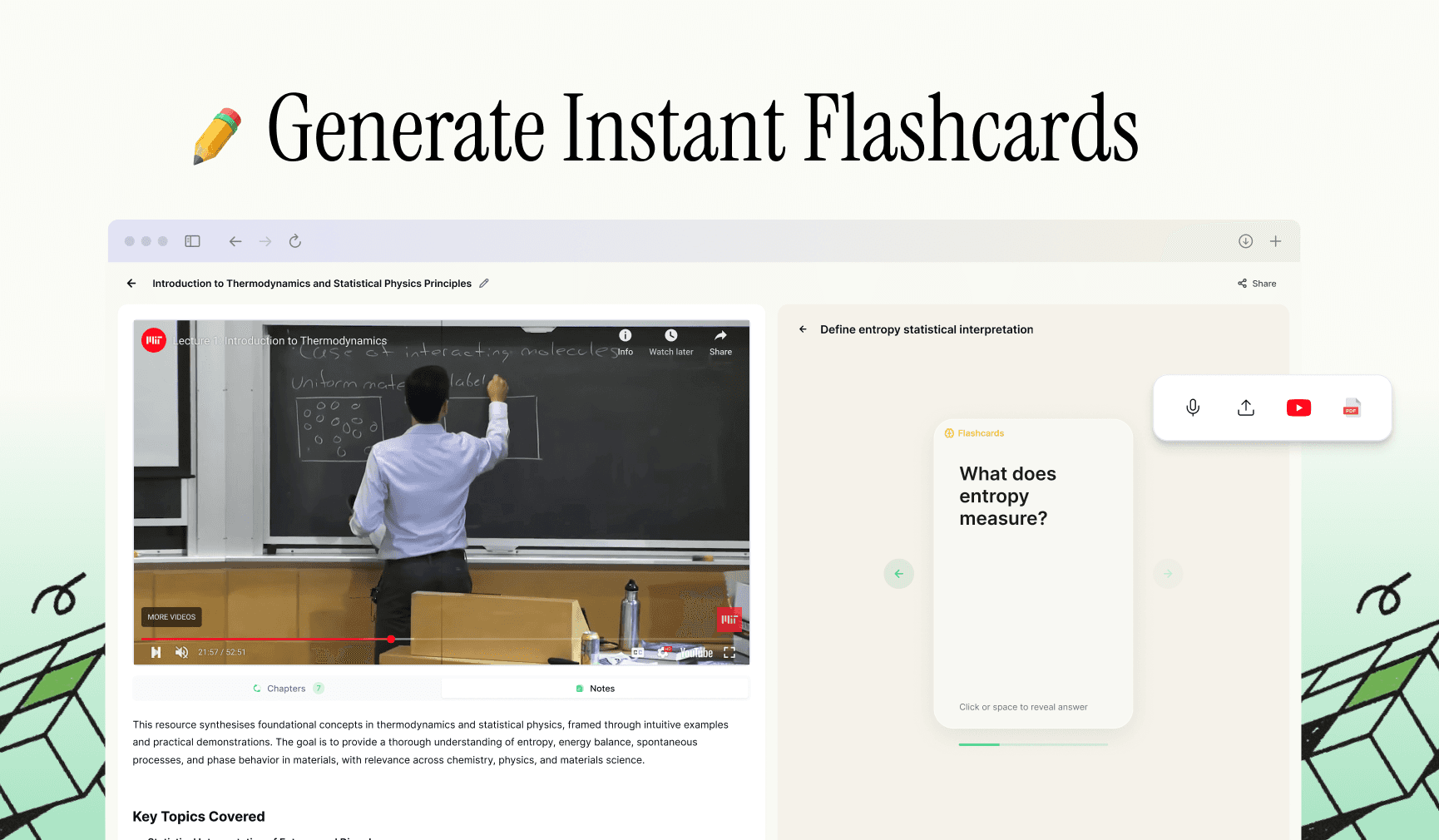
In Duetoday, the process is simple: upload your study material, click generate, and our AI identifies key principles to create a custom deck. You can then edit, organize, and start your study session immediately.
What are Faraday’s Law flashcards?
Faraday’s Law flashcards are targeted study tools that cover the relationship between a changing magnetic field and an electric circuit. They break down complex physics concepts—such as magnetic flux, electromotive force (EMF), and Lenz’s Law—into bite-sized, testable questions.
The outcome is simple: instead of passively rereading your textbook, you test your brain's ability to retrieve information. This builds the neural pathways needed to solve calculation problems and explain theoretical concepts on the fly. If you already have notes, Duetoday can generate a clean deck in minutes.
Why flashcards are one of the best ways to study Faraday’s Law
Faraday’s Law requires a mix of theoretical understanding and mathematical application. Flashcards allow you to isolate these variables, ensuring you don't just memorize a formula, but understand the logic behind it.
By using active recall and spaced repetition, you ensure that the core mechanics of induction move from your short-term memory into long-term mastery. No more staring at a blank page during an exam.
Remember constants and units without cramming
Separate similar concepts (e.g., Magnetic Flux vs. Magnetic Field)
Learn the steps for applying the Right-Hand Rule
Practice identifying the direction of induced current
Master the relationship between time and EMF
What to include in your Faraday’s Law flashcards
Effective flashcards follow the "atomic" rule: one idea per card. When studying electromagnetism, your cards should prompt you to think about both the "how" and the "why."
We recommend using four main card types to cover the subject comprehensively:
Definitions & key terms: Focus on terms like Weber, Tesla, and Induced EMF.
Processes & steps: "How do you determine the direction of induced current?"
Comparisons: "How does Faraday’s Law differ from Lenz’s Law?"
Application: "If the area of the loop doubles, what happens to the flux?"
Example prompts include: "State Faraday’s Law in words," "What is the formula for magnetic flux?", and "What does the negative sign in the equation represent?"
How to study Faraday’s Law with flashcards (a simple system)
To master physics, you need a two-pass approach. First, you build your deck to establish a foundation, and then you review in rounds to build speed and accuracy.
Keep your sessions short but frequent. Reviewing for 15 minutes a day is significantly more effective than a 4-hour marathon session the night before the test.
Make a deck from your physics notes or textbook chapters.
Do one quick round to find which concepts (like Lenz’s Law) trip you up.
Review the hardest cards daily for three days.
Mix in calculation-based cards to practice your math.
Do a final mixed-topic review before your exam.
Generate Faraday’s Law flashcards automatically in Duetoday
Making flashcards manually is slow and tedious, especially when you have to draw diagrams or write out complex equations. Duetoday removes the friction by doing the heavy lifting for you.
Position yourself for success by turning your lecture recordings or PDFs into a study tool instantly. Upload your material, click generate, and get a deck that is formatted and ready for active recall.
Upload or paste your Faraday’s Law material
Click Generate Flashcards
Review, edit, and start studying
Generate Faraday’s Law Flashcards in Duetoday
Start with your notes and get a deck you can actually use today. Stop rereading and start recalling.
Common Faraday’s Law flashcard mistakes (and how to fix them)
Most students make cards that are too wordy, which leads to rote memorization rather than actual understanding.
Cards are too long: Split complex derivations into multiple cards.
Only memorizing the formula: Add cards that ask for the physical meaning of each variable.
Ignoring the direction: Always include cards for Lenz’s Law and the Right-Hand Rule.
No review schedule: Ensure you repeat the "Hard" cards more frequently.
FAQ
How many flashcards do I need for Faraday’s Law? Typically, 20 to 30 well-designed cards can cover the core theory, formulas, and common applications for this specific topic.
What’s the best format for Faraday’s Law flashcards? A mix of 'Question/Answer' for definitions and 'Scenario/Outcome' for application problems works best.
How often should I review Faraday’s Law flashcards? Review them once a day for the first three days, then every few days until the concepts feel like second nature.
Should I make cards from a textbook or lecture notes? Use both. Lecture notes often highlight what your professor thinks is important, while textbooks provide the formal definitions.
How do I stop forgetting the formulas? Use 'cloze deletion' cards where you fill in a missing part of the formula to build stronger mental triggers.
What if my flashcards feel too easy? Add 'Challenge' cards that require you to combine Faraday’s Law with other concepts like Ohm’s Law.
Can I generate flashcards from a physics PDF? Yes, Duetoday can scan your physics PDFs and extract the most important information into flashcards automatically.
Are digital flashcards better than paper for physics? Digital cards are usually better because they allow for faster organization and the use of spaced repetition algorithms.
How long does it take to make a full deck? With Duetoday, it takes less than a minute. Manually, it could take an hour or more.
Can Duetoday handle mathematical symbols? Yes, Duetoday is designed to recognize and format the mathematical components of physics notes.

Duetoday is an AI-powered learning OS that turns your study materials into personalised, bite-sized study guides, cheat sheets, and active learning flows.