Generate Flashcards for Econometrics Basics
Generate Econometrics Basics flashcards in seconds. Turn your notes into study tools. Try for free!
Generate Flashcards with AI Free
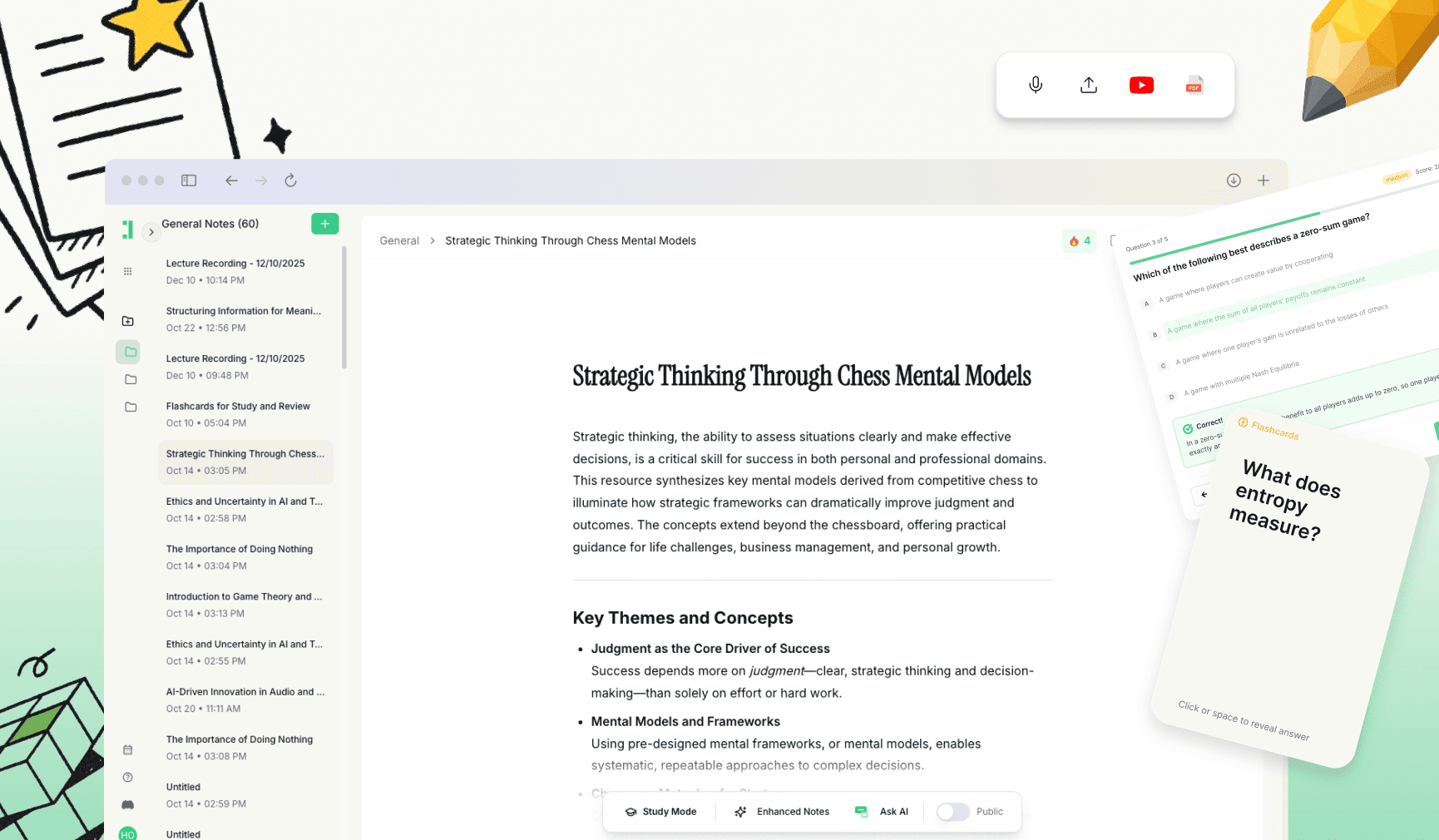
Generate Flashcards for Econometrics Basics
Turn your notes, PDFs, slides, or lectures into Econometrics Basics flashcards so you can review faster and remember more. Whether you are dealing with the Gauss-Markov assumptions or complex regression models, digital flashcards streamline your study sessions.
Generate Econometrics FlashcardsUpload notes / paste text
With Duetoday, you simply upload your material, and our AI identifies key statistical concepts to generate a custom deck. You can then review, edit, and study your cards immediately to maximize your exam preparation.
What are Econometrics Basics flashcards?
Econometrics Basics flashcards cover the fundamental intersection of economic theory, mathematics, and statistics. They focus on key terms like heteroskedasticity, steps for performing a t-test, OLS formulas, and the nuances of cause-and-effect relationships in data.
Instead of passively rereading dense textbooks, these flashcards force you to engage in active recall. By testing your knowledge of estimator properties and p-values, you build a deeper intuition for how data is analyzed in economics. If you already have notes, Duetoday can generate a clean deck in minutes.
Why flashcards work for Econometrics Basics
Econometrics requires a mix of rote memorization (definitions) and procedural application (how to solve a bias problem). Flashcards help bridge the gap between understanding a concept and applying it under exam pressure using spaced repetition.
Remember key terms like 'multicollinearity' without cramming.
Separate similar concepts, such as R-squared vs. Adjusted R-squared.
Learn estimation processes step-by-step (e.g., the steps of OLS).
Practice applying rules and formulas for hypothesis testing quickly.
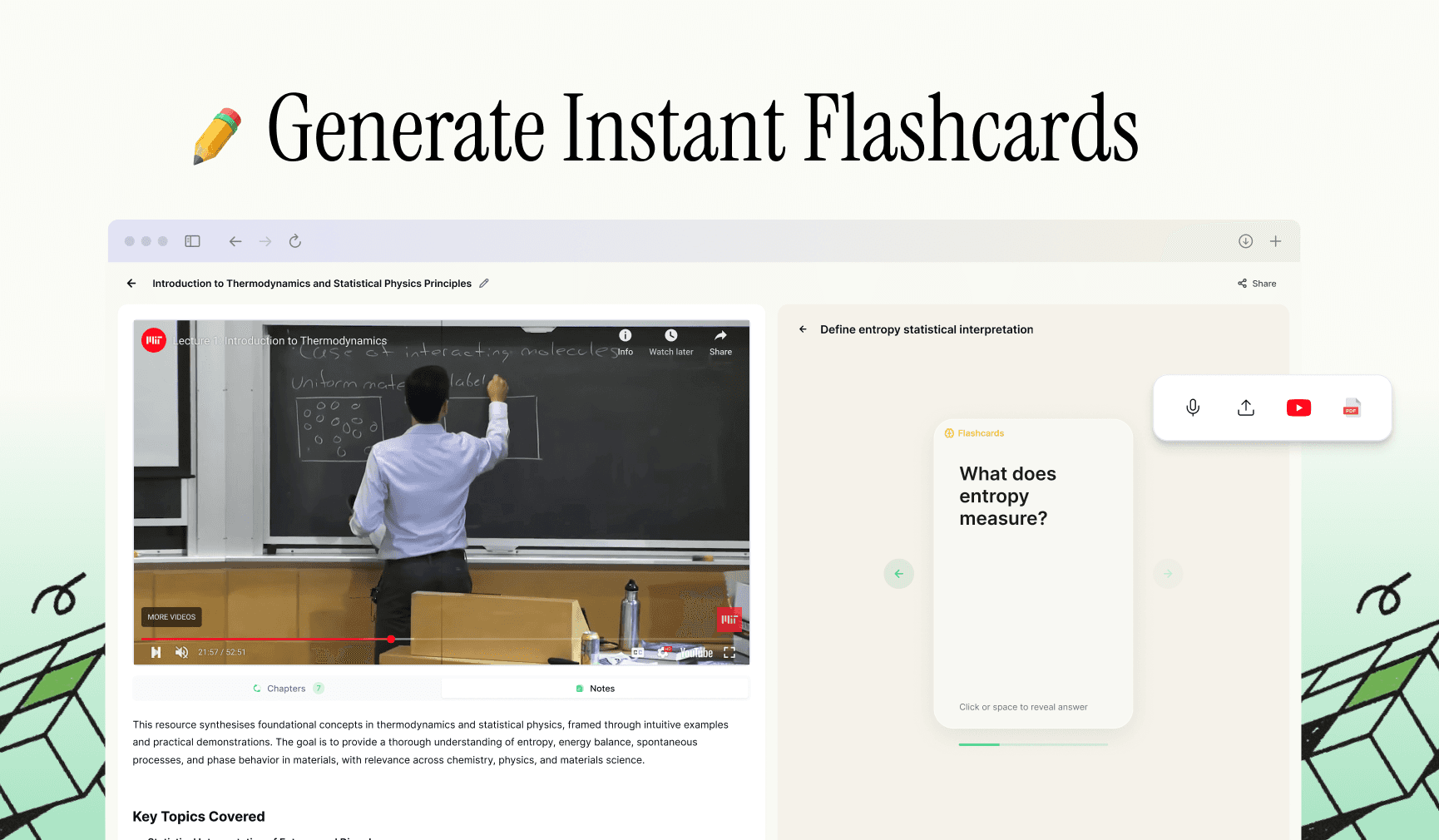
What to include in your Econometrics Basics flashcards
The best flashcards follow the 'one idea per card' rule. They should be question-based rather than long summaries to ensure your brain is actually working to find the answer.
Definitions & key terms: "What is an unbiased estimator?"
Processes & steps: "What is the first step in conducting a White test?"
Comparisons: "How is Type I error different from Type II error?"
Application: "When would you use a Log-Log model instead of a Linear-Log model?"
Use prompts like: "State the 5 Gauss-Markov assumptions," "Explain the null hypothesis in a Chow test," or "What does a p-value less than 0.05 signify?"
How to study Econometrics Basics with flashcards
Econometrics is best mastered through a two-pass approach. First, generate your deck from your slides or transcripts, then move into focused review rounds to identify which formulas or proofs are sticking.
Make a deck from your notes or generate it from PDF content.
Do one quick round to find weak spots in your statistical knowledge.
Review weak cards (like IV variables or dummy variables) daily.
Mix in harder application cards to simulate exam conditions.
Do a final mixed review of all chapters before your midterms or finals.
Generate Econometrics Basics flashcards automatically in Duetoday
Making econometrics cards manually is slow and messy, especially with complex notation. Duetoday simplifies this by turning your study materials into structured flashcards instantly.
Upload or paste your Econometrics material
Click Generate Flashcards
Review, edit, and start studying
Generate Econometrics Flashcards in Duetoday
Start with your notes and get a deck you can actually use today.
Common Econometrics Basics flashcard mistakes
Most students make cards that are too wordy or focus on the wrong details. Ensure your cards are study-ready by avoiding these pitfalls:
Cards are too long: Split complex proofs into one step per card.
Only memorizing words: Add 'explain why' prompts for the intuition behind formulas.
Confusing similar tests: Add comparison cards for t-tests vs. F-tests.
No review schedule: Use spaced repetition to keep old concepts fresh.
FAQ
How many flashcards do I need for Econometrics Basics? Usually 50-100 cards cover the core foundations like OLS, assumptions, and basic testing.
What’s the best format for these flashcards? Question-and-answer format is best, especially for interpreting coefficients.
How often should I review? Daily for the first week, then every few days to keep the statistical properties in your long-term memory.
Should I make cards from a textbook or slides? Slides are usually better for identifying the specific formulas your professor prioritizes.
How do I stop forgetting formulas? Use 'cloze deletion' or fill-in-the-blank cards for specific parts of an equation.
Are digital flashcards better than paper? Yes, because they allow for easy editing of complex econometric symbols and automated scheduling.
Can I generate flashcards from a PDF? Absolutely, Duetoday specializes in converting PDFs into structured study decks.
How long does it take to make a full deck? With Duetoday, it takes seconds to generate what would usually take hours manually.

Duetoday is an AI-powered learning OS that turns your study materials into personalised, bite-sized study guides, cheat sheets, and active learning flows.